Infanger Lukas, Dibiasi Christoph, Schaden Eva, Ulbing Stefan, Wiegele Marion, Lacom Conrad, Gratz Johannes
Department of Anaesthesia, Intensive Care Medicine and Pain Medicine, Medical University of Vienna, Vienna, Austria.
Front Med (Lausanne). 2021 Nov 16;8:777145. doi: 10.3389/fmed.2021.777145. eCollection 2021.
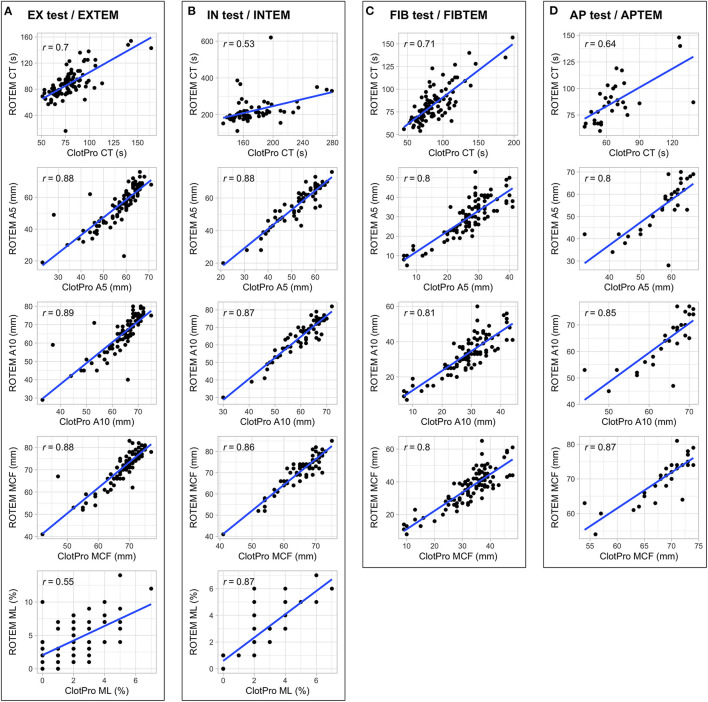
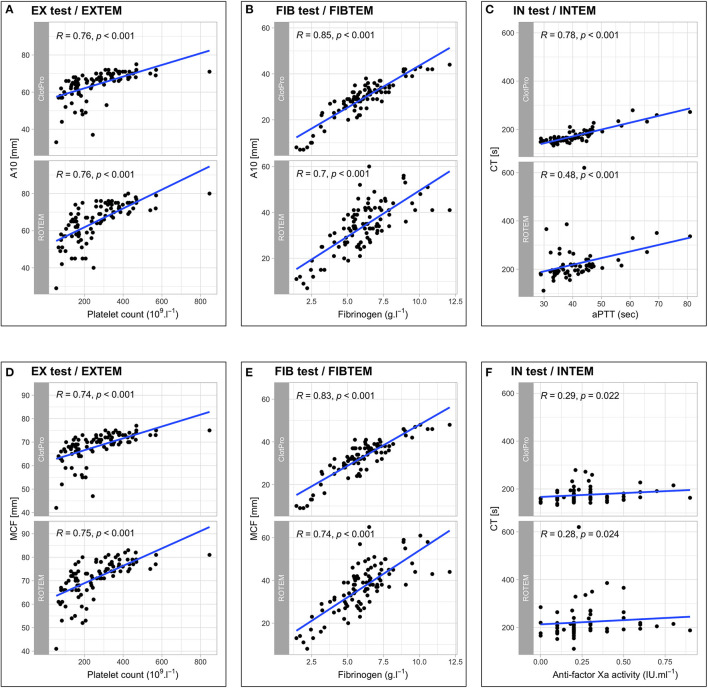
Viscoelastic coagulation testing has been suggested to help manage coagulopathy in critically ill patients with COVID-19. However, results from different viscoelastic devices are not readily comparable. ClotPro® is a novel thromboelastometry analyzer offering a wider range of commercially available assays. We compared the results from ClotPro with results from the well-established ROTEM® Delta device and conventional coagulation tests in critically ill patients with COVID-19. Viscoelastic parameters indicated the presence of a potentially hypercoagulable state in the majority of patients. In up to 95 paired measurements, we found strong correlations between several parameters routinely used in clinical practice: (i) EX test vs. EXTEM CT, A5, A10, MCF, (ii) IN test vs. INTEM A5, A10, MCF, and (iii) FIB test vs. FIBTEM A5, A10, MCF (all > 0.7 and < 0.001). In contrast, IN test CT vs. INTEM CT showed only a moderate correlation ( = 0.53 and < 0.001). Clot strength parameters of both devices exhibited strong correlations with platelet counts and fibrinogen levels (all > 0.7 and < 0.001). Divergent correlations of intrinsically activated assays with aPTT and anti-factor Xa activity were visible. Regarding absolute differences of test results, considerable delta occurred in CT, CFT, and clot strength parameters (all < 0.001) between both devices. Several parameters obtained by ClotPro show strong correlations with ROTEM Delta. Due to weak correlations of intrinsically activated clotting times and considerable absolute differences in a number of parameters, our findings underline the need for device-specific algorithms in this patient cohort.
有人建议采用粘弹性凝血检测来帮助管理COVID-19危重症患者的凝血病。然而,不同粘弹性设备的检测结果不易比较。ClotPro®是一种新型血栓弹力图分析仪,提供更广泛的商用检测方法。我们比较了ClotPro与成熟的ROTEM® Delta设备在COVID-19危重症患者中的检测结果以及传统凝血检测结果。粘弹性参数表明大多数患者存在潜在的高凝状态。在多达95对测量中,我们发现临床实践中常规使用的几个参数之间存在强相关性:(i) EX检测与EXTEM CT、A5、A10、MCF,(ii) IN检测与INTEM A5、A10、MCF,以及(iii) FIB检测与FIBTEM A5、A10、MCF(均> 0.7且< 0.001)。相比之下,IN检测CT与INTEM CT仅显示中度相关性(= 0.53且< 0.001)。两种设备的凝血强度参数均与血小板计数和纤维蛋白原水平呈强相关性(均> 0.7且< 0.001)。内源性激活检测与活化部分凝血活酶时间和抗Xa因子活性之间存在不同的相关性。关于检测结果的绝对差异,两种设备在CT、CFT和凝血强度参数方面均出现了显著差异(均< 0.001)。ClotPro获得的几个参数与ROTEM Delta显示出强相关性。由于内源性激活凝血时间的相关性较弱以及多个参数存在显著的绝对差异,我们的研究结果强调了在该患者群体中需要特定于设备的算法。