Liu Ziyi, Liang Yahang, Tang Xiaolong, Qu Hui
Department of Clinical Medicine, Qilu Medical College of Shandong University, Jinan, China.
Department of General Surgery, Qilu Hospital of Shandong University, Jinan, China.
Front Surg. 2021 Nov 16;8:745748. doi: 10.3389/fsurg.2021.745748. eCollection 2021.
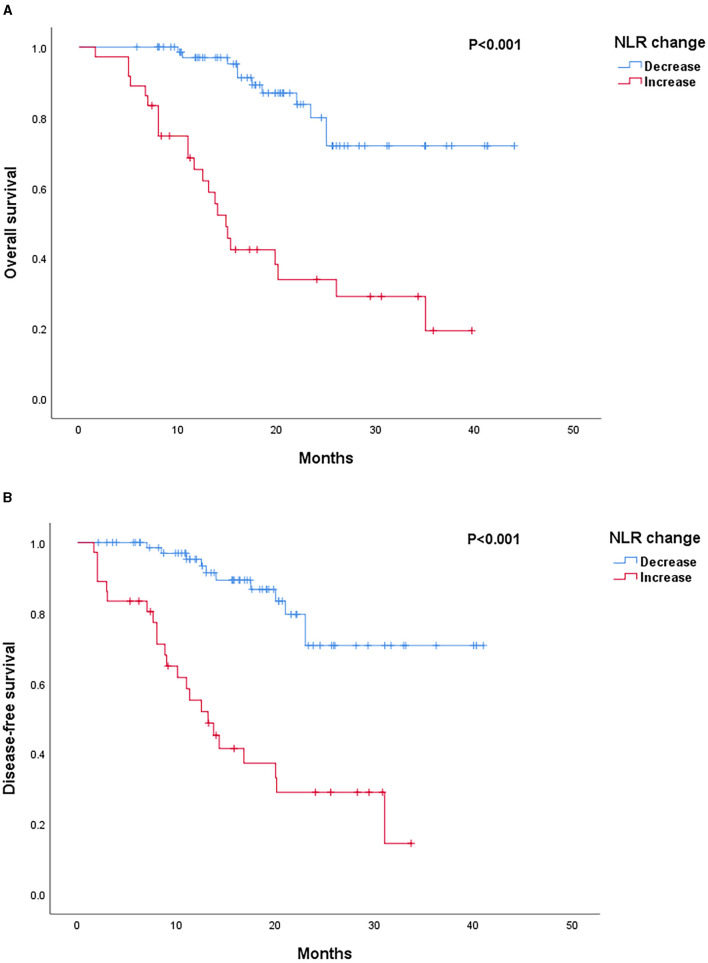
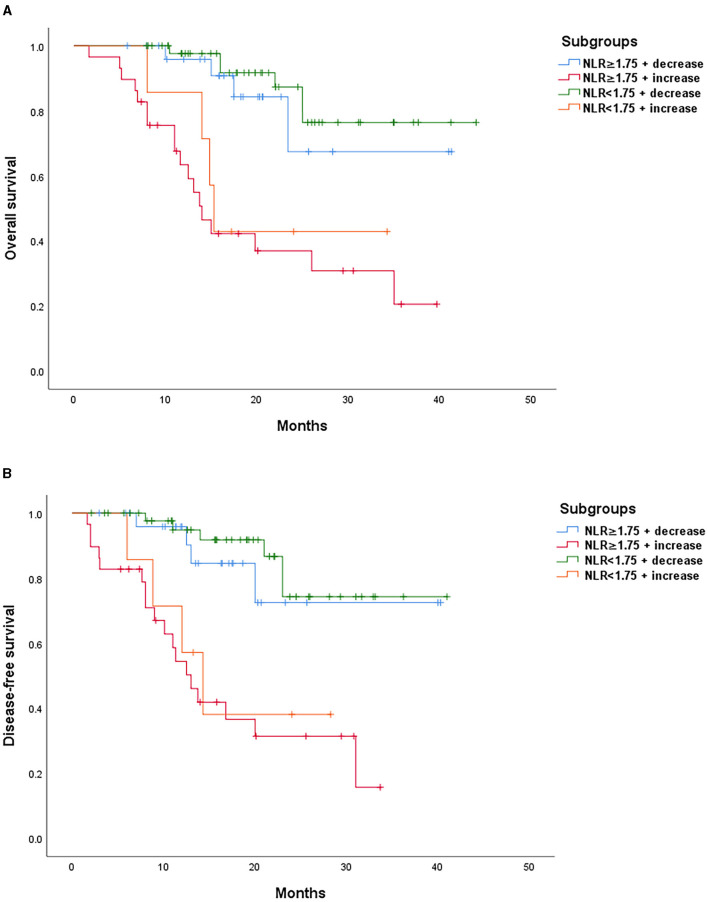
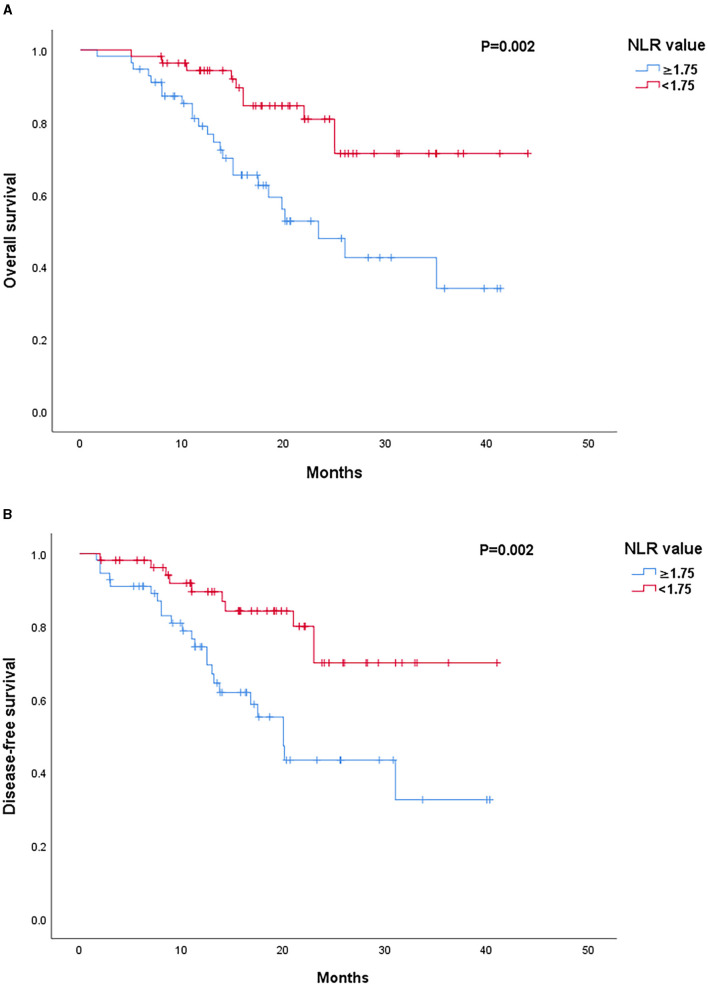
Gastric cancer is the fifth most commonly diagnosed tumor and is the fourth leading cause of cancer-related mortality, worldwide. Due to the low rate of early diagnosis, approximately two-thirds of patients are first diagnosed at an advanced stage. Neoadjuvant chemotherapy (NAC) is recommended for patients with advanced gastric cancer (AGC). The neutrophil-to-lymphocyte ratio (NLR), a combined inflammatory and immunogenic factor, has been universally used for predicting outcomes in AGC patients. Given that NLR is a dynamic process, in this study, we investigated the value of NLR change for the prediction of chemotherapeutic responses and prognosis in patients with AGC. We retrospectively enrolled 111 patients with AGC who underwent NAC following curative surgery. Patients were divided into two groups according to the NLR change after chemotherapy into the increased and decreased groups. Outcome measures were overall survival (OS) and disease-free survival (DFS). Univariate was calculated by Kaplan-Meier method. Multivariate analysis was performed using the Cox proportional hazards regression model. Post-chemotherapy, NLR increased in 36 patients and decreased in 75 patients. After a median follow-up time of 19 months, six patients developed local recurrence, 23 developed distant recurrence, and 34 died. Patients with reduced post-chemotherapy NLR showed significantly longer OS ( < 0.001) and DFS ( < 0.001). A decrease in the NLR after NAC was an independent indicator associated with better OS ( < 0.001) and DFS ( < 0.001). In patients with AGC, a decrease in NLR after NAC indicated better survival. NLR change could serve as a robust indicator for the efficiency of NAC and prognostic prediction in patients with AGC.
胃癌是全球第五大最常被诊断出的肿瘤,也是癌症相关死亡的第四大主要原因。由于早期诊断率低,约三分之二的患者首次被诊断时已处于晚期。晚期胃癌(AGC)患者推荐进行新辅助化疗(NAC)。中性粒细胞与淋巴细胞比值(NLR)作为一种综合炎症和免疫原性的因子,已被广泛用于预测AGC患者的预后。鉴于NLR是一个动态过程,在本研究中,我们探讨了NLR变化对AGC患者化疗反应和预后预测的价值。我们回顾性纳入了111例接受根治性手术后进行NAC的AGC患者。根据化疗后NLR的变化将患者分为两组,即升高组和降低组。观察指标为总生存期(OS)和无病生存期(DFS)。单因素分析采用Kaplan-Meier法计算。多因素分析采用Cox比例风险回归模型。化疗后,36例患者NLR升高,75例患者NLR降低。中位随访19个月后,6例患者出现局部复发,23例出现远处复发,34例死亡。化疗后NLR降低的患者OS(P<0.001)和DFS(P<0.001)显著更长。NAC后NLR降低是与更好的OS(P<0.001)和DFS(P<0.001)相关的独立指标。在AGC患者中,NAC后NLR降低表明生存期更好。NLR变化可作为AGC患者NAC疗效和预后预测的有力指标。