Schiefer Sabine, Wirsik Naita Maren, Kalkum Eva, Seide Svenja Elisabeth, Nienhüser Henrik, Müller Beat, Billeter Adrian, Büchler Markus W, Schmidt Thomas, Probst Pascal
Department of General, Visceral and Transplantation Surgery, University of Heidelberg, Im Neuenheimer Feld 420, 69120 Heidelberg, Germany.
Department of General, Visceral, Cancer and Transplant Surgery, University Hospital Cologne, Kerpener Str. 62, 50937 Köln, Germany.
Diagnostics (Basel). 2022 Feb 25;12(3):593. doi: 10.3390/diagnostics12030593.
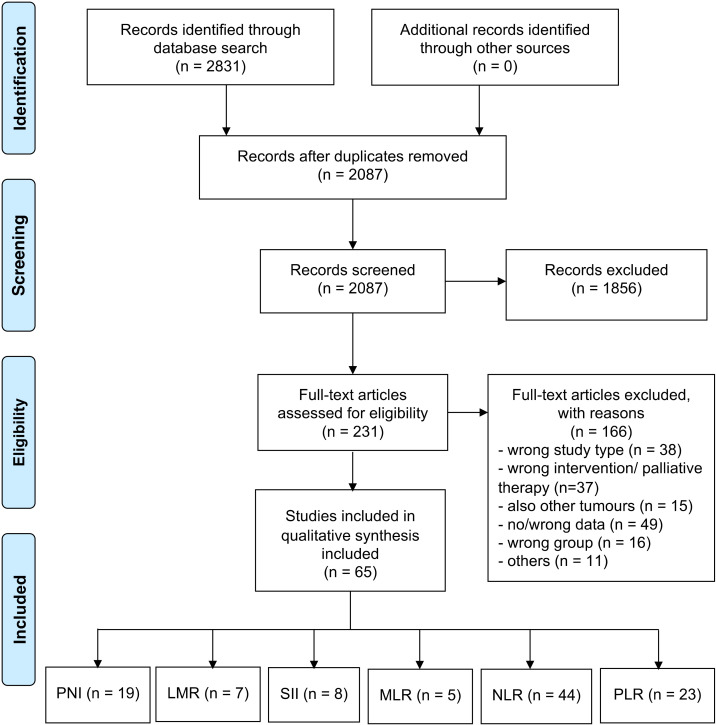
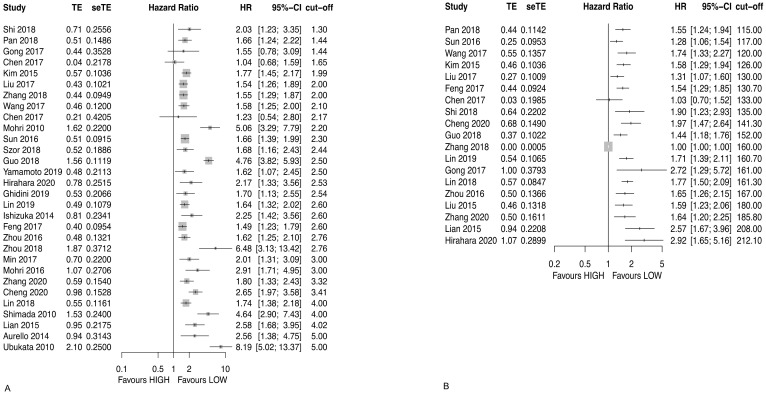
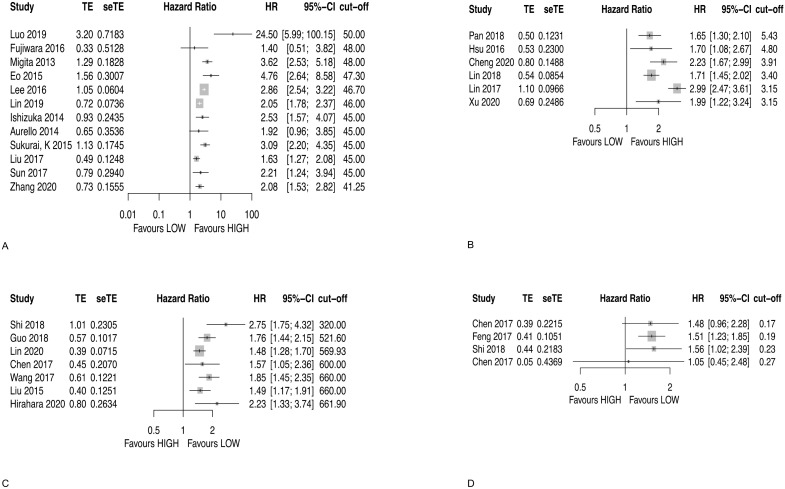
Various blood cell ratios exist which seem to have an impact on prognosis for resected gastric cancer patients. The aim of this systematic review was to investigate the prognostic role of blood cell ratios in patients with gastric cancer undergoing surgery in a curative attempt. A systematic literature search in MEDLINE (via PubMed), CENTRAL, and Web of Science was performed. Information on survival and cut-off values from all studies investigating any blood cell ratio in resected gastric cancer patients were extracted. Prognostic significance and optimal cut-off values were calculated by meta-analyses and a summary of the receiver operating characteristic. From 2831 articles, 65 studies investigated six different blood cell ratios (prognostic nutritional index (PNI), lymphocyte to monocyte ratio (LMR), systemic immune-inflammation index (SII), monocyte to lymphocyte ratio (MLR), neutrophil to lymphocyte ratio (NLR), and platelet to lymphocyte ratio (PLR)). There was a significant association for the PNI and NLR with overall survival and disease-free survival and for LMR and NLR with 5-year survival. The used cut-off values had high heterogeneity. The available literature is flawed by the use of different cut-off values hampering evidence-based patient treatment and counselling. This article provides optimal cut-off values recommendations for future research.
存在多种血细胞比率,它们似乎对接受手术切除的胃癌患者的预后有影响。本系统评价的目的是探讨血细胞比率在接受根治性手术的胃癌患者中的预后作用。我们在MEDLINE(通过PubMed)、CENTRAL和Web of Science中进行了系统的文献检索。提取了所有研究接受手术切除的胃癌患者任何血细胞比率的研究中的生存信息和临界值。通过荟萃分析和受试者工作特征曲线总结计算预后意义和最佳临界值。从2831篇文章中,65项研究调查了六种不同的血细胞比率(预后营养指数(PNI)、淋巴细胞与单核细胞比率(LMR)、全身免疫炎症指数(SII)、单核细胞与淋巴细胞比率(MLR)、中性粒细胞与淋巴细胞比率(NLR)以及血小板与淋巴细胞比率(PLR))。PNI和NLR与总生存期和无病生存期以及LMR和NLR与5年生存期之间存在显著关联。所使用的临界值具有高度异质性。现有文献因使用不同的临界值而存在缺陷,这妨碍了基于证据的患者治疗和咨询。本文为未来研究提供了最佳临界值建议。