Center for Open Science, Charlottesville, United States.
Science Exchange, Palo Alto, United States.
Elife. 2021 Dec 7;10:e67995. doi: 10.7554/eLife.67995.
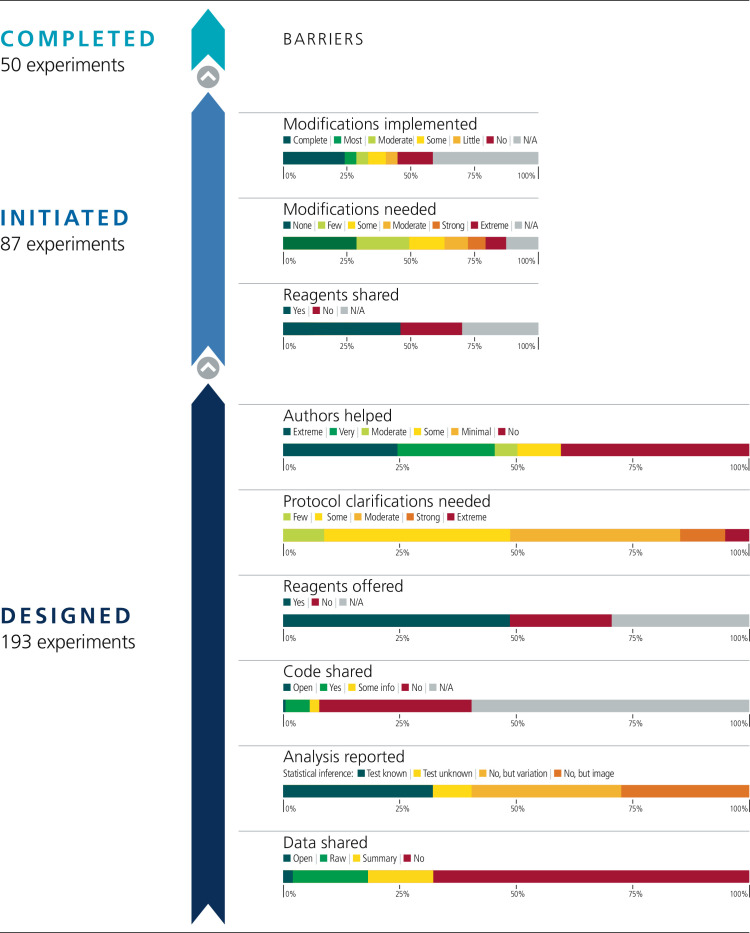
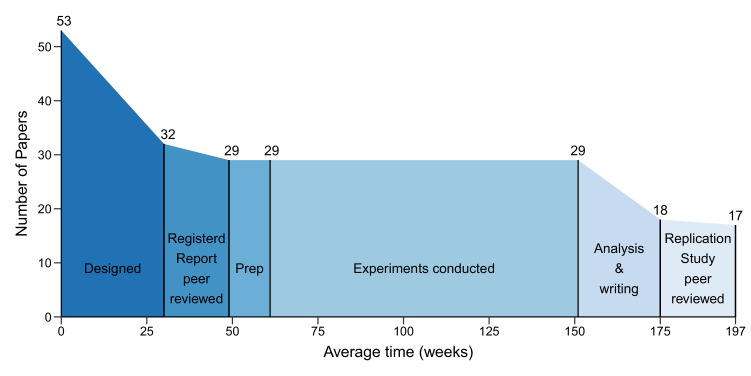
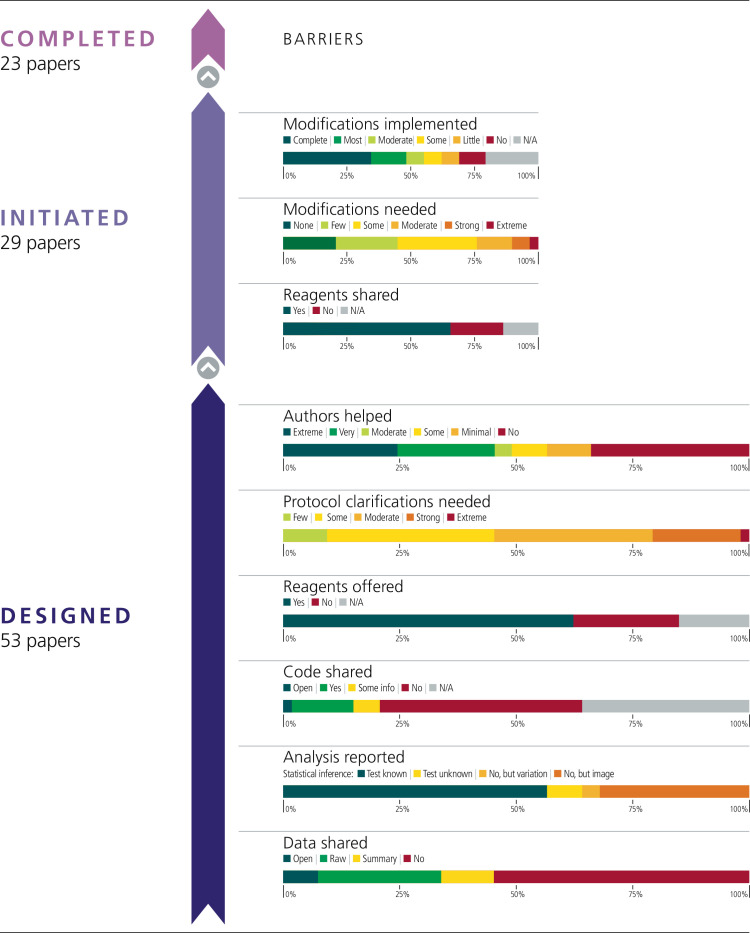
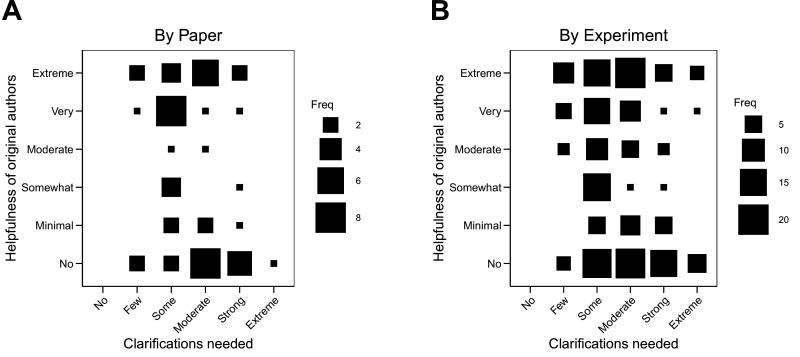
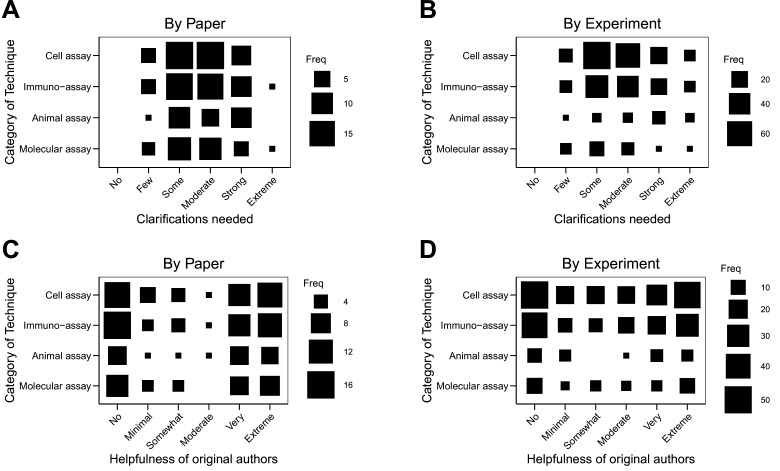
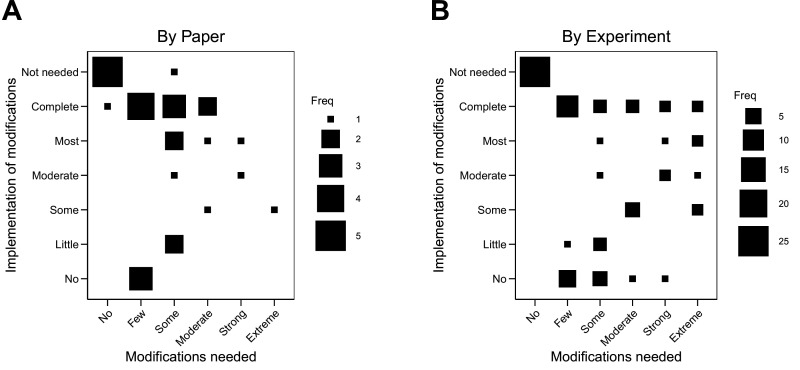
We conducted the Reproducibility Project: Cancer Biology to investigate the replicability of preclinical research in cancer biology. The initial aim of the project was to repeat 193 experiments from 53 high-impact papers, using an approach in which the experimental protocols and plans for data analysis had to be peer reviewed and accepted for publication before experimental work could begin. However, the various barriers and challenges we encountered while designing and conducting the experiments meant that we were only able to repeat 50 experiments from 23 papers. Here we report these barriers and challenges. First, many original papers failed to report key descriptive and inferential statistics: the data needed to compute effect sizes and conduct power analyses was publicly accessible for just 4 of 193 experiments. Moreover, despite contacting the authors of the original papers, we were unable to obtain these data for 68% of the experiments. Second, none of the 193 experiments were described in sufficient detail in the original paper to enable us to design protocols to repeat the experiments, so we had to seek clarifications from the original authors. While authors were or for 41% of experiments, they were for 9% of experiments, and (or did not respond to us) for 32% of experiments. Third, once experimental work started, 67% of the peer-reviewed protocols required modifications to complete the research and just 41% of those modifications could be implemented. Cumulatively, these three factors limited the number of experiments that could be repeated. This experience draws attention to a basic and fundamental concern about replication - it is hard to assess whether reported findings are credible.
我们开展了“重现计划:癌症生物学”,旨在调查癌症生物学领域的临床前研究的可重复性。该项目的最初目标是重复 53 篇高影响力论文中的 193 项实验,采用的方法是在开始实验之前,实验方案和数据分析计划必须经过同行评审并获得发表批准。然而,在设计和开展实验的过程中,我们遇到了各种各样的障碍和挑战,最终仅能重复 23 篇论文中的 50 项实验。本文报告了这些障碍和挑战。首先,许多原始论文未能报告关键的描述性和推论统计信息:在 193 项实验中,只有 4 项实验的数据可以公开获取,这些数据可以用来计算效应量和进行功效分析。此外,尽管我们联系了原始论文的作者,但仍有 68%的实验无法获得这些数据。其次,在原始论文中,193 项实验中没有一项实验的描述足够详细,我们无法根据原始论文设计重复实验的方案,因此不得不向原始作者寻求澄清。虽然作者对 41%的实验进行了或愿意提供帮助,但他们对 9%的实验表示,而对 32%的实验则未予答复或未回复我们。第三,一旦开始进行实验,67%的同行评审方案需要修改才能完成研究,而只有 41%的修改可以实施。这三个因素累加起来,限制了可重复进行的实验数量。这一经验引起了人们对复制的一个基本和根本问题的关注——很难评估报告的发现是否可信。