Department of Population and Quantitative Health Sciences, University of Massachusetts Chan Medical School, Worcester, Massachusetts, USA.
University of Nevada, Las Vegas, Las Vegas, Nevada, USA.
J Gerontol B Psychol Sci Soc Sci. 2022 Nov 23;77(11):2101-2112. doi: 10.1093/geronb/gbab224.
Black persons in the United States are more likely to suffer from social inequality. Chronic stress caused by social inequality and racial discrimination results in weathering of the body that causes physiological dysregulation and biological age being higher than chronological age (accelerated aging). Depression has been linked to both racial discrimination and accelerated aging and accelerated aging has been demonstrated to be higher in Black than White persons, on average. However, we know little about accelerated aging across the life course in Black Americans.
We used mixed-effects growth models to measure biological age acceleration, measured with cardiometabolic markers, over a 20-year period in Black participants of the Coronary Artery Risk Development in Young Adults Study who were aged 27-42 years at analytic baseline. We included an interaction between depressive symptoms and time to determine whether risk of depression was associated with a faster rate of biological aging.
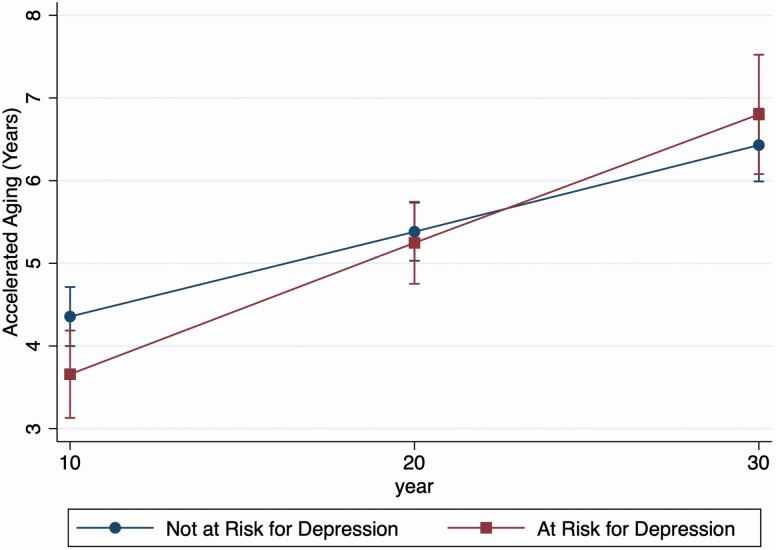
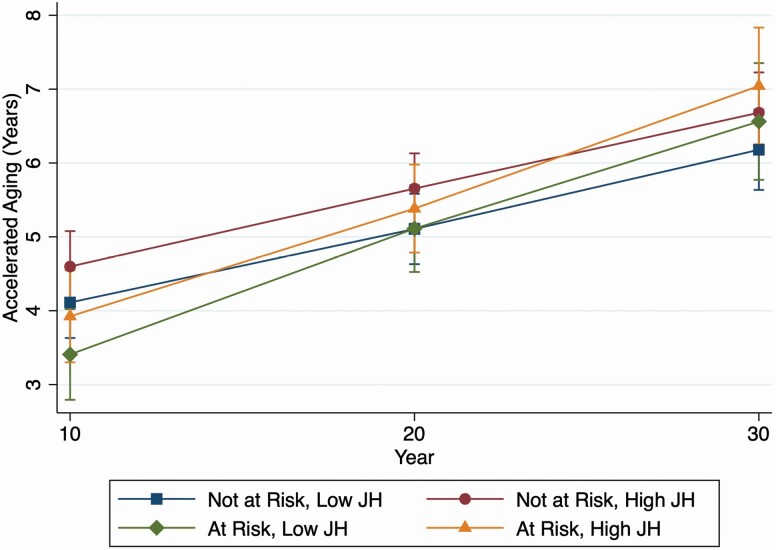
We found that the rate of biological aging increased over a 20-year span and that those at risk for depression had a faster rate of biological aging than those not at risk. We also found that various social factors were associated with biological age acceleration over time.
Given the known association between perceived racial discrimination and depressive symptoms, we provide a novel instance of the long-term effects of social inequality. Specifically, biological age acceleration, a marker of physiological dysregulation, is associated with time among Black persons and more strongly associated among those with depressive symptoms.
美国的黑人更有可能遭受社会不平等。社会不平等和种族歧视导致的慢性压力导致身体老化,从而导致生理失调和生物年龄高于实际年龄(加速老化)。抑郁与种族歧视和加速老化有关,而且平均而言,黑人的加速老化程度高于白人。然而,我们对美国黑人一生中的加速老化知之甚少。
我们使用混合效应增长模型来衡量黑人参与者在 27-42 岁分析基线时参加的年轻成年人冠状动脉风险发展研究中,20 年内使用心脏代谢标志物测量的生物年龄加速。我们包括抑郁症状和时间之间的交互作用,以确定抑郁风险是否与更快的生物老化速度有关。
我们发现,在 20 年内,生物老化的速度增加了,而那些有抑郁风险的人的生物老化速度比没有抑郁风险的人快。我们还发现,随着时间的推移,各种社会因素与生物年龄加速有关。
鉴于感知到的种族歧视和抑郁症状之间的已知关联,我们提供了社会不平等的长期影响的一个新实例。具体来说,生物年龄加速是生理失调的一个标志,与黑人的时间有关,与有抑郁症状的人的关系更密切。