Infectious Diseases Laboratory, National Institute of Immunology, Aruna Asaf Ali Marg, New Delhi, 110067, India.
Sci Rep. 2021 Dec 8;11(1):23640. doi: 10.1038/s41598-021-03059-4.
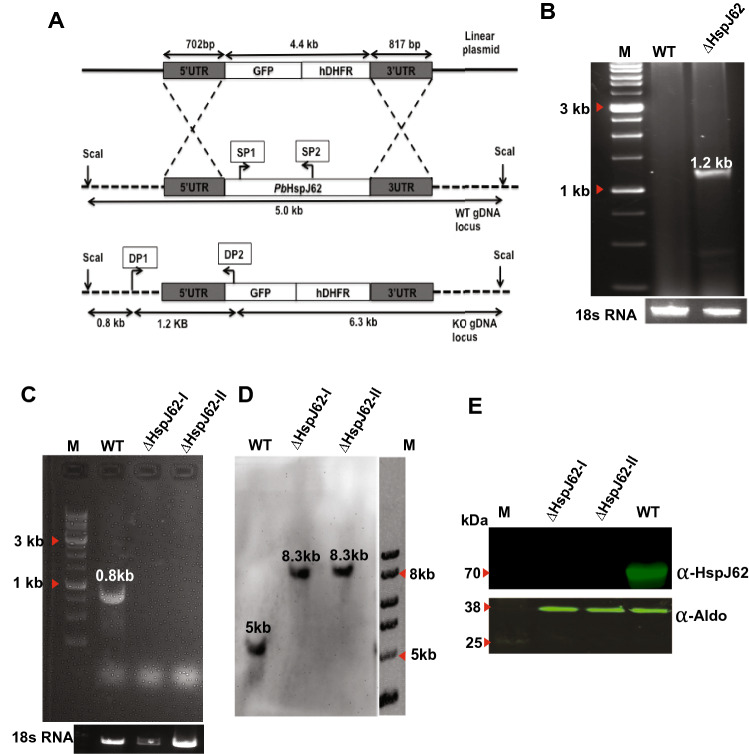
The continued existence of Plasmodium parasites in physiologically distinct environments during their transmission in mosquitoes and vertebrate hosts requires effector proteins encoded by parasite genes to provide adaptability. Parasites utilize their robust stress response system involving heat shock proteins for their survival. Molecular chaperones are involved in maintaining protein homeostasis within a cell during stress, protein biogenesis and the formation of protein complexes. Due to their critical role in parasite virulence, they are considered targets for therapeutic interventions. Our results identified a putative P. berghei heat shock protein (HSP) belonging to the HSP40 family (HspJ62), which is abundantly induced upon heat stress and expressed during all parasite stages. To determine the role HspJ62, a gene-disrupted P. berghei transgenic line was developed (ΔHspJ62), which resulted in disruption of gametocyte formation. Such parasites were unable to form subsequent sexual stages because of disrupted gametogenesis, indicating the essential role of HspJ62 in gametocyte formation. Transcriptomic analysis of the transgenic line showed downregulation of a number of genes, most of which were specific to male or female gametocytes. The transcription factor ApiAP2 was also downregulated in ΔHspJ62 parasites. Our findings suggest that the downregulation of ApiAP2 likely disrupts the transcriptional regulation of sexual stage genes, leading to impaired gametogenesis. This finding also highlights the critical role that HspJ62 indirectly plays in the development of P. berghei sexual stages and in facilitating the conversion from the asexual blood stage to the sexual stage. This study characterizes the HspJ62 protein as a fertility factor because parasites lacking it are unable to transmit to mosquitoes. This study adds an important contribution to ongoing research aimed at understanding gametocyte differentiation and formation in parasites. The molecule adds to the list of potential drug targets that can be targeted to inhibit parasite sexual development and consequently parasite transmission.
疟原虫寄生虫在蚊子和脊椎动物宿主中的传播过程中,存在于生理上不同的环境中,这需要寄生虫基因编码的效应蛋白提供适应性。寄生虫利用其强大的应激反应系统,包括热休克蛋白来生存。分子伴侣参与在应激、蛋白质生物发生和蛋白质复合物形成过程中维持细胞内的蛋白质稳态。由于它们在寄生虫毒力中的关键作用,它们被认为是治疗干预的靶点。我们的研究结果鉴定了一种假定的恶性疟原虫热休克蛋白(HSP),属于 HSP40 家族(HspJ62),它在热应激时大量诱导表达,并在寄生虫的所有阶段都表达。为了确定 HspJ62 的作用,开发了一种基因敲除的恶性疟原虫转基因系(ΔHspJ62),导致配子体形成中断。由于配子发生中断,这些寄生虫无法形成随后的有性阶段,表明 HspJ62 在配子体形成中起着至关重要的作用。转基因系的转录组分析显示,许多基因的表达下调,其中大多数基因是雄性或雌性配子体特异性的。转录因子 ApiAP2 在ΔHspJ62 寄生虫中也下调。我们的研究结果表明,ApiAP2 的下调可能破坏了性阶段基因的转录调控,导致配子发生受损。这一发现还突出了 HspJ62 间接在恶性疟原虫性阶段发育和促进从无性血阶段向性阶段转换中所起的关键作用。本研究将 HspJ62 蛋白鉴定为一种生育因子,因为缺乏它的寄生虫无法传播到蚊子。这项研究为正在进行的旨在理解寄生虫配子体分化和形成的研究做出了重要贡献。该分子增加了潜在的药物靶点列表,可以针对这些靶点来抑制寄生虫的性发育,从而抑制寄生虫的传播。