Centre for Language Evolution, University of Edinburgh, Edinburgh, UK.
Department of Psychology, Heriot-Watt University, Edinburgh, UK.
Philos Trans R Soc Lond B Biol Sci. 2022 Jan 31;377(1843):20200319. doi: 10.1098/rstb.2020.0319. Epub 2021 Dec 13.
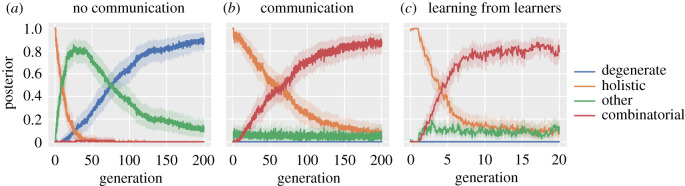
Language is the primary repository and mediator of human collective knowledge. A central question for evolutionary linguistics is the origin of the combinatorial structure of language (sometimes referred to as duality of patterning), one of language's basic design features. Emerging sign languages provide a promising arena to study the emergence of language properties. Many, but not all such sign languages exhibit combinatoriality, which generates testable hypotheses about its source. We hypothesize that combinatoriality is the inevitable result of learning biases in cultural transmission, and that population structure explains differences across languages. We construct an agent-based model with population turnover. Bayesian learning agents with a prior preference for compressible languages (modelling a pressure for language learnability) communicate in pairs under pressure to reduce ambiguity. We include two transmission conditions: agents learn the language either from the oldest agent or from an agent in the middle of their lifespan. Results suggest that (1) combinatoriality emerges during iterated cultural transmission under concurrent pressures for simplicity and expressivity and (2) population dynamics affect the rate of evolution, which is faster when agents learn from other learners than when they learn from old individuals. This may explain its absence in some emerging sign languages. We discuss the consequences of this finding for cultural evolution, highlighting the interplay of population-level, functional and cognitive factors. This article is part of a discussion meeting issue 'The emergence of collective knowledge and cumulative culture in animals, humans and machines'.
语言是人类集体知识的主要储存库和媒介。进化语言学的一个核心问题是语言组合结构(有时也称为模式二元性)的起源,这是语言的基本设计特征之一。新兴的手语为研究语言属性的出现提供了一个有前途的领域。许多(但不是全部)此类手语表现出组合性,这为其来源提供了可检验的假设。我们假设组合性是文化传播中学习偏差的必然结果,并且种群结构解释了语言之间的差异。我们构建了一个具有人口流动的基于代理的模型。具有可压缩语言先验偏好的贝叶斯学习代理(模拟语言可学习性的压力)在减少歧义的压力下进行成对交流。我们包括两种传输条件:代理从最老的代理或其生命周期中间的代理学习语言。结果表明:(1)在迭代文化传播过程中,在简单性和表达力的并发压力下,组合性会出现;(2)种群动态会影响进化速度,当代理从其他学习者那里学习时比从老年个体那里学习时更快。这可能解释了为什么有些新兴的手语中没有组合性。我们讨论了这一发现对文化进化的影响,强调了种群水平、功能和认知因素的相互作用。本文是关于“动物、人类和机器中集体知识和累积文化的出现”的讨论会议议题的一部分。