Department of Maxillofacial and Otorhinolaryngological Oncology, Tianjin Medical University Cancer Institute and Hospital, Tianjin, 300060, China.
Key Laboratory of Cancer Prevention and Therapy, Tianjin Cancer Institute, Tianjin, 300060, China.
Mol Cancer. 2021 Dec 11;20(1):163. doi: 10.1186/s12943-021-01461-0.
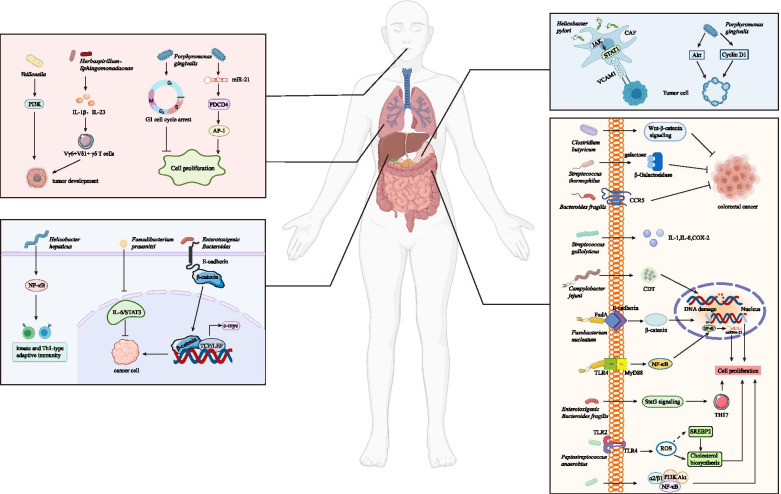
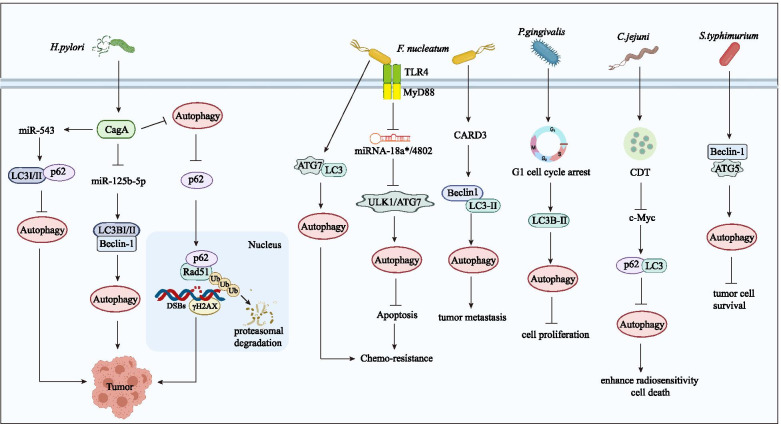
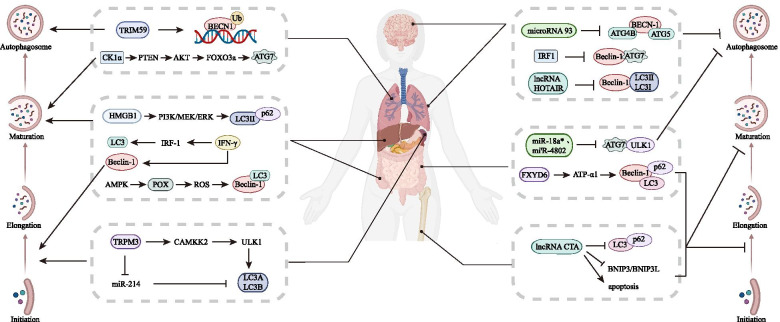
Autophagy is a highly conserved catabolic process seen in eukaryotes and is essentially a lysosome-dependent protein degradation pathway. The dysregulation of autophagy is often associated with the pathogenesis of numerous types of cancers, and can not only promote the survival of cancer but also trigger the tumor cell death. During cancer development, the microbial community might predispose cells to tumorigenesis by promoting mucosal inflammation, causing systemic disorders, and may also regulate the immune response to cancer. The complex relationship between autophagy and microorganisms can protect the body by activating the immune system. In addition, autophagy and microorganisms can crosstalk with each other in multifaceted ways to influence various physiological and pathological responses involved in cancer progression. Various molecular mechanisms, correlating the microbiota disorders and autophagy activation, control the outcomes of protumor or antitumor responses, which depend on the cancer type, tumor microenvironment and disease stage. In this review, we mainly emphasize the leading role of autophagy during the interaction between pathogenic microorganisms and human cancers and investigate the various molecular mechanisms by which autophagy modulates such complicated biological processes. Moreover, we also highlight the possibility of curing cancers with multiple molecular agents targeting the microbiota/autophagy axis. Finally, we summarize the emerging clinical trials investigating the therapeutic potential of targeting either autophagy or microbiota as anticancer strategies, although the crosstalk between them has not been explored thoroughly.
自噬是真核生物中普遍存在的一种高度保守的分解代谢过程,本质上是一种依赖溶酶体的蛋白降解途径。自噬的失调常与多种类型癌症的发病机制有关,它不仅能促进肿瘤细胞的存活,还能触发肿瘤细胞的死亡。在癌症发展过程中,微生物群落可能通过促进黏膜炎症、引起全身紊乱,从而使细胞易患肿瘤,并可能调节对癌症的免疫反应。自噬和微生物之间的复杂关系可以通过激活免疫系统来保护身体。此外,自噬和微生物可以通过多种方式相互交流,影响癌症进展中涉及的各种生理和病理反应。各种分子机制,与微生物群失调和自噬激活相关联,控制着促肿瘤或抗肿瘤反应的结果,这取决于癌症类型、肿瘤微环境和疾病阶段。在这篇综述中,我们主要强调了自噬在致病微生物与人类癌症相互作用过程中的主导作用,并研究了自噬调节这种复杂生物学过程的各种分子机制。此外,我们还强调了通过针对微生物群/自噬轴的多种分子药物来治疗癌症的可能性。最后,我们总结了新兴的临床试验,这些临床试验调查了靶向自噬或微生物群作为抗癌策略的治疗潜力,尽管它们之间的相互作用尚未得到深入探索。