Department of Child and Adolescent Psychiatry, Institute of Psychiatry, Psychology and Neuroscience, King's College London, LondonSE5 8AF, United Kingdom.
Centre for Interventional Paediatric Psychopharmacology and Rare Diseases (CIPPRD), National and Specialist Child and Adolescent Mental Health Services, Maudsley Hospital, LondonSE5 8AB, United Kingdom.
Eur Psychiatry. 2021 Dec 15;65(1):e4. doi: 10.1192/j.eurpsy.2021.2259.
Catatonic features can appear in autism spectrum disorders (ASDs). There can be overlap in symptoms across catatonia and ASD. The overall aim of this review is to provide evidence for the presence of catatonic features in subjects with ASD.
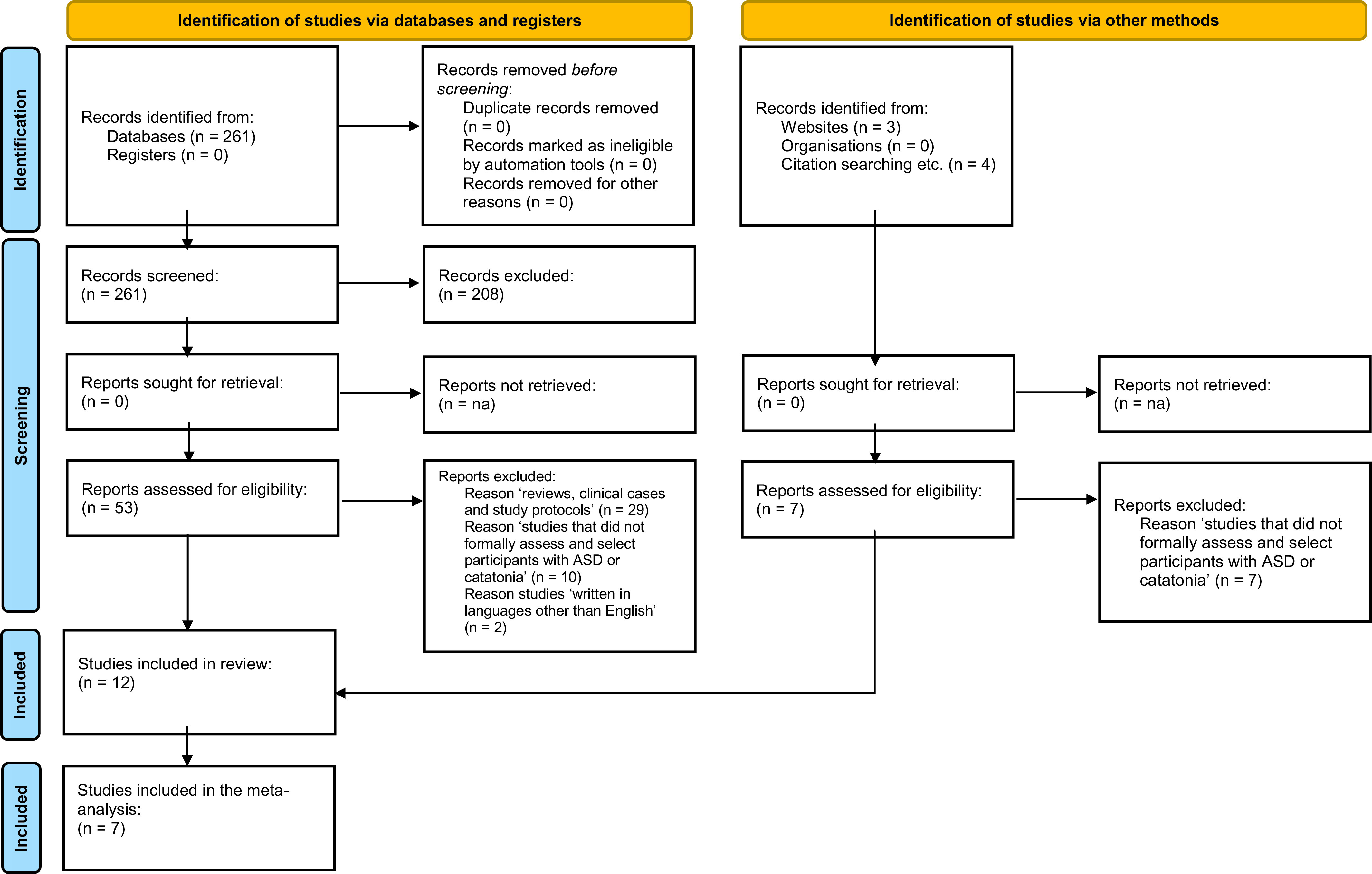
A systematic literature search using the Web of Science database from inception to July 10, 2021 was conducted following PRISMA, MOOSE guidelines and the PROSPERO protocol. (CRD42021248615). Twelve studies with information about catatonia and ASD were reviewed. Data from a subset was used to conduct meta-analyses of the presence of catatonia in ASD.
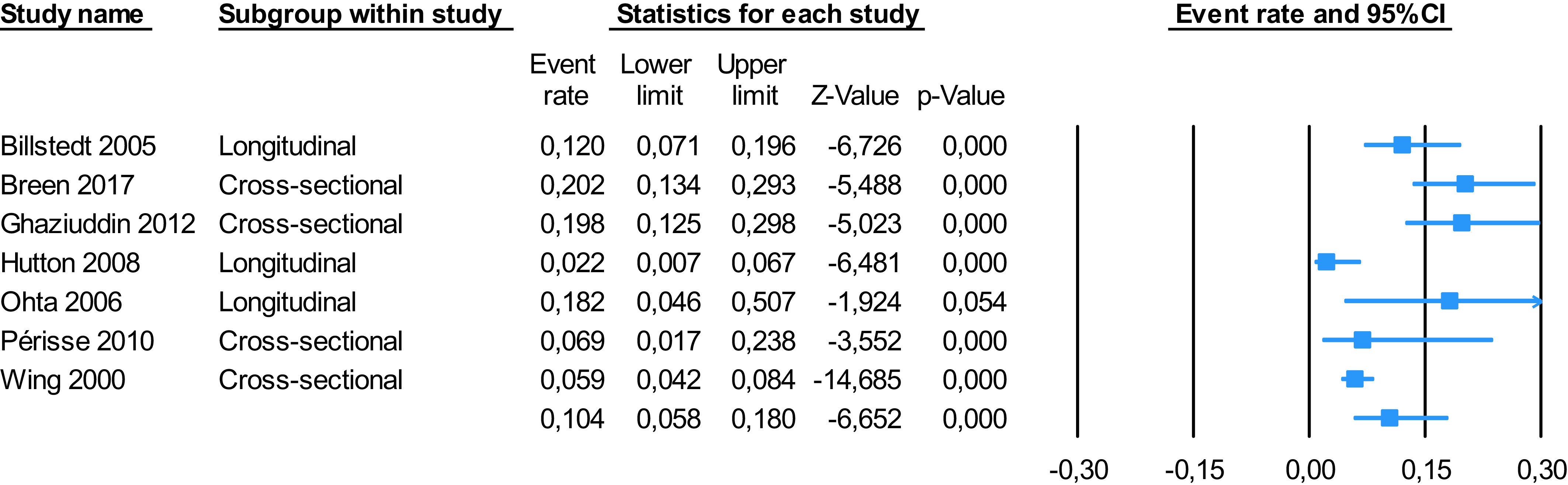
The systematic review included 12 studies, seven of which were used for the meta-analysis, comprising 969 individuals. The mean age was 21.25 (7.5) years. Two studies (16.6%) included only children and adolescents. A total of 70-100% were males. Our meta-analysis showed that 10.4% (5.8-18.0 95%CI) of individuals with ASD have catatonia. Motor disturbances were common in ASD subjects with catatonia. No differences were found in comorbidity. Several treatments have been used in ASD with catatonic features, including benzodiazepines, antipsychotics, and electroconvulsive therapy (ECT). The findings of the systematic review showed that ECT might help manage catatonic symptoms.
Different features of catatonia can exist in individuals with ASD and core symptoms of catatonia are reported in ASD. Longitudinal and longer-term studies are required to understand the relationship between catatonia and ASD, and the response of catatonic symptoms to treatment.
紧张症特征可能出现在自闭症谱系障碍(ASD)中。在紧张症和 ASD 中,症状可能存在重叠。本综述的总体目的是提供 ASD 患者存在紧张症特征的证据。
按照 PRISMA、MOOSE 指南和 PROSPERO 方案,对 Web of Science 数据库进行了系统的文献检索,检索时间从建库至 2021 年 7 月 10 日。(CRD42021248615)。共检索到 12 项关于紧张症和 ASD 的研究进行了综述。从一个子集的数据中进行了 ASD 中紧张症存在的荟萃分析。
系统综述纳入了 12 项研究,其中 7 项用于荟萃分析,共纳入 969 人。平均年龄为 21.25(7.5)岁。有两项研究(16.6%)仅包括儿童和青少年。共有 70-100%的患者为男性。我们的荟萃分析显示,10.4%(5.8-18.0 95%CI)的 ASD 患者存在紧张症。患有紧张症的 ASD 患者常见运动障碍。共病无差异。在患有紧张症特征的 ASD 中使用了几种治疗方法,包括苯二氮䓬类、抗精神病药和电惊厥治疗(ECT)。系统综述的结果表明,ECT 可能有助于控制紧张症症状。
不同的紧张症特征可能存在于 ASD 个体中,并且在 ASD 中报告了紧张症的核心症状。需要进行纵向和长期研究,以了解紧张症和 ASD 之间的关系,以及紧张症症状对治疗的反应。