Bandara Ananda Y, Weerasooriya Dilooshi K, Trexler Ryan V, Bell Terrence H, Esker Paul D
Department of Plant Pathology & Environmental Microbiology, The Pennsylvania State University, University Park, PA, United States.
Intercollege Graduate Degree Program in Ecology, The Pennsylvania State University, University Park, PA, United States.
Front Microbiol. 2021 Nov 30;12:675352. doi: 10.3389/fmicb.2021.675352. eCollection 2021.
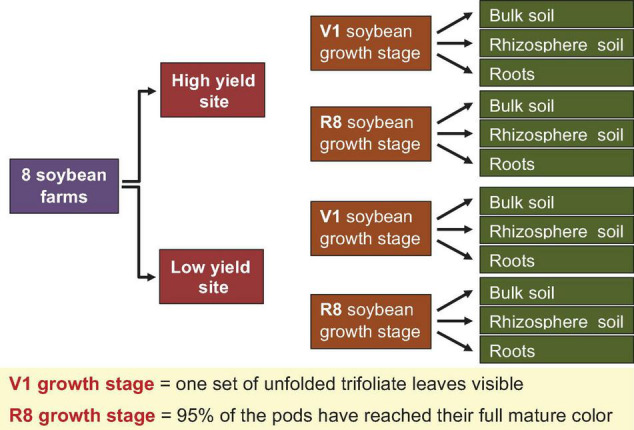
The occurrence of high- (H) and low- (L) yielding field sites within a farm is a commonly observed phenomenon in soybean cultivation. Site topography, soil physical and chemical attributes, and soil/root-associated microbial composition can contribute to this phenomenon. In order to better understand the microbial dynamics associated with each site type (H/L), we collected bulk soil (BS), rhizosphere soil (RS), and soybean root (R) samples from historically high and low yield sites across eight Pennsylvania farms at V1 (first trifoliate) and R8 (maturity) soybean growth stages (SGS). We extracted DNA extracted from collected samples and performed high-throughput sequencing of PCR amplicons from both the fungal ITS and prokaryotic 16S rRNA gene regions. Sequences were then grouped into amplicon sequence variants (ASVs) and subjected to network analysis. Based on both ITS and 16S rRNA gene data, a greater network size and edges were observed for all sample types from H-sites compared to L-sites at both SGS. Network analysis suggested that the number of potential microbial interactions/associations were greater in samples from H-sites compared to L-sites. Diversity analyses indicated that site-type was not a main driver of alpha and beta diversity in soybean-associated microbial communities. L-sites contained a greater percentage of fungal phytopathogens (ex: , , ), while H-sites contained a greater percentage of mycoparasitic (ex: ) and entomopathogenic (ex: ) fungal genera. Furthermore, roots from H-sites possessed a greater percentage of and genera known to contain plant growth promoting bacteria (ex: , ). Overall, our results revealed that there were differences in microbial composition in soil and roots from H- and L-sites across a variety of soybean farms. Based on our findings, we hypothesize that differences in microbial composition could have a causative relationship with observed within-farm variability in soybean yield.
在大豆种植中,农场内高产(H)和低产(L)田间地块的出现是一种常见现象。地块地形、土壤理化属性以及与土壤/根系相关的微生物组成都可能导致这种现象。为了更好地了解与每种地块类型(H/L)相关的微生物动态,我们在宾夕法尼亚州八个农场的V1(第一片三出复叶)和R8(成熟)大豆生长阶段(SGS),从历史上的高产和低产地块采集了土壤(BS)、根际土壤(RS)和大豆根(R)样本。我们从采集的样本中提取DNA,并对真菌ITS和原核生物16S rRNA基因区域的PCR扩增子进行高通量测序。然后将序列分组为扩增子序列变体(ASV)并进行网络分析。基于ITS和16S rRNA基因数据,在两个生长阶段,与L地块相比,H地块所有样本类型的网络规模和边数都更大。网络分析表明,与L地块相比,H地块样本中潜在的微生物相互作用/关联数量更多。多样性分析表明,地块类型不是大豆相关微生物群落中α和β多样性的主要驱动因素。L地块含有更高比例的真菌植物病原体(例如, , , ),而H地块含有更高比例的真菌寄生菌(例如, )和昆虫病原真菌(例如, )属。此外,H地块的根中含有更高比例的已知含有促进植物生长细菌的 属和 属(例如, , )。总体而言,我们的结果表明,不同大豆农场的H和L地块的土壤和根中的微生物组成存在差异。基于我们的发现,我们假设微生物组成的差异可能与观察到的农场内大豆产量变异性存在因果关系。