Department of Central Laboratory, The Second People's Hospital of Lianyungang City (Cancer Hospital of Lianyungang), Lianyungang, China.
School of Biotechnology, Jiangsu University of Science and Technology, Zhenjiang, China.
Front Cell Infect Microbiol. 2021 Dec 2;11:772966. doi: 10.3389/fcimb.2021.772966. eCollection 2021.
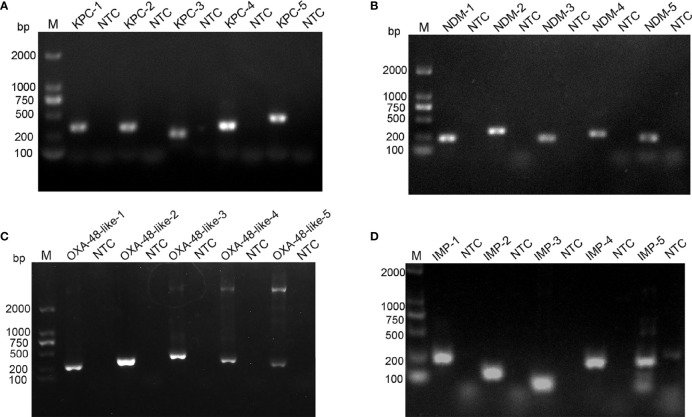
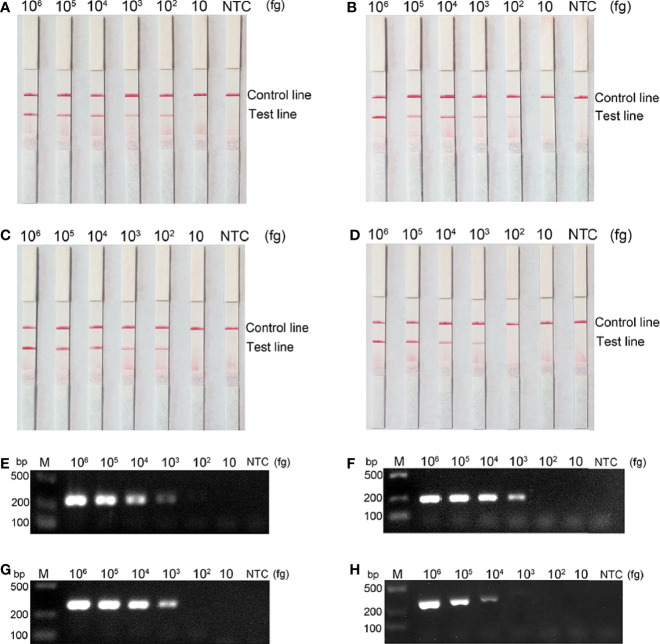
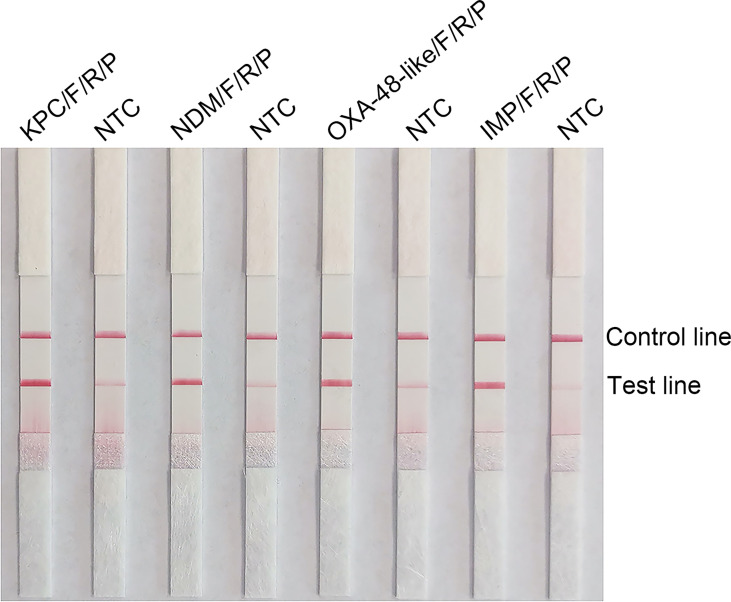
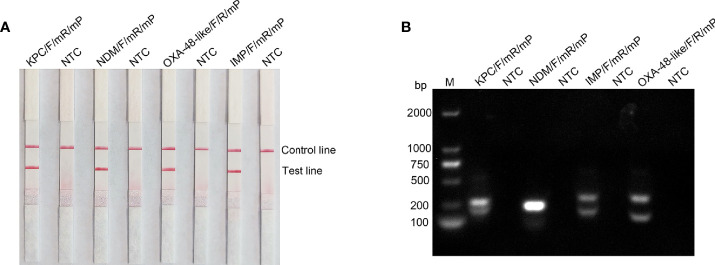
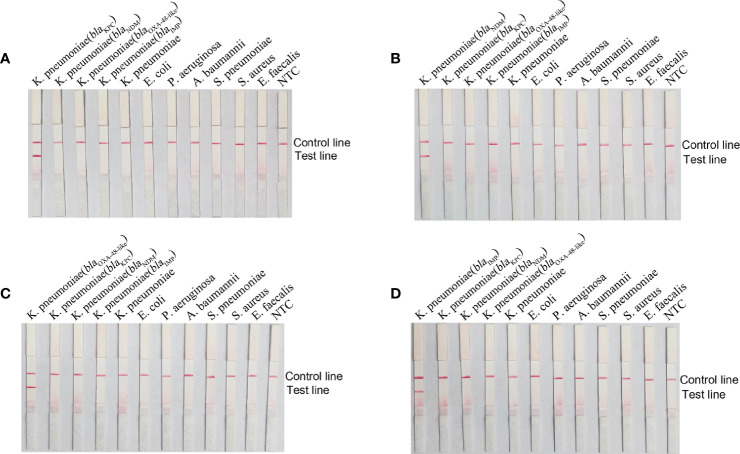
The emergence of carbapenemase-producing (CPE) infections is a major global public health threat. Rapid and accurate detection of pathogenic bacteria is essential to optimize treatment and timely avoid further transmission of these bacteria. Here, we aimed to develop a rapid on site visualization detection method for CPE using improved recombinase polymerase amplification (RPA) combined with lateral flow strip (LFS) method, based on four most popular carbapenemase genes: , , , and . All available allelic variants of the above carbapenemases were downloaded from the β-lactamase database, and the conserved regions were used as targets for RPA assay. Five primer sets were designed targeting to each carbapenemase gene and the RPA amplification products were analyzed by agarose gel electrophoresis. FITC-labeled specific probes were selected, combined with the best performance primer set (Biotin-labeled on the reverse primer), and detected by RPA-LFS. Mismatches were made to exclude the false positive signals interference. This assay was evaluated in 207 clinically validated carbapenem-resistant (CRE) isolates and made a comparison with conventional PCR. Results showed that the established RPA-LFS assay for CPE could be realized within 30 min at a constant temperature of 37°C and visually detected amplification products without the need for special equipment. This assay could specifically differentiate the four classes of carbapenemases without cross-reactivity and shared a minimum detection limit of 100 fg/reaction (for , , and ) or 1000 fg/reaction (for ), which is ten times more sensitive than PCR. Furthermore, the detection of 207 pre-validated clinically CRE strains using the RPA-LFS method resulted in 134 , 69 , 3 , and 1 . The results of the RPA-LFS assay were in consistent with PCR, indicating that this method shared high sensitivity and specificity. Therefore, the RPA-LFS method for CPE may be a simple, specific, and sensitive method for the rapid diagnosis of carbapenemase .
产碳青霉烯酶(CPE)感染的出现是一个主要的全球公共卫生威胁。快速准确地检测致病菌对于优化治疗和及时避免这些细菌的进一步传播至关重要。在这里,我们旨在开发一种基于四种最流行的碳青霉烯酶基因:、、、和的快速现场可视化检测 CPE 的方法,该方法结合了改进的重组聚合酶扩增(RPA)和侧流条(LFS)方法。从β-内酰胺酶数据库中下载了上述所有碳青霉烯酶的可用等位基因变体,并将保守区域用作 RPA 检测的靶标。针对每种碳青霉烯酶基因设计了五个引物组,并用琼脂糖凝胶电泳分析 RPA 扩增产物。选择了与 FITC 标记的特异性探针结合的最佳性能引物组(反向引物上标记生物素),并通过 RPA-LFS 进行检测。引入错配以排除假阳性信号干扰。该检测方法在 207 种经临床验证的碳青霉烯类耐药(CRE)分离株中进行了评估,并与常规 PCR 进行了比较。结果表明,建立的 CPE RPA-LFS 检测法可在 37°C 恒温下 30 分钟内实现,无需特殊设备即可直观地检测到扩增产物。该检测法可特异性区分四类碳青霉烯酶,无交叉反应,最小检测限为 100 fg/反应(用于、、和)或 1000 fg/反应(用于),比 PCR 敏感十倍。此外,使用 RPA-LFS 方法对 207 种经过预验证的临床 CRE 菌株进行检测,结果为 134 株、69 株、3 株和 1 株。RPA-LFS 检测法的结果与 PCR 一致,表明该方法具有较高的灵敏度和特异性。因此,CPE 的 RPA-LFS 方法可能是一种快速诊断碳青霉烯酶的简单、特异、敏感的方法。