Justin Michael Ingerman Center for Palliative Care, The Children's Hospital of Philadelphia, Philadelphia, Pennsylvania.
Division of General Pediatrics, Department of Pediatrics, Perelman School of Medicine at the University of Pennsylvania, Philadelphia.
JAMA Netw Open. 2021 Dec 1;4(12):e2137250. doi: 10.1001/jamanetworkopen.2021.37250.
Despite concerns regarding the potential deleterious physical and mental health outcomes among family members of a child with a life-threatening condition (LTC), few studies have examined empirical measures of health outcomes among these family members.
To examine whether mothers, fathers, sisters, and brothers of children with 1 of 4 types of pediatric LTCs have higher rates of health care encounters, diagnoses, and prescriptions compared with families of children without these conditions.
DESIGN, SETTING, AND PARTICIPANTS: This retrospective cohort study included US families with commercial insurance coverage from a single carrier. Children who had 1 of 4 LTCs (substantial prematurity, critical congenital heart disease, cancer, or a condition resulting in severe neurologic impairment) were identified by a diagnosis in their insurance claim data between July 1, 2015, and June 30, 2016. Each case child and their family was matched with up to 4 control children and their families based on the age of the case and control children. Data were analyzed between August 2020 and March 2021.
Having a child or sibling with substantial prematurity, critical congenital heart disease, cancer, or a condition resulting in severe and progressive neurologic impairment.
Rates of occurrence of health care encounters, physical and mental health diagnoses, and physical and mental health medication prescriptions, identified from insurance claims data, were compared between case and control families using a multivariable negative binomial regression model. The statistical analysis adjusted for observed differences between case and control families and accounted for clustering at the family level.
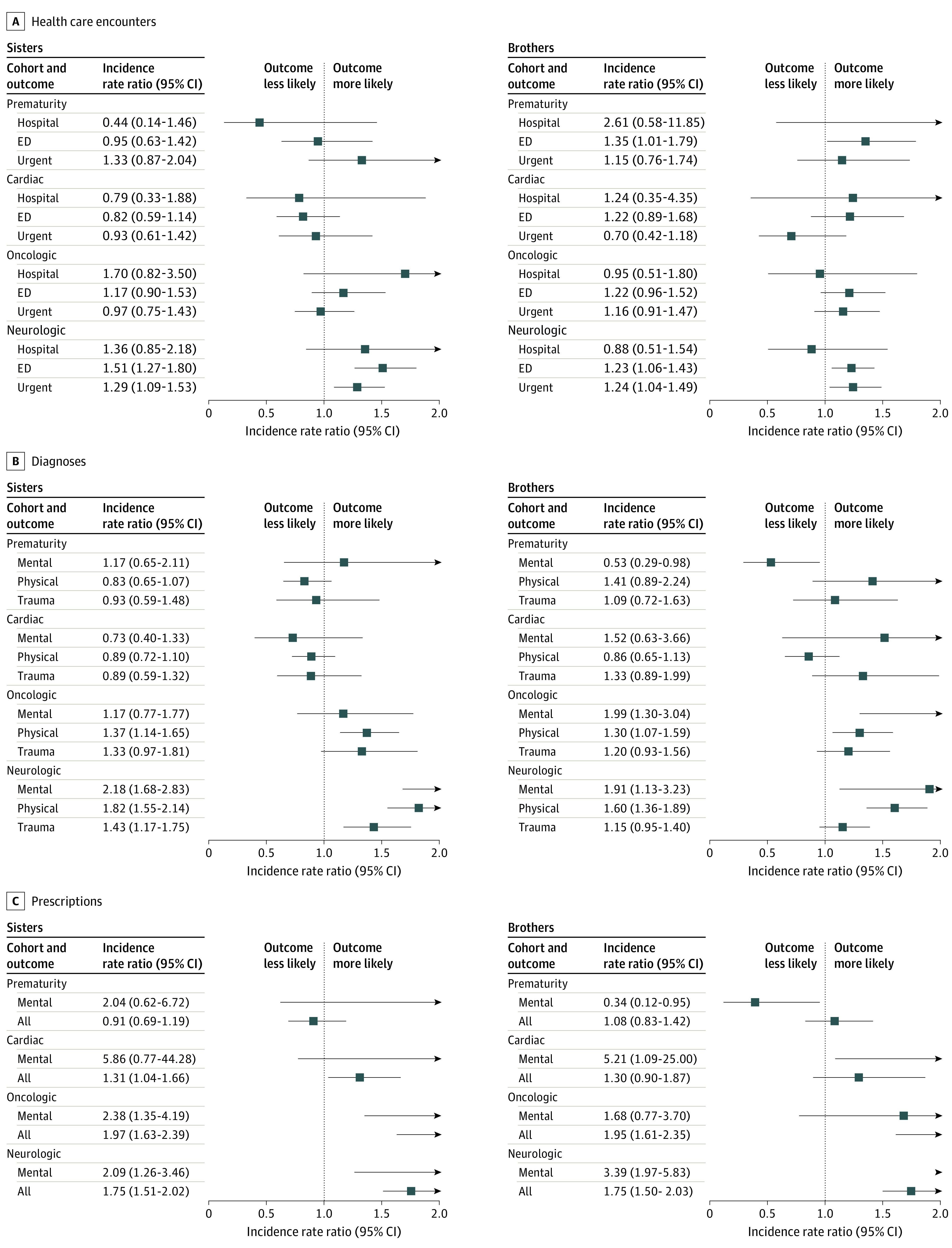
The study included 25 528 children (6909 case children [27.1%] and 18 619 control children [72.9%]; median age, 6.0 years [IQR, 1-13 years]; 13 294 [52.1%] male), 43 357 parents (11 586 case parents [26.7%] and 31 771 control parents [73.3%]; mean [SD] age, 40.4 [8.1] years; 22 318 [51.5%] female), and 25 706 siblings (7664 case siblings [29.8%] and 18 042 control siblings [70.2%]; mean [SD] age, 12.1 [6.5] years; 13 114 [51.0%] male). Overall, case mothers had higher rates of the composite outcome of health care encounters, diagnoses, and prescriptions compared with control mothers (incident rate ratio [IRR], 1.61; 95% CI, 1.54-1.68), as did case fathers compared with control fathers (IRR, 1.55; 95% CI, 1.46-1.64). Sisters of children with LTCs had higher rates of the composite outcome compared with sisters of children without LTCs (IRR, 1.68; 95% CI, 1.55-1.82), as did brothers of children with LTCs compared with brothers of children without LTCs (IRR, 1.70; 95% CI, 1.56-1.85).
In this cohort study, mothers, fathers, sisters, and brothers who had a child or sibling with 1 of 4 types of LTCs had higher rates of health care encounters, diagnoses, and medication prescriptions compared with families who did not have a child with that condition. The findings suggest that family members of children with LTCs may experience poorer mental and physical health outcomes. Interventions for parents and siblings of children with LTCs that aim to safeguard their mental and physical well-being appear to be warranted.
尽管人们对患有危及生命疾病的儿童的家庭成员可能会产生身体和心理健康方面的不良后果表示担忧,但很少有研究检查这些家庭成员的健康结果的实证衡量标准。
本研究旨在检查患有以下 4 种儿科危及生命疾病(LTC)之一的儿童的母亲、父亲、姐妹和兄弟是否比没有这些疾病的儿童的家庭有更高的医疗保健就诊率、诊断率和处方率。
设计、地点和参与者:这是一项回顾性队列研究,纳入了来自一家单一保险公司的美国有商业保险的家庭。通过保险索赔数据,在 2015 年 7 月 1 日至 2016 年 6 月 30 日期间,识别出患有 4 种 LTC 之一(严重早产、严重先天性心脏病、癌症或导致严重神经功能障碍的疾病)的儿童病例。每个患儿及其家庭都与多达 4 名对照患儿及其家庭相匹配,匹配的依据是患儿和对照患儿的年龄。数据在 2020 年 8 月至 2021 年 3 月之间进行分析。
患儿或患儿兄弟姐妹患有严重早产、严重先天性心脏病、癌症或导致严重和进行性神经功能障碍的疾病。
从保险索赔数据中确定的医疗保健就诊率、身心健康诊断率和身心健康药物处方率,通过多变量负二项回归模型,在病例和对照组家庭之间进行比较。统计分析调整了病例和对照组家庭之间的观察差异,并考虑了家庭层面的聚类。
研究纳入了 25528 名儿童(6909 名病例儿童[27.1%]和 18619 名对照儿童[72.9%];中位数年龄 6.0 岁[IQR 1-13 岁];13294 名[52.1%]男性),43537 名父母(11586 名病例父母[26.7%]和 31771 名对照父母[73.3%];平均[标准差]年龄 40.4[8.1]岁;22318 名[51.5%]女性)和 25706 名兄弟姐妹(7664 名病例兄弟姐妹[29.8%]和 18042 名对照兄弟姐妹[70.2%];平均[标准差]年龄 12.1[6.5]岁;13114 名[51.0%]男性)。总的来说,与对照母亲相比,患有 LTC 的母亲有更高的医疗保健就诊、诊断和处方的综合结果发生率(发病率比[IRR],1.61;95%CI,1.54-1.68),患有 LTC 的父亲也有更高的综合结果发生率(IRR,1.55;95%CI,1.46-1.64)。与没有 LTC 的儿童的兄弟姐妹相比,患有 LTC 的儿童的姐妹也有更高的综合结果发生率(IRR,1.68;95%CI,1.55-1.82),患有 LTC 的儿童的兄弟也有更高的综合结果发生率(IRR,1.70;95%CI,1.56-1.85)。
在这项队列研究中,患有 4 种 LTC 之一的儿童的母亲、父亲、姐妹和兄弟与没有该疾病的儿童的家庭相比,有更高的医疗保健就诊率、诊断率和药物处方率。这些发现表明,患有 LTC 儿童的家庭成员可能会经历更差的身心健康结果。针对患有 LTC 儿童的父母和兄弟姐妹的干预措施,旨在保障他们的身心健康,似乎是合理的。