Catalan Institute of Oncology, IDIBELL, L'Hospitalet, Barcelona, Spain.
National Cancer Center Hospital, Tokyo, Japan.
Drug Saf. 2022 Jan;45(1):45-64. doi: 10.1007/s40264-021-01127-2. Epub 2021 Dec 20.
RELAY was a global, double-blind, placebo-controlled phase III study that demonstrated superior progression-free survival (PFS) for ramucirumab plus erlotinib (RAM + ERL) versus placebo plus erlotinib (PBO + ERL) in the first-line treatment of patients with epidermal growth factor receptor (EGFR) exon 19 deletion or exon 21 (L858R) mutation-positive, metastatic non-small-cell lung cancer (NSCLC).
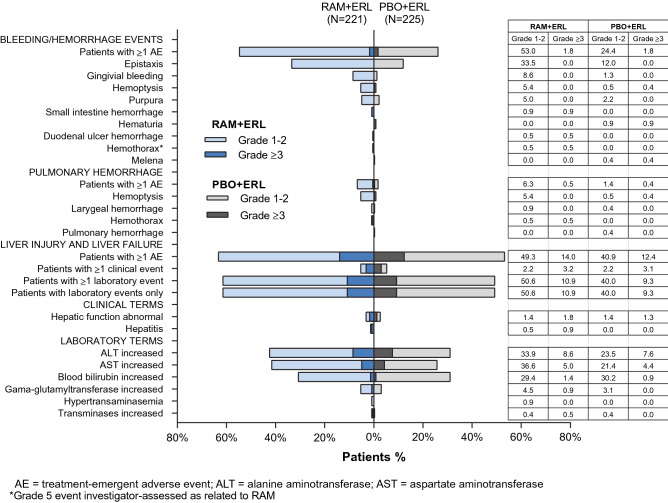
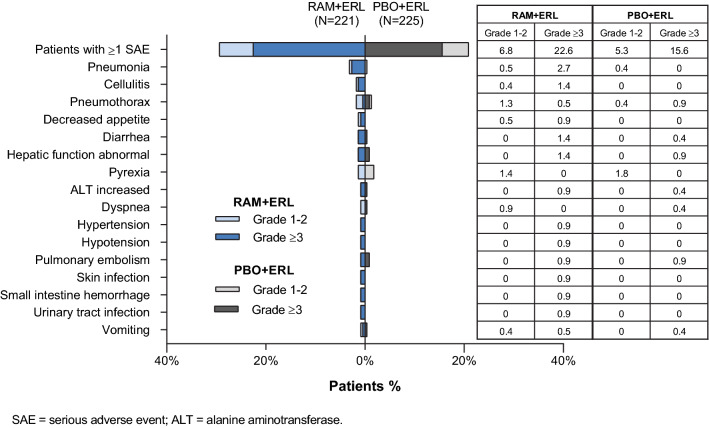
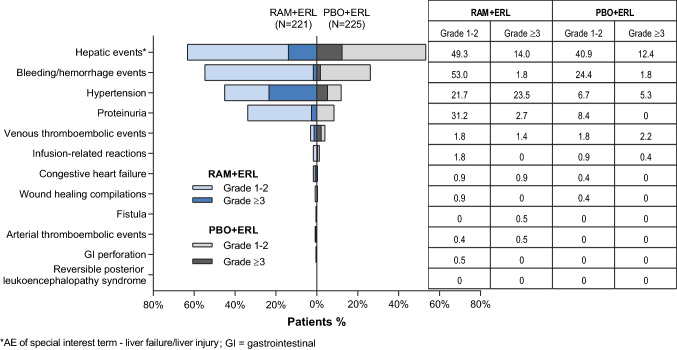
This article provides an in-depth analysis of the safety profile of RAM + ERL versus PBO + ERL observed in RELAY.
Eligible patients met these criteria: stage IV NSCLC; EGFR exon 19 deletion or exon 21 substitution (L858R) mutation; Eastern Cooperative Oncology Group performance status 0 or 1; and no central nervous system metastases. Patients were randomized (1:1) to receive erlotinib 150 mg/day orally plus either ramucirumab 10 mg/kg intravenously or matching placebo once every 2 weeks, until disease progression or unacceptable toxicity. The primary endpoint was PFS. Safety was evaluated based on reported treatment-emergent adverse events (AEs) and clinical laboratory assessments.
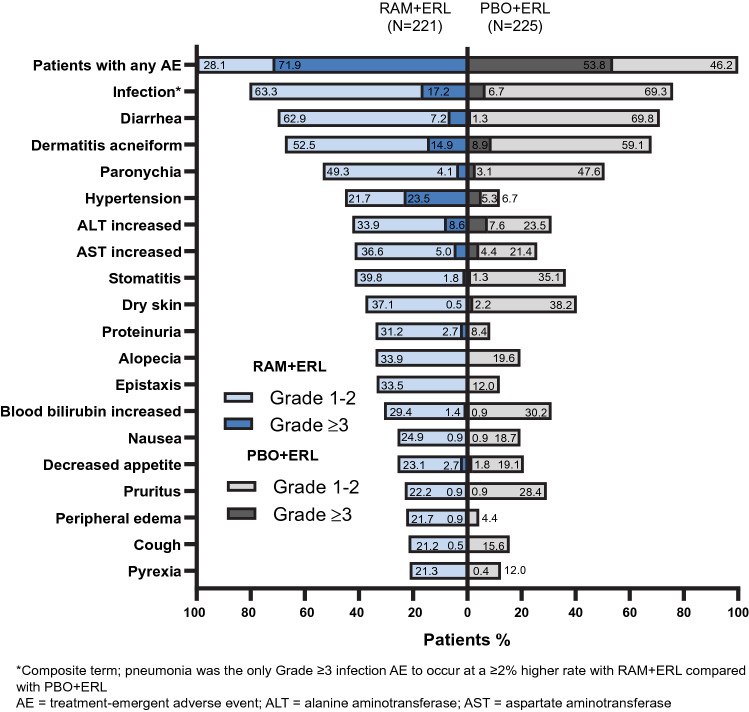
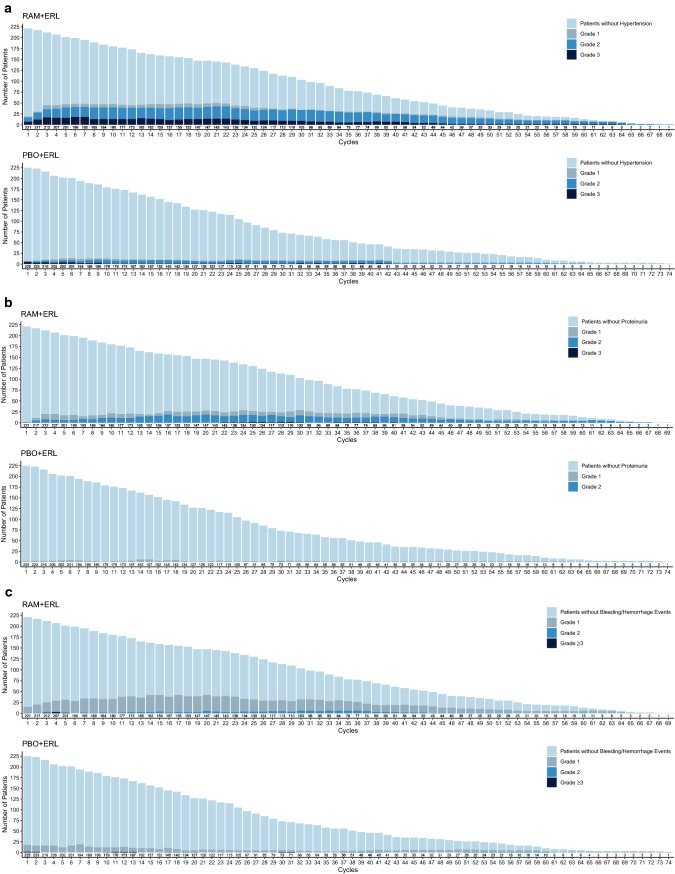
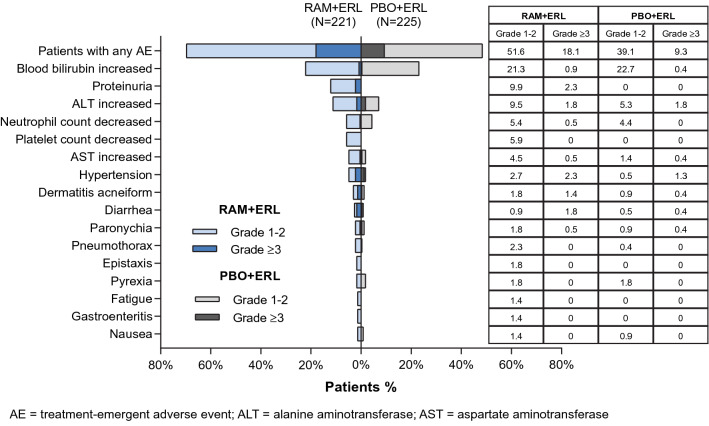
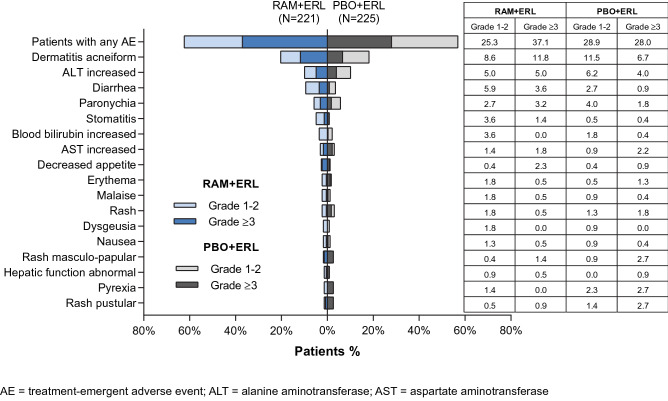
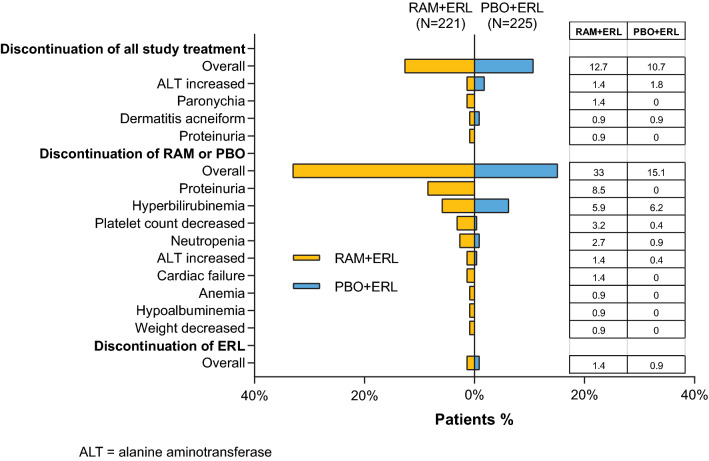
The safety population comprised 446 patients (221 in RAM+ERL arm; 225 in PBO + ERL arm) who received at least one dose of study drug between January 2016 and February 2018. The overall incidence of grade ≥ 3 AEs was higher with RAM + ERL than with PBO + ERL, primarily driven by grade 3 hypertension. Grade ≥ 3 dermatitis acneiform and diarrhea were also reported more frequently in the RAM + ERL arm. The increased incidence of AEs with RAM + ERL was easily detected through routine monitoring and managed through dose adjustments and appropriate supportive care.
This in-depth safety analysis from RELAY supports that RAM + ERL, irrespective of the increased incidence of AEs, does not affect a patient's ability to benefit from treatment.
NCT02411448.
RELAY 是一项全球性、双盲、安慰剂对照的 III 期研究,结果表明,在表皮生长因子受体(EGFR)外显子 19 缺失或外显子 21(L858R)突变阳性、转移性非小细胞肺癌(NSCLC)的一线治疗中,雷莫芦单抗联合厄洛替尼(RAM + ERL)与安慰剂联合厄洛替尼(PBO + ERL)相比,无进展生存期(PFS)更优。
本文深入分析了 RELAY 中观察到的 RAM + ERL 相对于 PBO + ERL 的安全性概况。
符合条件的患者符合以下标准:IV 期 NSCLC;EGFR 外显子 19 缺失或外显子 21 替换(L858R)突变;东部肿瘤协作组表现状态 0 或 1;无中枢神经系统转移。患者按 1:1 随机分组,接受厄洛替尼 150mg/天口服联合雷莫芦单抗 10mg/kg 静脉注射或匹配安慰剂,每 2 周一次,直至疾病进展或不可接受的毒性。主要终点为 PFS。根据报告的治疗中出现的不良事件(AE)和临床实验室评估来评估安全性。
安全性人群包括 446 例患者(RAM+ERL 组 221 例,PBO + ERL 组 225 例),他们在 2016 年 1 月至 2018 年 2 月期间至少接受了一剂研究药物。RAM + ERL 组的总体 3 级及以上 AE 发生率高于 PBO + ERL 组,主要由 3 级高血压引起。RAM + ERL 组也更频繁地报告 3 级痤疮样皮炎和腹泻。通过常规监测很容易发现 RAM + ERL 引起的 AE 发生率增加,并通过剂量调整和适当的支持性护理进行管理。
来自 RELAY 的这项深入安全性分析支持 RAM + ERL 不会影响患者从治疗中获益的能力,尽管 AE 发生率增加。
NCT02411448。