Department of Family Medicine (Vanstone, Taneja, Popoola, Panday, Lennox), McMaster University, Hamilton, Ont.; Department of Communication (Greyson), University of Massachusetts Amherst, Amherst, Mass.; School of Population and Public Health (Greyson), University of British Columbia, Vancouver, BC; Division of Maternal-Fetal Medicine, Department of Obstetrics and Gynecology, Radiology and Health Research Methods, Evidence & Impact (McDonald), McMaster University, Hamilton, Ont.
CMAJ. 2021 Dec 20;193(50):E1906-E1914. doi: 10.1503/cmaj.211236.
Cannabis use among pregnant and lactating people is increasing, despite clinical evidence showing that cannabis use may be associated with low birth weight and childhood developmental deficits. Our objective was to understand why pregnant and lactating people use cannabis and how these motivations change across perinatal stages.
Using qualitative, constructivist grounded theory methodology, we conducted telephone and virtual interviews with 52 individuals from across Canada. We selected participants using maximum variation and theoretical sampling. They were eligible if they had been pregnant or lactating within the past year and had decided to continue, cease or decrease their cannabis use during the perinatal period.
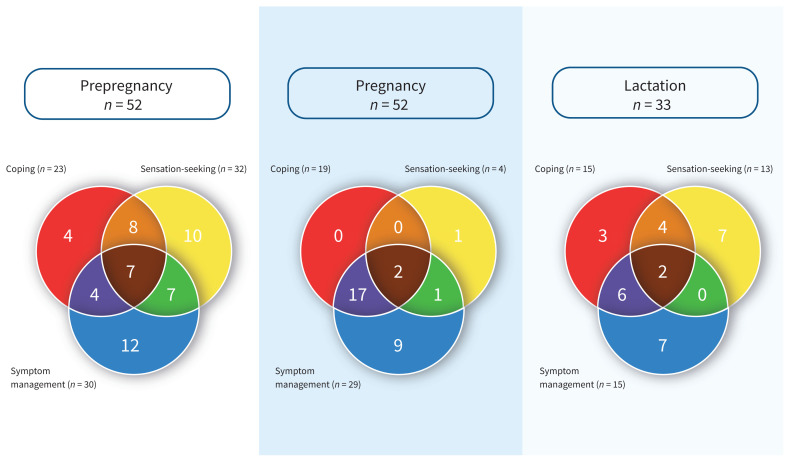
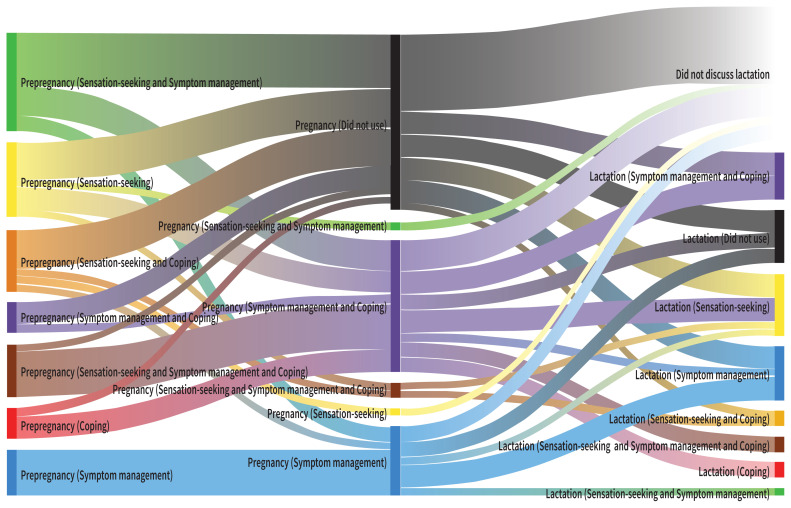
We identified 3 categories of reasons that people use cannabis during pregnancy and lactation: sensation-seeking for fun and enjoyment; symptom management of chronic conditions and conditions related to pregnancy; and coping with the unpleasant, but nonpathologized, experiences of life. Before pregnancy, participants endorsed reasons for using cannabis in these 3 categories in similar proportions, with many offering multiple reasons for use. During pregnancy, reasons for use shifted primarily to symptom management. During lactation, reasons returned to resemble those expressed before pregnancy.
In this study, we showed that pregnant and lactating people use cannabis for many reasons, particularly for symptom management. Reasons for cannabis use changed across reproductive stages. The dynamic nature of the reasons for use across stages speaks to participant perception of benefits and risks, and perhaps a desire to cast cannabis use during pregnancy as therapeutic because of perceived stigma.
尽管临床证据表明,大麻的使用可能与低出生体重和儿童发育缺陷有关,但在孕妇和哺乳期人群中,大麻的使用仍在增加。我们的目的是了解为什么孕妇和哺乳期人群会使用大麻,以及这些动机在围产期阶段是如何变化的。
使用定性、建构主义扎根理论方法,我们对来自加拿大各地的 52 名个人进行了电话和虚拟访谈。我们使用最大变异和理论抽样选择参与者。他们符合条件的标准是,在过去一年中曾怀孕或哺乳,并且在围产期决定继续、停止或减少大麻的使用。
我们确定了人们在怀孕期间和哺乳期使用大麻的 3 个原因类别:寻求刺激以获得乐趣和享受;慢性疾病和与怀孕相关疾病的症状管理;以及应对不愉快但非病理性的生活体验。在怀孕前,参与者以相似的比例认可这 3 个类别的使用大麻的原因,许多人提供了多种使用原因。在怀孕期间,使用的原因主要转向症状管理。在哺乳期,原因又回到了怀孕前表达的原因。
在这项研究中,我们表明,孕妇和哺乳期人群使用大麻的原因很多,特别是为了症状管理。使用大麻的原因在生殖阶段发生了变化。使用原因在各阶段的动态性质反映了参与者对益处和风险的看法,也许是因为认为怀孕期间使用大麻是有治疗作用的,因为存在污名化。