• 文献检索
  • 文档翻译
  • 深度研究
  • 学术资讯
  • Suppr Zotero 插件Zotero 插件
  • 邀请有礼
  • 套餐&价格
  • 历史记录
应用&插件
Suppr Zotero 插件Zotero 插件浏览器插件Mac 客户端Windows 客户端微信小程序
定价
高级版会员购买积分包购买API积分包
服务
文献检索文档翻译深度研究API 文档MCP 服务
关于我们
关于 Suppr公司介绍联系我们用户协议隐私条款
关注我们

Suppr 超能文献

核心技术专利:CN118964589B侵权必究
粤ICP备2023148730 号-1Suppr @ 2026

文献检索

告别复杂PubMed语法,用中文像聊天一样搜索,搜遍4000万医学文献。AI智能推荐,让科研检索更轻松。

立即免费搜索

文件翻译

保留排版,准确专业,支持PDF/Word/PPT等文件格式,支持 12+语言互译。

免费翻译文档

深度研究

AI帮你快速写综述,25分钟生成高质量综述,智能提取关键信息,辅助科研写作。

立即免费体验

错误信息警告:推特的温和审核对新冠疫苗信念回声的影响

Misinformation warnings: Twitter's soft moderation effects on COVID-19 vaccine belief echoes.

作者信息

Sharevski Filipo, Alsaadi Raniem, Jachim Peter, Pieroni Emma

机构信息

College of Computing and Digital Media, DePaul University, 243 S Wabash Ave, Chicago, IL 60640, United States.

出版信息

Comput Secur. 2022 Mar;114:102577. doi: 10.1016/j.cose.2021.102577. Epub 2021 Dec 16.

DOI:10.1016/j.cose.2021.102577
PMID:34934255
原文链接:https://pmc.ncbi.nlm.nih.gov/articles/PMC8675217/
Abstract

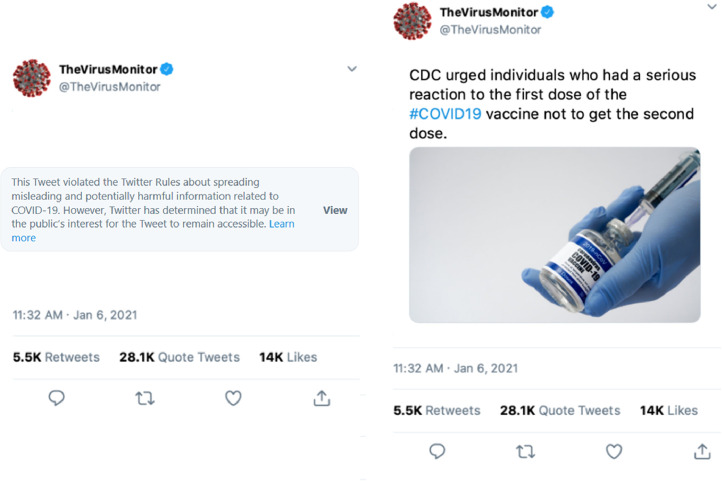
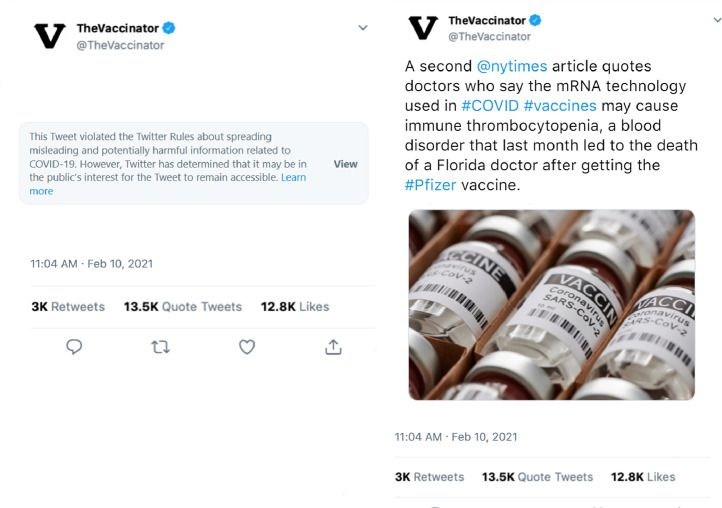
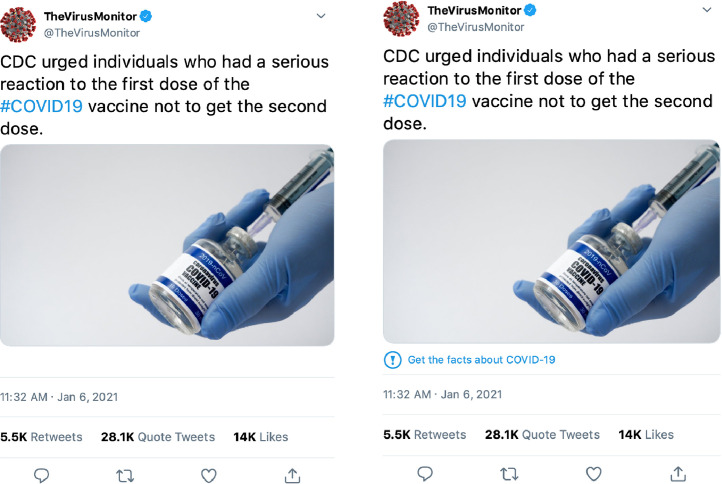
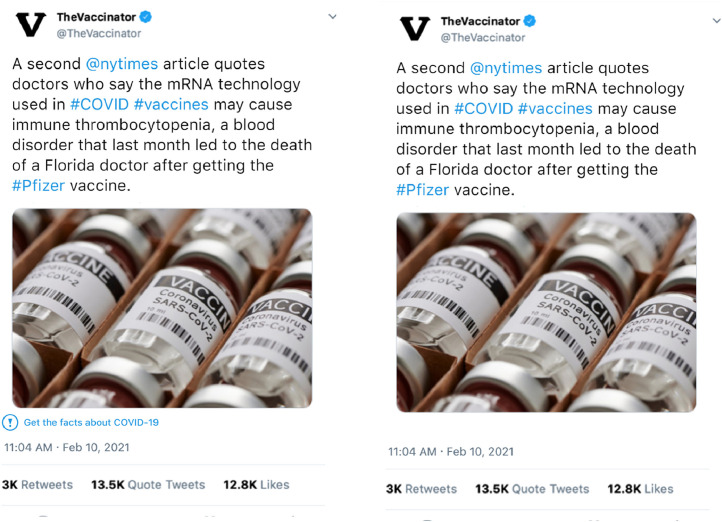
Twitter, prompted by the rapid spread of alternative narratives, started actively warning users about the spread of COVID-19 misinformation. This form of soft moderation comes in two forms: as an interstitial cover before the Tweet is displayed to the user or as a contextual tag displayed below the Tweet. We conducted a 319-participants study with both verified and misleading Tweets covered or tagged with the COVID-19 misinformation warnings to investigate how Twitter users perceive the accuracy of COVID-19 vaccine content on Twitter. The results suggest that the interstitial covers work, but not the contextual tags, in reducing the perceived accuracy of COVID-19 misinformation. Soft moderation is known to create so-called "belief echoes" where the warnings echo back, instead of dispelling, preexisting beliefs about morally-charged topics. We found that such "belief echoes" do exist among Twitter users in relationship to the perceived safety and efficacy of the COVID-19 vaccine as well as the vaccination hesitancy for themselves and their children. These "belief echoes" manifested as skepticism of adequate COVID-19 immunization particularly among Republicans and Independents as well as female Twitter users. Surprisingly, we found that the belief echoes are strong enough to preclude adult Twitter users to receive the COVID-19 vaccine regardless of their education level.

摘要

受另类叙事迅速传播的影响,推特开始积极向用户发出关于新冠疫情错误信息传播的警告。这种软性审核有两种形式:一种是在推文展示给用户之前的插页式封面,另一种是显示在推文下方的上下文标签。我们对319名参与者进行了一项研究,研究对象包括被新冠疫情错误信息警告覆盖或标记的已验证推文和误导性推文,以调查推特用户如何看待推特上新冠疫苗内容的准确性。结果表明,插页式封面在降低对新冠疫情错误信息的感知准确性方面有效,但上下文标签则不然。众所周知,软性审核会产生所谓的“信念回声”,即警告会强化而非消除人们对道德敏感话题的既有信念。我们发现,在推特用户中,这种“信念回声”确实存在,涉及对新冠疫苗的安全性和有效性的感知,以及他们自己和孩子接种疫苗的犹豫态度。这些“信念回声”表现为对新冠疫苗接种是否充分的怀疑,尤其是在共和党人和独立人士以及女性推特用户中。令人惊讶的是,我们发现这种信念回声足够强烈,以至于无论教育程度如何,成年推特用户都不愿意接种新冠疫苗。
https://cdn.ncbi.nlm.nih.gov/pmc/blobs/1730/8675217/6aa9bbfdf6b6/gr4_lrg.jpg
https://cdn.ncbi.nlm.nih.gov/pmc/blobs/1730/8675217/4c3135af8723/gr1_lrg.jpg
https://cdn.ncbi.nlm.nih.gov/pmc/blobs/1730/8675217/b48dfa2099c2/gr2_lrg.jpg
https://cdn.ncbi.nlm.nih.gov/pmc/blobs/1730/8675217/006e9a0acd67/gr3_lrg.jpg
https://cdn.ncbi.nlm.nih.gov/pmc/blobs/1730/8675217/6aa9bbfdf6b6/gr4_lrg.jpg
https://cdn.ncbi.nlm.nih.gov/pmc/blobs/1730/8675217/4c3135af8723/gr1_lrg.jpg
https://cdn.ncbi.nlm.nih.gov/pmc/blobs/1730/8675217/b48dfa2099c2/gr2_lrg.jpg
https://cdn.ncbi.nlm.nih.gov/pmc/blobs/1730/8675217/006e9a0acd67/gr3_lrg.jpg
https://cdn.ncbi.nlm.nih.gov/pmc/blobs/1730/8675217/6aa9bbfdf6b6/gr4_lrg.jpg

相似文献

1
Misinformation warnings: Twitter's soft moderation effects on COVID-19 vaccine belief echoes.错误信息警告:推特的温和审核对新冠疫苗信念回声的影响
Comput Secur. 2022 Mar;114:102577. doi: 10.1016/j.cose.2021.102577. Epub 2021 Dec 16.
2
Spread of COVID-19 Vaccine Misinformation in the Ninth Inning: Retrospective Observational Infodemic Study.新冠疫苗错误信息在最后阶段的传播:回顾性观察性信息疫情研究
JMIR Infodemiology. 2022 Mar 16;2(1):e33587. doi: 10.2196/33587. eCollection 2022 Jan-Jun.
3
Constituents' Inferences of Local Governments' Goals and the Relationship Between Political Party and Belief in COVID-19 Misinformation: Cross-sectional Survey of Twitter Followers of State Public Health Departments.地方政府目标的选民推断以及政党与新冠疫情错误信息中的信念之间的关系:对州公共卫生部门推特关注者的横断面调查
JMIR Infodemiology. 2022 Feb 10;2(1):e29246. doi: 10.2196/29246. eCollection 2022 Jan-Jun.
4
Global Misinformation Spillovers in the Vaccination Debate Before and During the COVID-19 Pandemic: Multilingual Twitter Study.新冠疫情之前及期间疫苗接种辩论中的全球错误信息传播:多语言推特研究
JMIR Infodemiology. 2023 May 24;3:e44714. doi: 10.2196/44714.
5
COVID-19 Vaccine Hesitancy on Social Media: Building a Public Twitter Data Set of Antivaccine Content, Vaccine Misinformation, and Conspiracies.社交媒体上对 COVID-19 疫苗的犹豫:构建一个关于反疫苗内容、疫苗错误信息和阴谋论的公共 Twitter 数据集。
JMIR Public Health Surveill. 2021 Nov 17;7(11):e30642. doi: 10.2196/30642.
6
Impact of Social Reference Cues on Misinformation Sharing on Social Media: Series of Experimental Studies.社交媒体上社会参照线索对错误信息传播的影响:一系列实验研究。
J Med Internet Res. 2023 Aug 24;25:e45583. doi: 10.2196/45583.
7
Coronavirus Goes Viral: Quantifying the COVID-19 Misinformation Epidemic on Twitter.冠状病毒迅速传播:量化推特上关于新冠疫情的错误信息传播情况
Cureus. 2020 Mar 13;12(3):e7255. doi: 10.7759/cureus.7255.
8
Investigation of COVID-19 Misinformation in Arabic on Twitter: Content Analysis.推特上阿拉伯语新冠疫情虚假信息调查:内容分析
JMIR Infodemiology. 2022 Jul 26;2(2):e37007. doi: 10.2196/37007. eCollection 2022 Jul-Dec.
9
COVID-19 Health Beliefs Regarding Mask Wearing and Vaccinations on Twitter: Deep Learning Approach.推特上关于佩戴口罩和接种疫苗的新冠疫情健康观念:深度学习方法
JMIR Infodemiology. 2022 Oct 31;2(2):e37861. doi: 10.2196/37861. eCollection 2022 Jul-Dec.
10
Negative COVID-19 Vaccine Information on Twitter: Content Analysis.推特上关于新冠疫苗的负面信息:内容分析
JMIR Infodemiology. 2022 Aug 29;2(2):e38485. doi: 10.2196/38485. eCollection 2022 Jul-Dec.

引用本文的文献

1
Labeling AI-generated media online.对在线人工智能生成的媒体进行标注。
PNAS Nexus. 2025 May 28;4(6):pgaf170. doi: 10.1093/pnasnexus/pgaf170. eCollection 2025 Jun.
2
Unraveling the Use of Disinformation Hashtags by Social Bots During the COVID-19 Pandemic: Social Networks Analysis.解析新冠疫情期间社交机器人对虚假信息主题标签的使用:社交网络分析
JMIR Infodemiology. 2025 Jan 9;5:e50021. doi: 10.2196/50021.
3
A thematic analysis of UK COVID-19 vaccine hesitancy discussions on Twitter.对英国推特上关于新冠疫苗犹豫情绪讨论的主题分析。

本文引用的文献

1
Assessing COVID-19 vaccine literacy: a preliminary online survey.评估 COVID-19 疫苗知识:一项初步的在线调查。
Hum Vaccin Immunother. 2021 May 4;17(5):1304-1312. doi: 10.1080/21645515.2020.1829315. Epub 2020 Oct 29.
2
A global survey of potential acceptance of a COVID-19 vaccine.一项针对 COVID-19 疫苗潜在接受度的全球调查。
Nat Med. 2021 Feb;27(2):225-228. doi: 10.1038/s41591-020-1124-9. Epub 2020 Oct 20.
3
Using a Global Pandemic as a Teachable Moment to Promote Vaccine Literacy and Build Resilience to Misinformation.
BMC Public Health. 2025 Jan 7;25(1):61. doi: 10.1186/s12889-024-21125-0.
4
Impact of Artificial Intelligence-Generated Content Labels On Perceived Accuracy, Message Credibility, and Sharing Intentions for Misinformation: Web-Based, Randomized, Controlled Experiment.人工智能生成内容标签对错误信息的感知准确性、信息可信度及分享意图的影响:基于网络的随机对照实验
JMIR Form Res. 2024 Dec 24;8:e60024. doi: 10.2196/60024.
5
Health misinformation: protocol for a hybrid concept analysis and development.健康错误信息:混合概念分析与发展的方案
HRB Open Res. 2024 Jan 31;5:70. doi: 10.12688/hrbopenres.13641.2. eCollection 2022.
6
Fact-checker warning labels are effective even for those who distrust fact-checkers.事实核查警告标签即使对那些不信任事实核查者的人也有效。
Nat Hum Behav. 2024 Oct;8(10):1957-1967. doi: 10.1038/s41562-024-01973-x. Epub 2024 Sep 2.
7
Vaccine Hesitancy in Taiwan: Temporal, Multilayer Network Study of Echo Chambers Shaped by Influential Users.台湾地区的疫苗犹豫:由有影响力用户塑造的回音室的时间性、多层网络研究
Online J Public Health Inform. 2024 Aug 9;16:e55104. doi: 10.2196/55104.
8
Facebook's shared articles on HPV vaccination: analysis of persuasive strategies.脸书分享的 HPV 疫苗接种文章:说服策略分析。
BMC Public Health. 2024 Jun 24;24(1):1679. doi: 10.1186/s12889-024-19099-0.
9
How denialist amplification spread COVID misinformation and undermined the credibility of public health science.否认主义的放大效应如何传播新冠错误信息并损害公共卫生科学的可信度。
J Public Health Policy. 2024 Mar;45(1):114-125. doi: 10.1057/s41271-023-00451-4. Epub 2024 Feb 22.
10
The Role of Social Media in Knowledge, Perceptions, and Self-Reported Adherence Toward COVID-19 Prevention Guidelines: Cross-Sectional Study.社交媒体在新冠病毒预防指南的知识、认知和自我报告的遵守方面的作用:一项横断面研究。
JMIR Infodemiology. 2024 Feb 16;4:e44395. doi: 10.2196/44395.
利用全球大流行作为一个教育契机,以促进疫苗知识普及并增强对错误信息的抵御能力。
Am J Public Health. 2020 Oct;110(S3):S284-S285. doi: 10.2105/AJPH.2020.305906.
4
Officials gird for a war on vaccine misinformation.官员们准备好应对疫苗错误信息之战。
Science. 2020 Jul 3;369(6499):14-15. doi: 10.1126/science.369.6499.14.
5
Controversies in Respiratory Protective Equipment Selection and Use During COVID-19.新型冠状病毒肺炎疫情期间呼吸防护设备选择与使用中的争议
J Hosp Med. 2020 May;15(5):292-294. doi: 10.12788/jhm.3437. Epub 2020 Apr 24.
6
Weaponized Health Communication: Twitter Bots and Russian Trolls Amplify the Vaccine Debate.武器化的健康传播:推特机器人和俄罗斯水军放大疫苗辩论。
Am J Public Health. 2018 Oct;108(10):1378-1384. doi: 10.2105/AJPH.2018.304567. Epub 2018 Aug 23.
7
Could Social Bots Pose a Threat to Public Health?社交机器人会对公众健康构成威胁吗?
Am J Public Health. 2018 Aug;108(8):1005-1006. doi: 10.2105/AJPH.2018.304512.
8
Using Twitter to Understand Public Perceptions Regarding the #HPV Vaccine: Opportunities for Public Health Nurses to Engage in Social Marketing.利用推特了解公众对#人乳头瘤病毒疫苗的看法:公共卫生护士参与社会营销的机会
Public Health Nurs. 2017 Jul;34(4):316-323. doi: 10.1111/phn.12318. Epub 2017 Mar 6.
9
Applying Multiple Data Collection Tools to Quantify Human Papillomavirus Vaccine Communication on Twitter.应用多种数据收集工具量化推特上的人乳头瘤病毒疫苗传播情况
J Med Internet Res. 2016 Dec 5;18(12):e318. doi: 10.2196/jmir.6670.
10
Explicit warnings reduce but do not eliminate the continued influence of misinformation.明确的警告减少但不能消除错误信息的持续影响。
Mem Cognit. 2010 Dec;38(8):1087-100. doi: 10.3758/MC.38.8.1087.