Dr. Pinnamaneni Siddhartha Institute of Medical Sciences and Research Foundation, Gannavaram, Krishna District, Andhra Pradesh, India.
Indian J Ophthalmol. 2022 Jan;70(1):233-237. doi: 10.4103/ijo.IJO_1572_21.
The study aimed to estimate the prevalence of subnormal stereoacuity in school children and to assess the factors associated with it.
In this prospective cross-sectional study, a total of 2,376 school children without amblyopia and manifest squint were screened by the titmus fly test, Snellen chart, tests for heterophoria, anterior segment examination, and fundoscopy. Children with a manifest squint, amblyopia (best-corrected visual acuity [BCVA] <6/18), and history of ocular trauma or surgery, and one-eyed children were excluded. Cycloplegic refraction was done in children with uncorrected or undercorrected refractive errors, and stereoacuity was assessed again with spectacle correction.
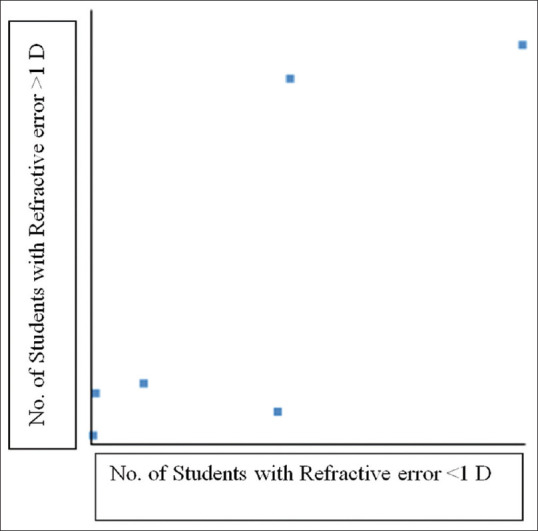
The prevalence of normal stereoacuity by titmus fly test was 93.18% with correction of refractive errors. Girls had slightly better stereopsis compared with boys. The subnormal stereoacuity was significantly associated with refractive error (P < 0.00001, significant at P < 0.05), unilateral refractive error (P < 0.00001, significant at P < 0.05), bilateral refractive error (P < 0.00001, significant at P < 0.05), anisometropia (P < 0.00001, significant at P < 0.05), ametropia (P < 0.00001, significant at P < 0.05), lower BCVA (P < 0.00001, significant at P < 0.05), hyperopia (P < 0.05, significant at P < 0.05), and heterophoria (P = 0.014, significant at P < 0.05). The subnormal stereoacuity was positively correlated with the magnitude of refractive error of the eyes.
This study underlines the significant impact of identification and correction of refractive errors and squints in school children. The measurement of stereoacuity will be of immense importance and must be included in the screening programs for children.
本研究旨在评估在校儿童低立体视敏度的患病率,并分析相关影响因素。
本前瞻性横断面研究共筛查了 2376 名无弱视和显斜视的在校儿童,使用同视机、Snellen 视力表、隐斜视检查、眼前节检查和眼底镜进行检查。患有显斜视、弱视(最佳矫正视力[BCVA]<6/18)、眼部创伤或手术史以及单眼儿童被排除在外。对未矫正或欠矫屈光不正的儿童进行睫状肌麻痹验光,然后用眼镜矫正再次评估立体视锐度。
经矫正屈光不正后,同视机检查正常立体视敏度的患病率为 93.18%。与男孩相比,女孩的立体视锐度略好。低立体视敏度与屈光不正(P<0.00001,P<0.05 有统计学意义)、单侧屈光不正(P<0.00001,P<0.05 有统计学意义)、双侧屈光不正(P<0.00001,P<0.05 有统计学意义)、屈光参差(P<0.00001,P<0.05 有统计学意义)、屈光不正(P<0.00001,P<0.05 有统计学意义)、低 BCVA(P<0.00001,P<0.05 有统计学意义)、远视(P<0.05,P<0.05 有统计学意义)和隐斜视(P=0.014,P<0.05 有统计学意义)显著相关。低立体视敏度与眼屈光误差的大小呈正相关。
本研究强调了识别和矫正在校儿童屈光不正和斜视的重要性。立体视锐度的测量非常重要,必须纳入儿童筛查计划。