Valenzuela-Vallejo Laura, Corredor-Orlandelli David, Alzate-Ricaurte Sergio, Hernández-Santamaría Valentina, Aguirre-Ruiz Juan Felipe, Peña-Peña Adwar
School of Medicine and Health Sciences, Universidad del Rosario, Bogotá 110111, Colombia.
Internal Medicine Department Fundación Cardioinfantil-LaCardio, Bogotá 110111, Colombia.
Clin Pract. 2021 Nov 26;11(4):914-918. doi: 10.3390/clinpract11040105.
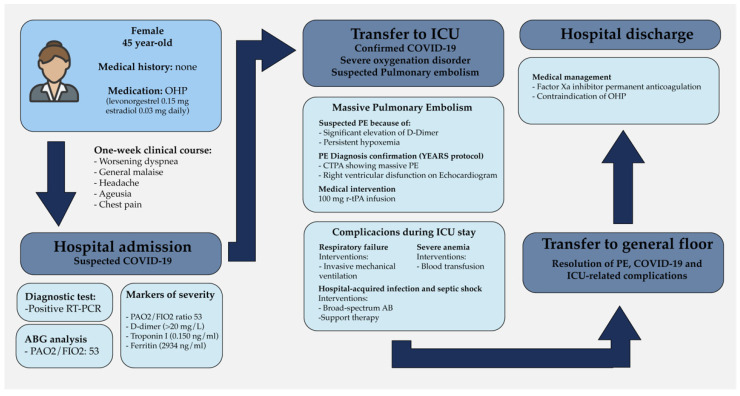
Coronavirus 19 disease (COVID-19) presents a highly variable clinical presentation and course, ranging from asymptomatic patients to rapidly progressive, fatal pneumonia. The known heterogeneous outcomes can affect both previously healthy patients and those with significant comorbidities, who develop clinical courses with possibly more multisystemic compromise. Likewise, the development of thrombotic phenomena during the acute course of the disease is associated with complications that worsen patient prognosis. We present a case report of a 45-year-old multiparous patient with a history of overweight and chronic use of oral hormonal contraception with low doses of levonorgestrel and estradiol as the only risk factors favoring the development of thrombotic events. During her outpatient COVID-19 clinical course, she developed massive pulmonary thromboembolism resulting in secondary obstructive shock, which required pharmacological thrombolysis. At discharge, hormonal contraception was considered contraindicated, and the patient was released from our institution with continued oral anticoagulant therapy. COVID-19 infection, contraceptive hormone therapy, and overweight are known risk factors for the development of thromboembolic events. The impact of their concomitance has not been studied to date. From our experience, we discuss the impact these risk factors have when present together and invite others to report similar cases.
冠状病毒病19(COVID-19)临床表现高度多变,从无症状患者到快速进展的致命性肺炎不等。已知的不同结局会影响既往健康的患者以及患有严重合并症的患者,后者可能会出现更多多系统功能受损的临床病程。同样,在疾病急性期出现的血栓形成现象与恶化患者预后的并发症相关。我们报告一例45岁经产妇病例,其有超重病史且长期使用低剂量左炔诺孕酮和雌二醇的口服激素避孕药,这是唯一有利于血栓形成事件发生的危险因素。在她的COVID-19门诊临床病程中,她发生了大面积肺血栓栓塞,导致继发性梗阻性休克,需要进行药物溶栓治疗。出院时,激素避孕被视为禁忌,患者出院时继续接受口服抗凝治疗。COVID-19感染、避孕激素治疗和超重是已知的血栓栓塞事件发生的危险因素。它们同时存在的影响迄今尚未得到研究。根据我们的经验,我们讨论了这些危险因素同时存在时的影响,并邀请其他人员报告类似病例。