Whitton Clare, Bogueva Diana, Marinova Dora, Phillips Clive J C
School of Population Health, Curtin University, Perth, WA 6102, Australia.
Curtin University Sustainable Policy (CUSP) Institute, Curtin University, GPO Box U1987, Perth, WA 6845, Australia.
Animals (Basel). 2021 Dec 6;11(12):3466. doi: 10.3390/ani11123466.
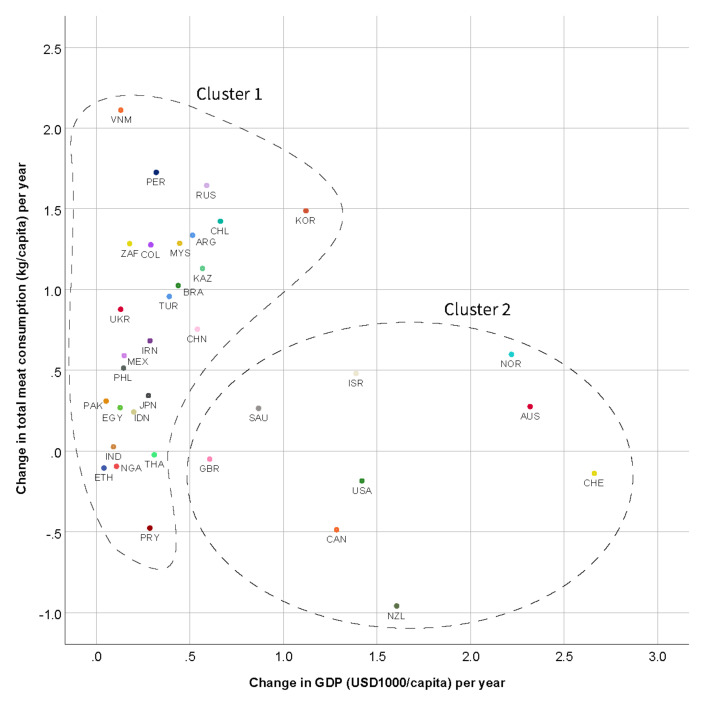
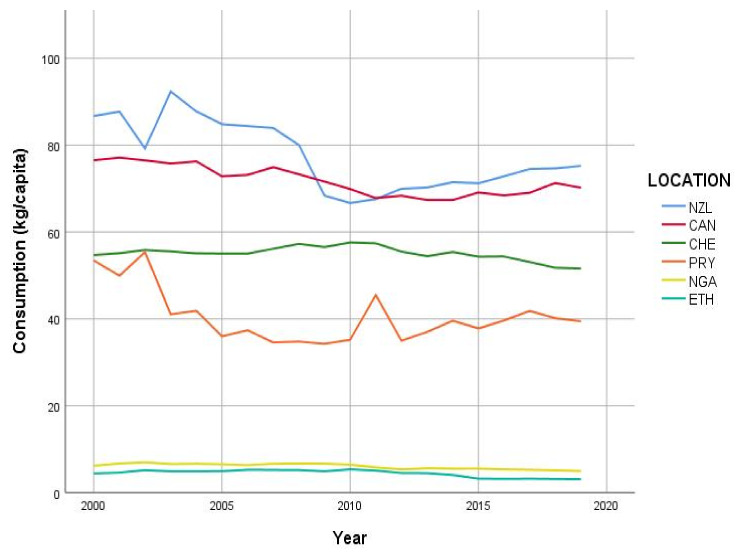
Growing prosperity, but also disease outbreaks, natural disasters, and consumer preferences are changing global meat consumption. We investigated the 2000-2019 trends in 35 countries monitored by the Food and Agriculture Organization and the Organisation for Economic Co-operation and Development. We also tested relationships with Gross Domestic Product (GDP). Several countries appeared to be reaching peak consumption of some meats, and three (New Zealand, Canada, and Switzerland) have reached this. Poultry consumption increased over time in most countries, and beef and mutton/lamb consumption decreased in many. Using cluster analysis, we divided countries into two clusters: one in which increases in GDP per capita matched increases in meat consumption; and a second one of nine countries, for which there was no association between per capita change in GDP and meat consumption. There was evidence of a tipping point around USD 40,000 of GDP per capita, after which increases in economic well-being do not lead to increased meat consumption.
经济的日益繁荣,以及疾病爆发、自然灾害和消费者偏好的变化,正在改变全球肉类消费格局。我们研究了由联合国粮食及农业组织和经济合作与发展组织监测的35个国家在2000年至2019年期间的趋势。我们还测试了肉类消费与国内生产总值(GDP)之间的关系。几个国家似乎正达到某些肉类的消费峰值,其中三个国家(新西兰、加拿大和瑞士)已经达到这一峰值。在大多数国家,家禽消费量随时间增加,而在许多国家牛肉和羊肉消费量下降。通过聚类分析,我们将这些国家分为两类:一类是人均GDP的增长与肉类消费的增长相匹配;另一类是九个国家,其人均GDP变化与肉类消费之间没有关联。有证据表明,人均GDP达到约4万美元左右存在一个临界点,超过这个临界点后,经济福祉的增加并不会导致肉类消费的增加。