Lungulescu Eduard-Marius, Setnescu Radu, Pătroi Eros A, Lungu Magdalena V, Pătroi Delia, Ion Ioana, Fierăscu Radu-Claudiu, Șomoghi Raluca, Stan Miruna, Nicula Nicoleta-Oana
National Institute for Research and Development in Electrical Engineering ICPE-CA, 313 Splaiul Unirii, 030138 Bucharest, Romania.
Department of Advanced Technologies, Faculty of Sciences and Arts, Valahia University of Târgoviște, 13 Aleea Sinaia, 130004 Targoviste, Romania.
Nanomaterials (Basel). 2021 Dec 14;11(12):3388. doi: 10.3390/nano11123388.
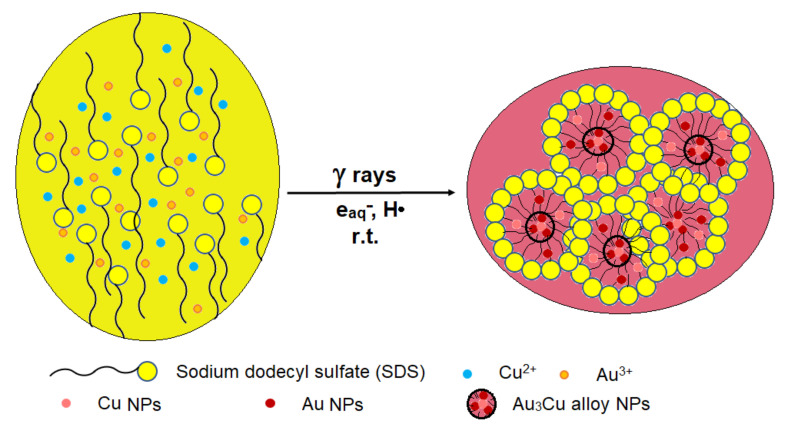
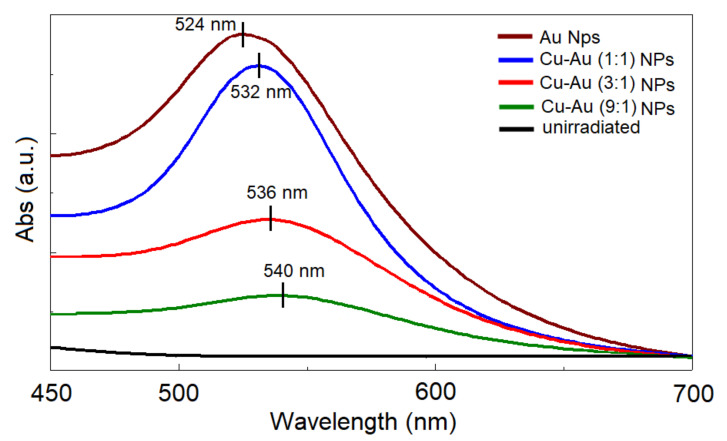
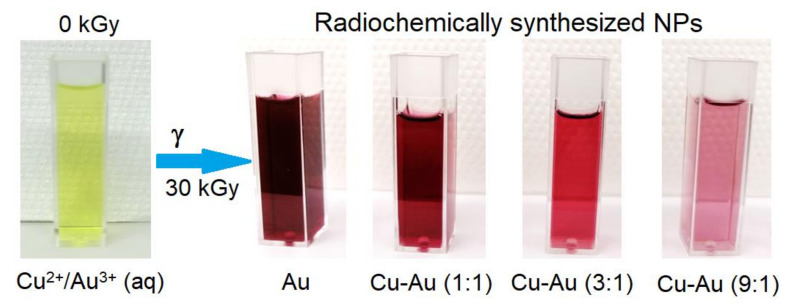
The use of nanotechnologies in the applied biomedical sciences can offer a new way to treat infections and disinfect surfaces, materials, and products contaminated with various types of viruses, bacteria, and fungi. The Cu-Au nanoparticles (NPs) were obtained by an eco-friendly method that allowed the obtaining in a one-step process of size controlled, well dispersed, fully reduced, highly stable NPs at very mild conditions, using high energy ionizing radiations. The gamma irradiation was performed in an aqueous system of Cu/Au/Sodium Dodecyl Sulfate (SDS)/Ethylene Glycol. After irradiation, the change of color to ruby-red was the first indicator for the formation of NPs. Moreover, the UV-Vis spectra showed a maximum absorption peak between 524 and 540 nm, depending on the copper amount. The Cu-Au NPs presented nearly spherical shapes, sizes between 20 and 90 nm, and a zeta potential of about -44 mV indicating a good electrostatic stability. The biocidal properties performed according to various standards applied in the medical area, in dirty conditions, showed a 5 lg reduction for , , and , a 5 lg reduction for both enveloped and non-enveloped viruses such as Adenovirus type 5, Murine Norovirus, and human Coronavirus 229E, and a 4 lg reduction for , respectively. Thus, the radiochemically synthesized Cu-Au alloy NPs proved to have high biocide efficiency against the tested bacteria, fungi, and viruses (both encapsulated and non-encapsulated). Therefore, these nanoparticle solutions are suitable to be used as disinfectants in the decontamination of hospital surfaces or public areas characterized by high levels of microbiological contamination.
纳米技术在应用生物医学科学中的应用可以为治疗感染以及对被各种病毒、细菌和真菌污染的表面、材料和产品进行消毒提供一种新方法。铜金纳米颗粒(NPs)是通过一种环保方法获得的,该方法能够在非常温和的条件下,利用高能电离辐射,通过一步法获得尺寸可控、分散良好、完全还原且高度稳定的纳米颗粒。γ辐照在铜/金/十二烷基硫酸钠(SDS)/乙二醇的水体系中进行。辐照后,颜色变为红宝石红色是纳米颗粒形成的第一个指标。此外,紫外可见光谱显示,根据铜含量的不同,最大吸收峰在524至540纳米之间。铜金纳米颗粒呈现近球形,尺寸在20至90纳米之间,ζ电位约为-44毫伏,表明具有良好的静电稳定性。根据医学领域应用的各种标准在脏污条件下进行的杀菌性能测试表明,对 、 和 有5个对数级的减少,对包膜和非包膜病毒如5型腺病毒、小鼠诺如病毒和人冠状病毒229E有5个对数级的减少,对 分别有4个对数级的减少。因此,放射化学合成的铜金合金纳米颗粒被证明对测试的细菌、真菌和病毒(包括包膜和非包膜病毒)具有高杀菌效率。因此,这些纳米颗粒溶液适用于在医院表面或微生物污染程度高的公共区域去污中用作消毒剂。