Wirth Nicolas T, Nikel Pablo I
The Novo Nordisk Foundation Center for Biosustainability, Technical University of Denmark, 2800 Kgs. Lyngby, Denmark.
Chem Catal. 2021 Nov 18;1(6):1234-1259. doi: 10.1016/j.checat.2021.09.002.
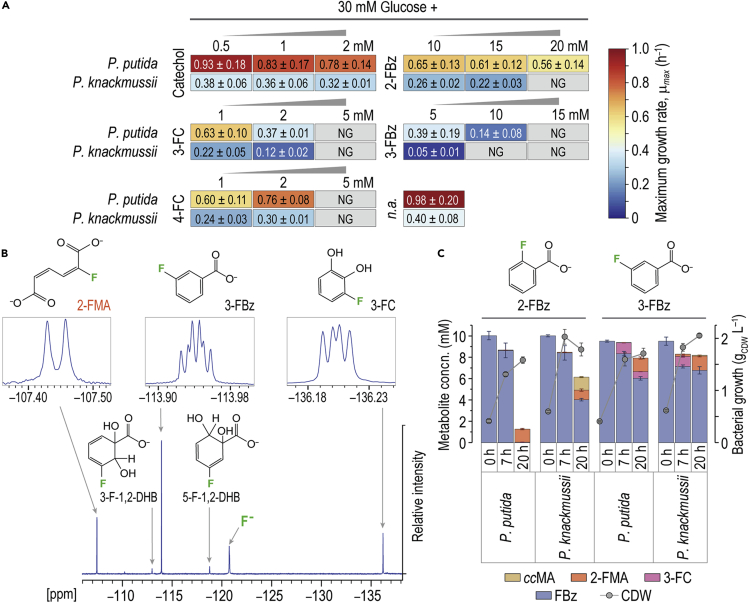
The wealth of bio-based building blocks produced by engineered microorganisms seldom include halogen atoms. Muconate is a platform chemical with a number of industrial applications that could be broadened by introducing fluorine atoms to tune its physicochemical properties. The soil bacterium naturally assimilates benzoate via the -cleavage pathway with ,-muconate as intermediate. Here, we harnessed the native enzymatic machinery (encoded within the and gene clusters) to provide catalytic access to 2-fluoro-,-muconate (2-FMA) from fluorinated benzoates. The reactions in this pathway are highly imbalanced, leading to accumulation of toxic intermediates and limited substrate conversion. By disentangling regulatory patterns of and in response to fluorinated effectors, metabolic activities were adjusted to favor 2-FMA biosynthesis. After implementing this combinatorial approach, engineered . converted 3-fluorobenzoate to 2-FMA at the maximum theoretical yield. Hence, this study illustrates how synthetic biology can expand the diversity of nature's biochemical catalysis.
工程微生物产生的大量生物基构件很少含有卤素原子。粘康酸是一种具有多种工业应用的平台化学品,通过引入氟原子来调节其物理化学性质,其应用范围可能会扩大。土壤细菌通过以γ-粘康酸为中间体的β-裂解途径自然同化苯甲酸。在这里,我们利用天然酶机制(由基因簇和基因簇编码)从氟化苯甲酸催化生成2-氟-γ-粘康酸(2-FMA)。该途径中的反应高度不平衡,导致有毒中间体的积累和底物转化率有限。通过解开和对氟化效应物的调控模式,调节代谢活性以促进2-FMA的生物合成。实施这种组合方法后,工程化的……以最大理论产率将3-氟苯甲酸转化为2-FMA。因此,本研究说明了合成生物学如何能够扩展自然界生化催化的多样性。