Biomedical Signal Processing & AI research group, Digital Health Section, DTU Health Tech, Technical University of Denmark, Lyngby.
Section of Surgical Pathophysiology 7621, Rigshospitalet, Copenhagen
Acta Orthop. 2022 Jan 3;93:117-123. doi: 10.2340/17453674.2021.843.
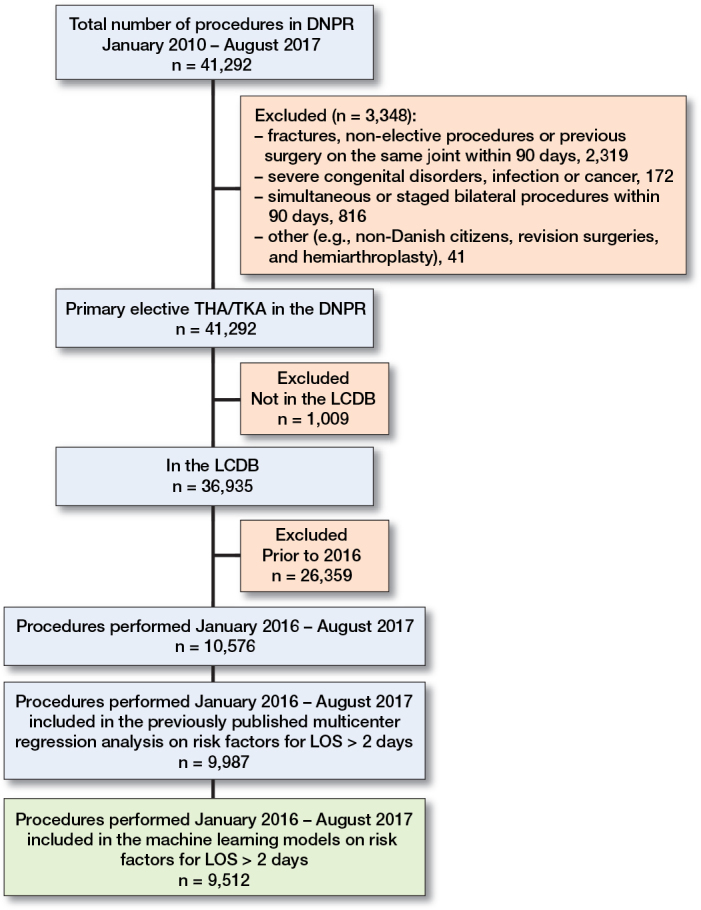
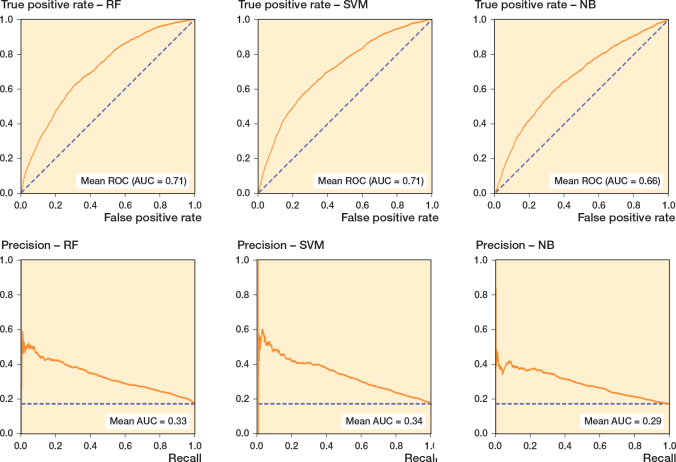
Background and purpose: Prediction of postoperative outcomes and length of hospital stay (LOS) of patients is vital for allocation of healthcare resources. We investigated the performance of prediction models based on machinelearning algorithms compared with a previous risk stratification model using traditional multiple logistic regression, for predicting the risk of a LOS of > 2 days after fast-track total hip and knee replacement. Patients and methods: 3 different machine learning classifiers were trained on data from the Lundbeck Centre for Fast-track Hip and Knee Replacement Database (LCDB) collected from 9,512 patients between 2016 and 2017. The chosen classifiers were a random forest classifier (RF), a support vector machine classifier with a polynomial kernel (SVM), and a multinomial Naïve-Bayes classifier (NB). Results: Comparing performance measures of the classifiers with the traditional model revealed that all the models had a similar performance in terms of F1 score, accuracy, sensitivity, specificity, area under the receiver operating curve (AUC), and area under the precision-recall curve (AUPRC). A feature importance analysis of the RF classifier found hospital, age, use of walking aid, living alone, and joint operated on to be the most relevant input features. None of the classifiers reached a clinically relevant performance with the input data from the LCDB. Interpretation: Despite the promising prospects of machine-learning practices for disease and risk prediction, none of the machine learning models tested outperformed the traditional multiple regression model in predicting which patients in this cohort had a LOS > 2 days.
预测患者的术后结果和住院时间(LOS)对于医疗资源的分配至关重要。我们研究了基于机器学习算法的预测模型与使用传统多逻辑回归的先前风险分层模型相比,在预测快速通道全髋关节和膝关节置换后 LOS 超过 2 天的风险方面的表现。
我们在 2016 年至 2017 年间从 Lundbeck 快速通道髋关节和膝关节置换数据库(LCDB)中收集了 9512 名患者的数据,并对 3 种不同的机器学习分类器进行了训练。选择的分类器包括随机森林分类器(RF)、具有多项式核的支持向量机分类器(SVM)和多项式朴素贝叶斯分类器(NB)。
将分类器的性能衡量指标与传统模型进行比较后发现,所有模型在 F1 评分、准确性、敏感性、特异性、接收器操作特征曲线下面积(AUC)和精度-召回曲线下面积(AUPRC)方面的性能均相似。RF 分类器的特征重要性分析发现,医院、年龄、使用助行器、独居和手术关节是最相关的输入特征。
尽管机器学习在疾病和风险预测方面具有广阔的前景,但在所测试的机器学习模型中,没有一种能够比传统的多元回归模型更好地预测该队列中哪些患者的 LOS 超过 2 天。