Ordóñez-Díaz María Dolores, Gil-Campos Mercedes, Flores-Rojas Katherine, Muñoz-Villanueva María Carmen, Mesa María Dolores, de la Torre-Aguilar María José, Gil Ángel, Pérez-Navero Juan Luis
Unit of Neonatology, Department of Paediatrics, Maimonides Biomedical Research Institute of Cordoba, Reina Sofia Hospital, University of Córdoba, Córdoba, Spain.
Unit of Metabolism and Paediatric Research, Maimonides Biomedical Research Institute of Cordoba, Reina Sofia University Hospital, University of Córdoba, Córdoba, Spain.
Front Nutr. 2021 Dec 21;8:793862. doi: 10.3389/fnut.2021.793862. eCollection 2021.
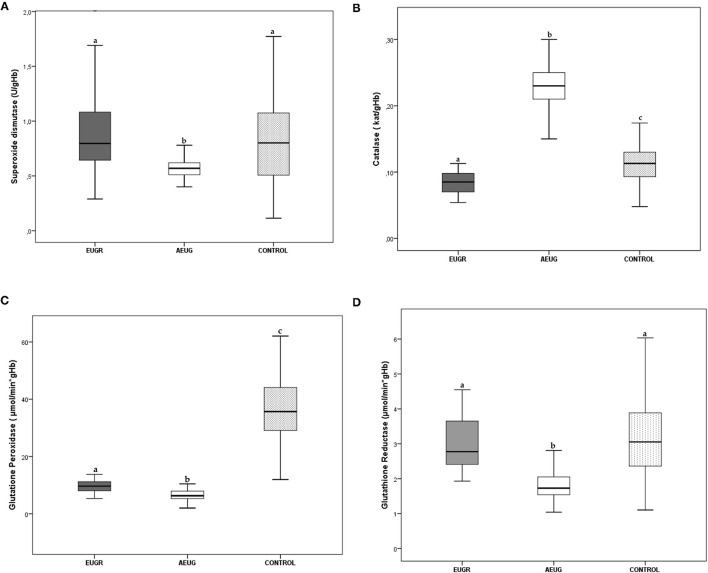
An impaired antioxidant status has been described during foetal growth restriction (FGR). Similarly, the antioxidant defence system can be compromised in preterm children with extrauterine growth restriction (EUGR). The aim of this prospective study was to evaluate the antioxidant status in prepubertal children with a history of prematurity without FGR, with and without EUGR, compared to a healthy group. In total, 211 children were recruited and classified into three groups: 38 with a history of prematurity and EUGR; 50 with a history of prematurity and adequate extrauterine growth (AEUG); and 123 control children born at term. Catalase (CAT), superoxide dismutase (SOD), glutathione peroxidase (GPx) and glutathione reductase (GR) activities were assessed in lysed erythrocytes with spectrophotometric methods. Plasma levels of the antioxidants α-tocopherol, retinol and β-carotene were determined through solvent extraction and ultra-high-pressure liquid chromatography coupled to mass spectrometry. Children with the antecedent of EUGR and prematurity had lower CAT activity than the other two groups and lower GPx activity than the control children. Lower SOD, GPx and GR activities were observed in the AEUG group compared to the controls. However, higher concentrations of α-tocopherol and β-carotene were found in the EUGR group compared to the other groups; retinol levels were also higher in EUGR than in AEUG children. In EUGR and AEUG children, enzymatic antioxidant activities and plasma antioxidants were associated with metabolic syndrome components and pro-inflammatory biomarkers. This study reveals, for the first time, that the EUGR condition and prematurity appear to be linked to an impairment of the antioxidant defence status, which might condition an increased risk of adverse metabolic outcomes later in life.
胎儿生长受限(FGR)期间曾有抗氧化状态受损的描述。同样,宫外生长受限(EUGR)的早产儿的抗氧化防御系统也可能受到损害。本前瞻性研究的目的是评估无FGR的早产史青春期前儿童,有或无EUGR情况下的抗氧化状态,并与健康组进行比较。总共招募了211名儿童并分为三组:38名有早产和EUGR病史;50名有早产和宫外生长正常(AEUG)病史;123名足月出生的对照儿童。采用分光光度法评估裂解红细胞中的过氧化氢酶(CAT)、超氧化物歧化酶(SOD)、谷胱甘肽过氧化物酶(GPx)和谷胱甘肽还原酶(GR)活性。通过溶剂萃取和超高压液相色谱-质谱联用测定抗氧化剂α-生育酚、视黄醇和β-胡萝卜素的血浆水平。有EUGR和早产史的儿童的CAT活性低于其他两组,GPx活性低于对照儿童。与对照组相比,AEUG组的SOD、GPx和GR活性较低。然而,与其他组相比,EUGR组的α-生育酚和β-胡萝卜素浓度较高;EUGR组的视黄醇水平也高于AEUG儿童。在EUGR和AEUG儿童中,酶促抗氧化活性和血浆抗氧化剂与代谢综合征组分及促炎生物标志物相关。本研究首次揭示,EUGR状况和早产似乎与抗氧化防御状态受损有关,这可能会增加日后生活中不良代谢结局的风险。