College of Statistics and Data Science, Faculty of Science, Beijing University of Technology, Beijing, China.
Center for Applied Statistics, School of Statistics, Renmin University of China, Beijing, China.
BMJ Glob Health. 2022 Jan;7(1). doi: 10.1136/bmjgh-2021-007109.
It has been reported that strict non-pharmaceutical measures can significantly reduce the incidence and mortality of respiratory and intestinal infectious diseases during the COVID-19 pandemic, but there are limited reports on the impact in terms of the rates of zoonotic diseases.
We extracted the incidence and mortality data of eight notifiable infectious zoonotic diseases from the website of the National Health Commission of the People's Republic of China for the period of January 2015 to April 2021.
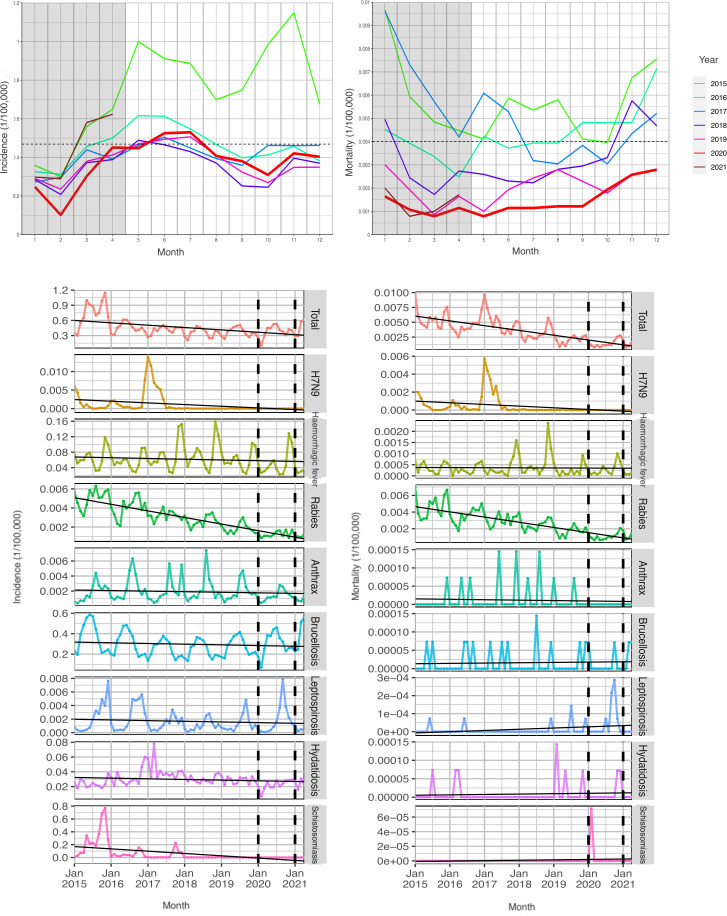
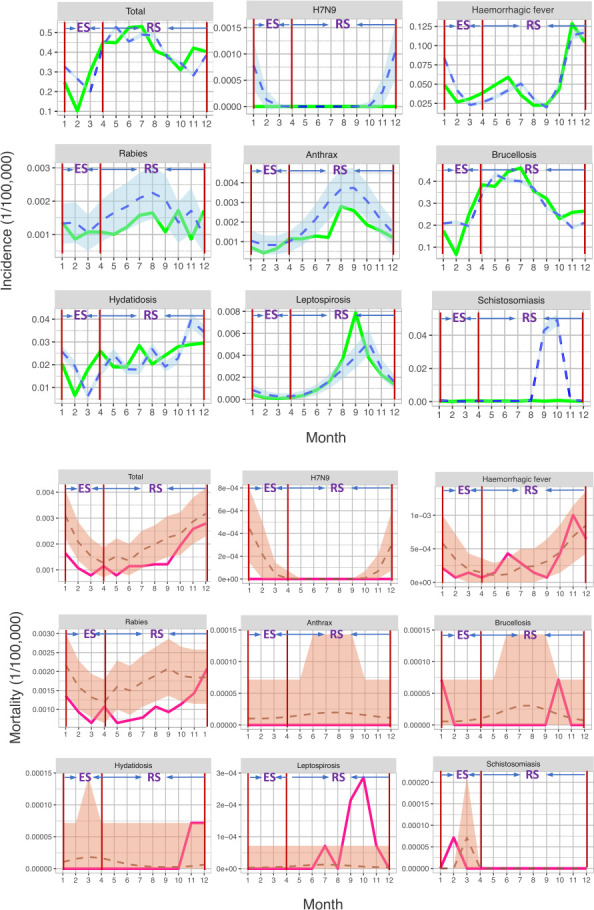
First, the overall incidence of zoonotic diseases decreased from 0.3714 per 100 000 in 2015-2019 to 0.2756 in 2020 (25.79% reduction, p<0.001); however, a dramatic increase in activity was seen in 2021 compared with 2020 (0.4478 per 100 000 in 2021, 62.47% increase, p<0.001). Anthrax, brucellosis, leptospirosis and hydatid disease exhibited significant upward trends in 2021. Second, analysed further by stages, the monthly incidence in the routine stage (from May to December 2020) was much higher than that in the emergency stage of the COVID-19 (from January to April 2020) (55.33% increase, p<0.001). We also found that the monthly observed incidence was significantly lower than the predicted incidence of a 10.29% reduction in the emergency stage. Third, no differences were seen in mortality between 2021 and 2020, while a significant decline was found in 2020 compared with the previous 5 years (72.70%, p<0.001).
Strict containment and feasible suppression strategies during the 2020 period of the COVID-19 pandemic had positive impacts on the overall incidence of zoonotic diseases in China. However, anthrax, brucellosis, leptospirosis and hydatid diseases might increase with the relaxation of non-pharmacological interventions in 2021.
据报道,在 COVID-19 大流行期间,严格的非药物措施可以显著降低呼吸道和肠道传染病的发病率和死亡率,但关于人畜共患病发病率的影响的报告有限。
我们从中华人民共和国国家卫生健康委员会网站上提取了 2015 年 1 月至 2021 年 4 月期间 8 种法定报告的传染性动物源性疾病的发病率和死亡率数据。
首先,动物源性疾病的总发病率从 2015-2019 年的 0.3714/100000 下降到 2020 年的 0.2756/100000(下降 25.79%,p<0.001);然而,与 2020 年相比,2021 年的活动急剧增加(2021 年为 0.4478/100000,增加 62.47%,p<0.001)。炭疽、布鲁氏菌病、钩端螺旋体病和包虫病在 2021 年呈明显上升趋势。其次,进一步按阶段分析,COVID-19 紧急阶段(2020 年 1 月至 4 月)的常规阶段(2020 年 5 月至 12 月)的每月发病率明显高于紧急阶段(COVID-19 紧急阶段的每月发病率增加 55.33%,p<0.001)。我们还发现,紧急阶段的预测发病率下降了 10.29%,而实际每月观察到的发病率明显低于预测发病率。第三,2021 年和 2020 年的死亡率没有差异,而 2020 年与前 5 年相比死亡率显著下降(72.70%,p<0.001)。
在 2020 年 COVID-19 大流行期间实施严格的遏制和可行的抑制策略对中国动物源性疾病的总体发病率产生了积极影响。然而,炭疽、布鲁氏菌病、钩端螺旋体病和包虫病可能会随着 2021 年非药物干预的放松而增加。