Human Systems Engineering (MMS), Fraunhofer Institute for Communication, Information Processing and Ergonomics (FKIE), Zanderstr. 5, 53111, Bonn, Germany.
Hochschule Döpfer University of Applied Sciences, Cologne, Germany.
Exp Brain Res. 2022 Feb;240(2):651-663. doi: 10.1007/s00221-021-06303-5. Epub 2022 Jan 7.
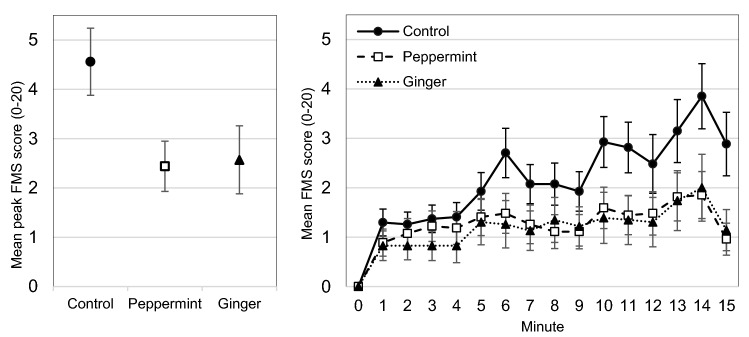
Visually induced motion sickness (VIMS) is a common side-effect of exposure to virtual reality (VR). Its unpleasant symptoms may limit the acceptance of VR technologies for training or clinical purposes. Mechanical stimulation of the mastoid and diverting attention to pleasant stimuli-like odors or music have been found to ameliorate VIMS. Chewing gum combines both in an easy-to-administer fashion and should thus be an effective countermeasure against VIMS. Our study investigated whether gustatory-motor stimulation by chewing gum leads to a reduction of VIMS symptoms. 77 subjects were assigned to three experimental groups (control, peppermint gum, and ginger gum) and completed a 15-min virtual helicopter flight, using a VR head-mounted display. Before and after VR exposure, we assessed VIMS with the Simulator Sickness Questionnaire (SSQ), and during the virtual flight once every minute with the Fast Motion Sickness Scale (FMS). Chewing gum (peppermint gum: M = 2.44, SD = 2.67; ginger gum: M = 2.57, SD = 3.30) reduced the peak FMS scores by 2.05 (SE = 0.76) points as compared with the control group (M = 4.56, SD = 3.52), p < 0.01, d = 0.65. Additionally, taste ratings correlated slightly negatively with both the SSQ and the peak FMS scores, suggesting that pleasant taste of the chewing gum is associated with less VIMS. Thus, chewing gum may be useful as an affordable, accepted, and easy-to-access way to mitigate VIMS in numerous applications like education or training. Possible mechanisms behind the effect are discussed.
视觉诱导运动病 (VIMS) 是暴露于虚拟现实 (VR) 时的常见副作用。其不愉快的症状可能会限制 VR 技术在培训或临床应用中的接受度。已经发现,对乳突的机械刺激和将注意力转移到令人愉悦的刺激(如气味或音乐)可以减轻 VIMS。咀嚼口香糖结合了这两种方法,易于管理,因此应该是对抗 VIMS 的有效对策。我们的研究调查了咀嚼口香糖引起的味觉-运动刺激是否会导致 VIMS 症状减轻。77 名受试者被分配到三个实验组(对照组、薄荷味口香糖组和生姜味口香糖组),并使用 VR 头戴式显示器完成了 15 分钟的虚拟直升机飞行。在 VR 暴露前后,我们使用模拟器疾病问卷 (SSQ) 评估 VIMS,在虚拟飞行期间,每分钟评估一次快速运动病量表 (FMS)。与对照组相比(M=4.56,SD=3.52),咀嚼口香糖(薄荷味口香糖:M=2.44,SD=2.67;生姜味口香糖:M=2.57,SD=3.30)可使 FMS 评分峰值降低 2.05(SE=0.76)点,p<0.01,d=0.65。此外,味觉评分与 SSQ 和 FMS 评分峰值呈轻微负相关,表明咀嚼口香糖的宜人味道与 VIMS 较少相关。因此,咀嚼口香糖可能是一种在教育或培训等众多应用中减轻 VIMS 的经济实惠、可接受且易于获得的方法。讨论了背后的可能机制。