Alvis Lauren M, Douglas Robyn D, Shook Natalie J, Oosterhoff Benjamin
The Hackett Center for Mental Health, P.O. Box 130059, Houston, TX 77057 USA.
School of Nursing, University of Connecticut, Storrs Hall, Room 113B. 231 Glenbrook Road, Unit 4026, Storrs, CT 06269 USA.
Curr Psychol. 2022 Jan 3:1-12. doi: 10.1007/s12144-021-02670-y.
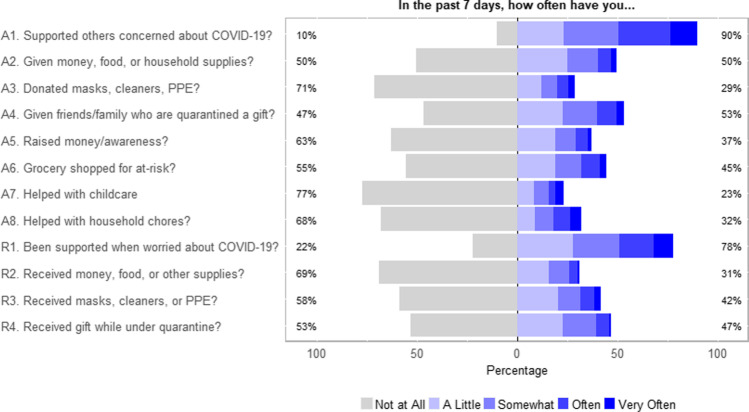
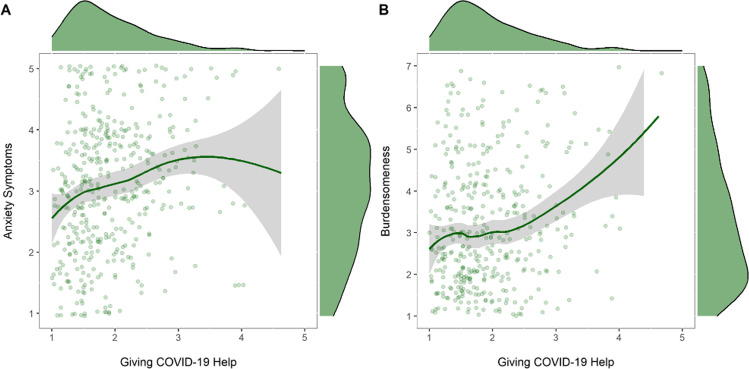
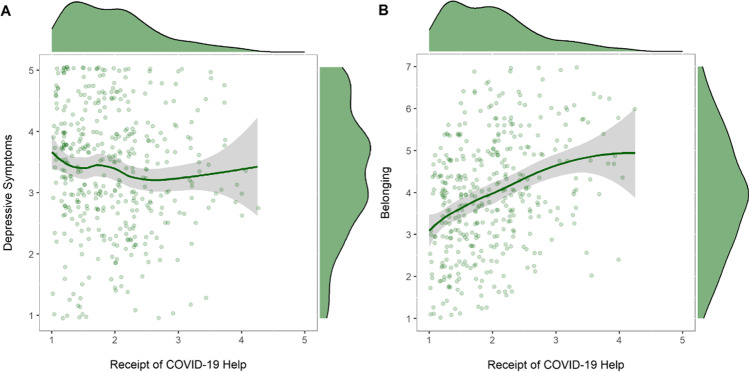
Natural disasters and times of crisis, such as the COVID-19 pandemic, are extremely stressful events, with severe mental health consequences. However, such events also provide opportunities for prosocial support between citizens, which may be related to mental health symptoms and interpersonal needs. We examined adolescents' prosocial experiences as both actors and recipients during the early stages of the COVID-19 pandemic and assessed whether these experiences were associated with indicators of mental health. Adolescents ( = 426; 78% female) aged 13 to 20 years ( = 16.43, = 1.10; 63.6% White, 12.9% Hispanic/Latinx, 8.5% Asian, 4.2% Black, 2.8% Native American) were recruited across the US in early April of 2020. Participants reported on their COVID-19 prosocial experiences (helping others, receiving help) and mental health (depressive symptoms, anxiety symptoms, burdensomeness, belongingness). Multiple regression models indicated greater engagement in COVID-19 prosocial behavior was associated with greater anxiety symptoms and greater burdensomeness. Receiving more COVID-19 help was associated with lower depressive symptoms and higher belongingness. Findings highlight the importance of furthering our understanding of the nuanced connections between prosocial experiences and adolescents' mental health to help inform post-pandemic recovery and relief efforts.
The online version contains supplementary material available at 10.1007/s12144-021-02670-y.
自然灾害和危机时期,如新冠疫情大流行,是极具压力的事件,会产生严重的心理健康后果。然而,此类事件也为公民之间的亲社会支持提供了机会,这可能与心理健康症状和人际需求有关。我们研究了青少年在新冠疫情大流行早期作为施助者和受助者的亲社会经历,并评估了这些经历是否与心理健康指标相关。2020年4月初在美国各地招募了13至20岁的青少年(n = 426;78%为女性)(M = 16.43,SD = 1.10;63.6%为白人,12.9%为西班牙裔/拉丁裔,8.5%为亚裔,4.2%为黑人,2.8%为美洲原住民)。参与者报告了他们在新冠疫情期间的亲社会经历(帮助他人、接受帮助)和心理健康状况(抑郁症状、焦虑症状、负担感、归属感)。多元回归模型表明,更多地参与新冠疫情期间的亲社会行为与更多的焦虑症状和更强的负担感相关。获得更多的新冠疫情期间的帮助与更低的抑郁症状和更高的归属感相关。研究结果凸显了进一步理解亲社会经历与青少年心理健康之间细微联系的重要性,以帮助为疫情后的恢复和救济工作提供信息。
在线版本包含可在10.1007/s12144-021-02670-y获取的补充材料。