Bui Thi Hong Thai, Tran Thi Minh Duc, Nguyen Thi Nhu Trang, Vu Thy Cam, Ngo Xuan Diep, Nguyen Thi Hang Phuong, Do Thi Le Hang
Faculty of Psychology, VNU University of Social Sciences and Humanities, Vietnam National University, Ha Noi, Vietnam.
Faculty of Sociology, VNU University of Social Sciences and Humanities, Vietnam National University, Ha Noi, Vietnam.
Health Psychol Behav Med. 2022 Jan 5;10(1):104-120. doi: 10.1080/21642850.2021.2019585. eCollection 2022.
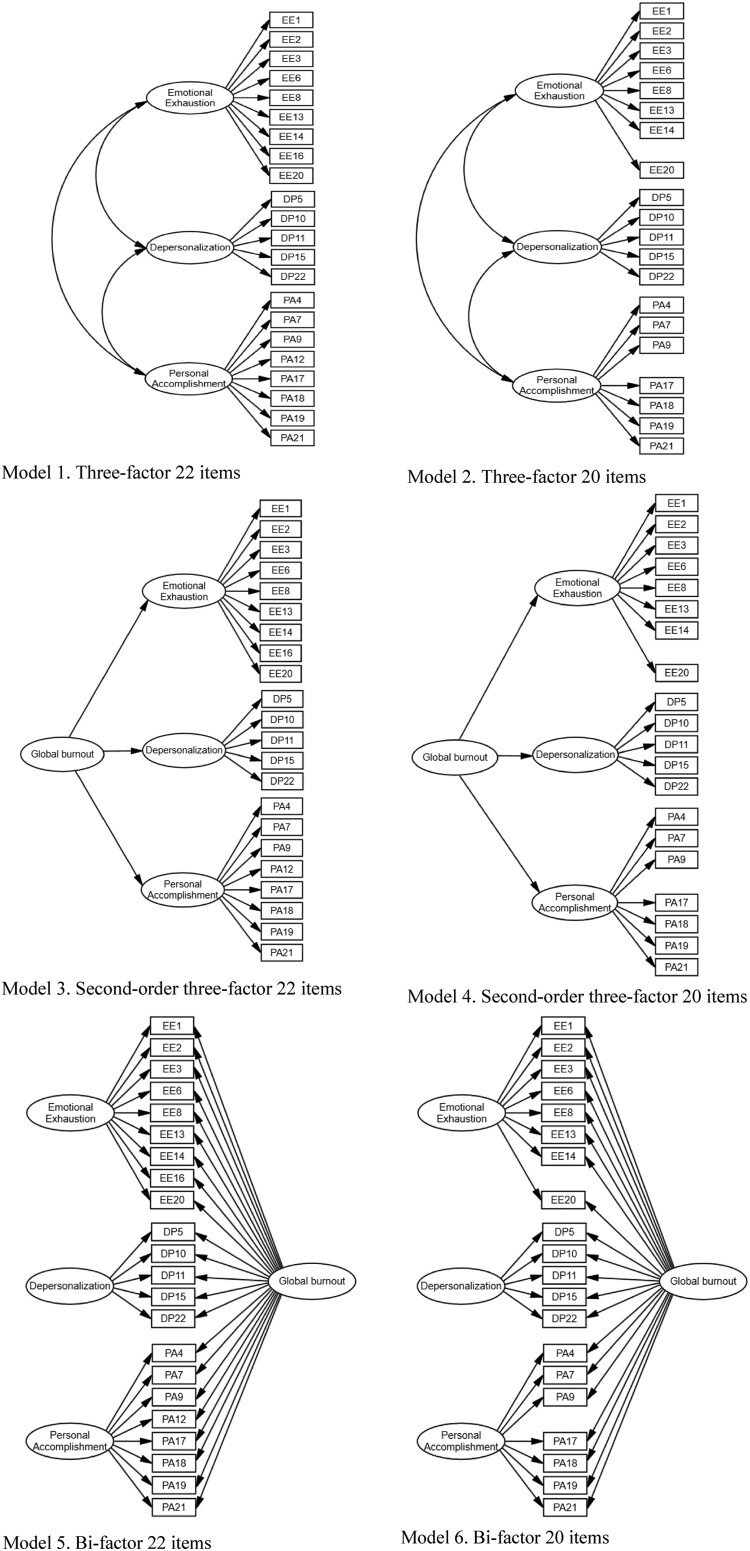
Despite its popularity, Maslach Burnout Inventory-Human Service Survey (MBI-HSS)'s factorial structure has been subject to considerable debate, and its measurement invariance (MI) is seldomly examined. This cross-sectional study aims at reassessing the most popularly suggested structures of this instrument, namely the 20- and 22-item three-factor model on Vietnamese healthcare professionals. It also examines the MI of MBI-HSS across genders, occupations, and mental health conditions.
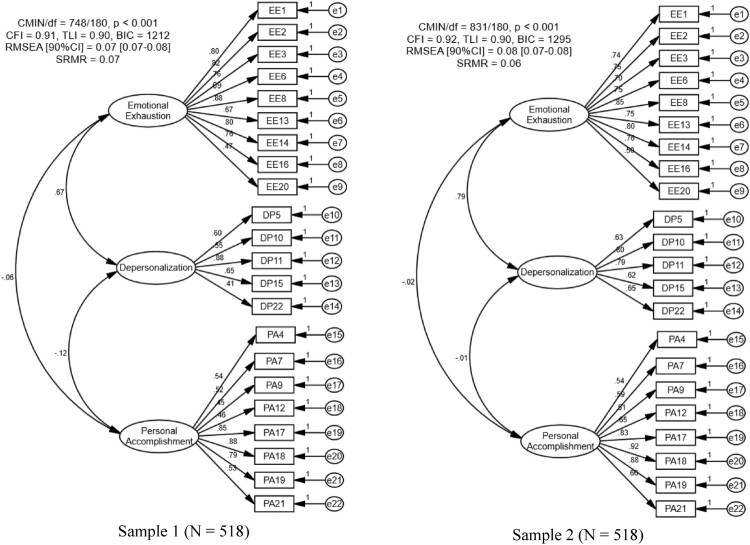
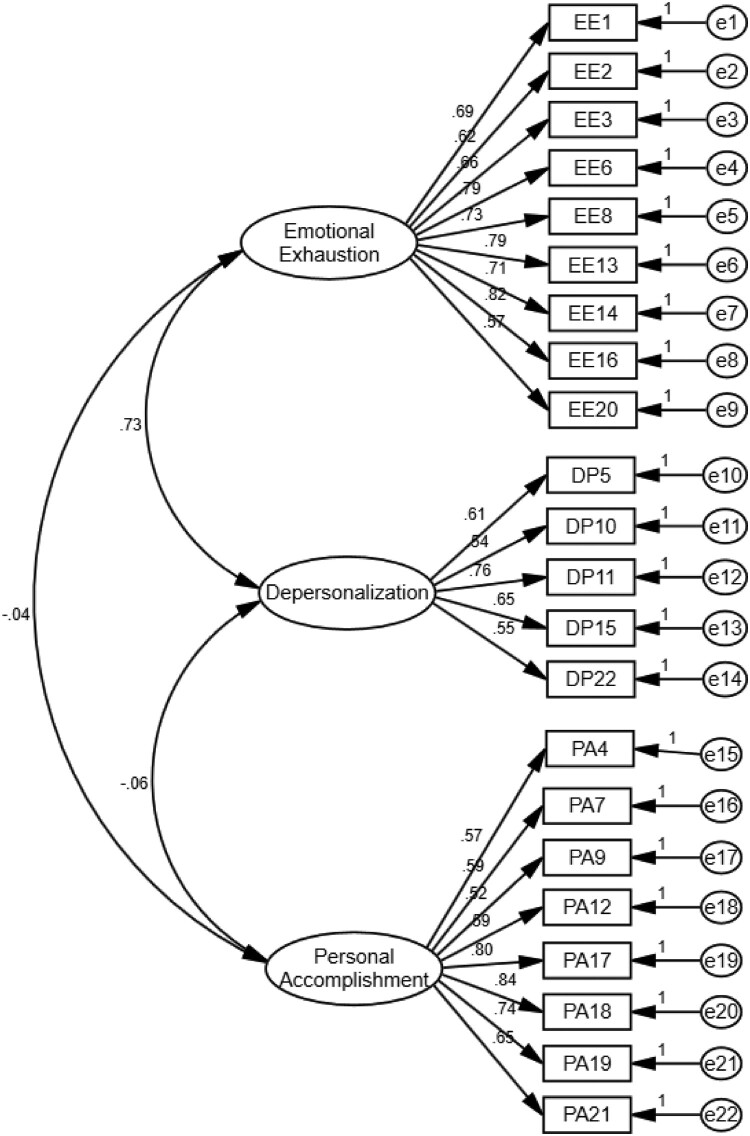
Self-administered questionnaires were sent out to 1500 doctors and nurses working at 15 hospitals in big cities in Vietnam in September and October 2020, and 1162 valid questionnaires were collected. The questionnaire consists of three sets of questions covering (1) demographic information of participants; (2) MBI-HSS questionnaire; and (3) The 21-item version of the Depression-Anxiety-Stress Scale. MBI-HSS scale was validated on Vietnamese sample for the first time; therefore, we used the repeated forward-backward procedure to translate this scale into Vietnamese. To examine which model best fits the data, a series of Confirmatory Factor Analysis (CFA) was used to test the model fit of correlated three-factor model, second-order hierarchical model, and bi-factor model. The reliability of the MBI-HSS was assessed using Cronbach's coefficients. Then, multiple-group CFA (MGCFA) was applied to determine whether the MBI-HSS has a similar structure between groups different in gender, occupation, and mental health condition.
Our findings confirmed that the 22-item MBI-HSS best fit the data, and this scale measures three distinct but related aspects of burnout, including Emotional Exhaustion, Depersonalization, and Personal Accomplishment. The MI of MBI-HSS across genders and occupations was also confirmed. However, data did not fit well with group at risk for common mental health disorders. It can be concluded that the Vietnamese version of MBI-HSS is a valid measure to assess burnout level of healthcare professionals in Vietnam who are not at risk for mental health disorders.
尽管马氏倦怠量表-人类服务调查(MBI-HSS)很受欢迎,但其因子结构一直备受争议,且很少有人检验其测量不变性(MI)。这项横断面研究旨在重新评估该工具最常被提及的结构,即针对越南医疗保健专业人员的20项和22项三因素模型。它还检验了MBI-HSS在性别、职业和心理健康状况方面的测量不变性。
2020年9月和10月,向越南大城市15家医院的1500名医生和护士发放了自填式问卷,共收集到1162份有效问卷。问卷包括三组问题,涵盖(1)参与者的人口统计学信息;(2)MBI-HSS问卷;以及(3)21项版的抑郁-焦虑-压力量表。MBI-HSS量表首次在越南样本上进行了验证;因此,我们采用反复的前后翻译程序将该量表翻译成越南语。为了检验哪种模型最适合数据,我们使用了一系列验证性因子分析(CFA)来测试相关三因素模型、二阶层次模型和双因素模型的模型拟合度。使用克朗巴哈系数评估MBI-HSS的信度。然后,应用多组CFA(MGCFA)来确定MBI-HSS在性别、职业和心理健康状况不同的组之间是否具有相似的结构。
我们的研究结果证实,22项的MBI-HSS最适合数据,该量表测量了倦怠的三个不同但相关的方面,包括情感耗竭、去个性化和个人成就感。MBI-HSS在性别和职业方面的测量不变性也得到了证实。然而,数据与常见心理健康障碍风险组不太拟合。可以得出结论,越南版的MBI-HSS是评估越南无心理健康障碍风险的医疗保健专业人员倦怠水平的有效工具。