Loera Barbara, Converso Daniela, Viotti Sara
Department of Psychology, University of Turin, Turin, Italy.
PLoS One. 2014 Dec 12;9(12):e114987. doi: 10.1371/journal.pone.0114987. eCollection 2014.
The Maslach Burnout Inventory (MBI) is the mainstream measure for burnout. However, its psychometric properties have been questioned, and alternative measurement models of the inventory have been suggested.
Different models for the number of items and factors of the MBI-HSS, the version of the Inventory for the Human Service sector, were tested in order to identify the most appropriate model for measuring burnout in Italy.
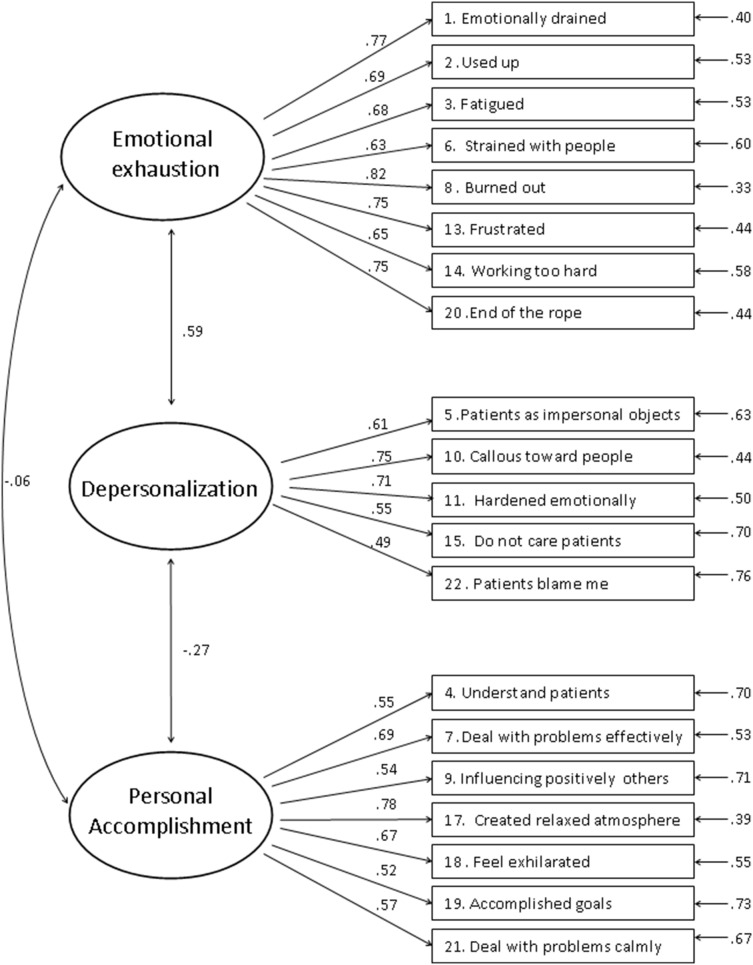
The study dataset consisted of a sample of 925 nurses. Ten alternative models of burnout were compared using confirmatory factor analysis. The psychometric properties of items and reliability of the MBI-HSS subscales were evaluated.
Item malfunctioning may confound the MBI-HSS factor structure. The analysis confirmed the factorial structure of the MBI-HSS with a three-dimensional, 20-item assessment.
The factorial structure underlying the MBI-HSS follows Maslach's definition when items are reduced from the original 22 to a 20-item set. Alternative models, either with fewer items or with an increased number of latent dimensions in the burnout structure, do not yield better results to justify redefining the item set or theoretically revising the syndrome construct.
马氏职业倦怠量表(MBI)是职业倦怠的主流测量工具。然而,其心理测量特性受到质疑,有人提出了该量表的替代测量模型。
对用于人类服务部门的MBI-HSS版本的项目数量和因子的不同模型进行测试,以确定在意大利测量职业倦怠的最合适模型。
研究数据集由925名护士组成。使用验证性因子分析比较了10种职业倦怠替代模型。评估了MBI-HSS项目的心理测量特性和分量表的信度。
项目功能失调可能会混淆MBI-HSS的因子结构。分析证实了MBI-HSS的因子结构为三维20项评估。
当项目从原来的22项减少到20项时,MBI-HSS的因子结构符合马氏的定义。在职业倦怠结构中,项目数量更少或潜在维度数量增加的替代模型,都不能产生更好的结果来证明重新定义项目集或从理论上修订综合征结构是合理的。