Taniguchi Yuta, Kuno Toshiki, Komiyama Jun, Adomi Motohiko, Suzuki Toshiki, Abe Toshikazu, Ishimaru Miho, Miyawaki Atsushi, Saito Makoto, Ohbe Hiroyuki, Miyamoto Yoshihisa, Imai Shinobu, Kamio Tadashi, Tamiya Nanako, Iwagami Masao
Graduate School of Comprehensive Human Sciences, University of Tsukuba, Tsukuba, Ibaraki, Japan.
Health Services Research and Development Center, University of Tsukuba, Tsukuba, Ibaraki, Japan.
Lancet Reg Health West Pac. 2022 Mar;20:100365. doi: 10.1016/j.lanwpc.2021.100365. Epub 2022 Jan 2.
COVID-19 has worse mortality than influenza in American and European studies, but evidence from the Western Pacific region is scarce.
Using a large-scale multicenter inpatient claims data in Japan, we identified individuals hospitalised with COVID-19 in 2020 or influenza in 2017-2020. We compared patient characteristics, supportive care, and in-hospital mortality, with multivariable logistic regression analyses for in-hospital mortality overall, by age group, and among patients with mechanical ventilation.
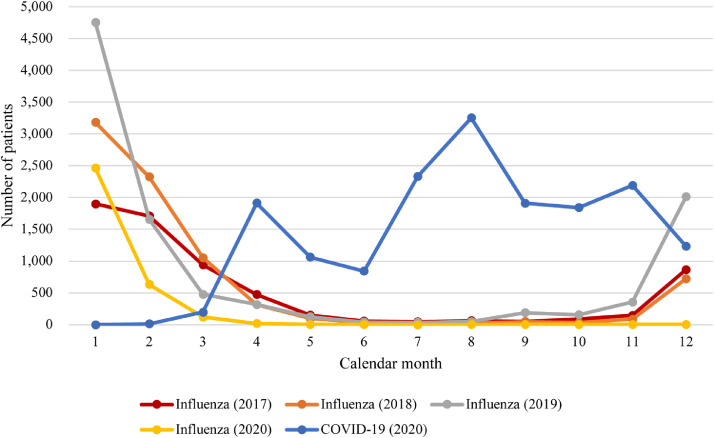
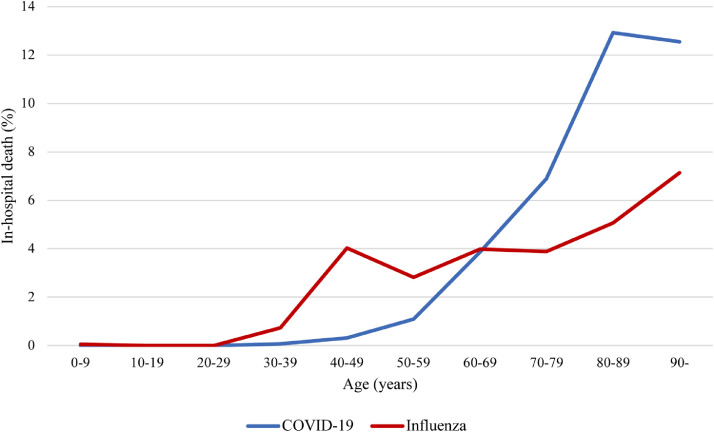
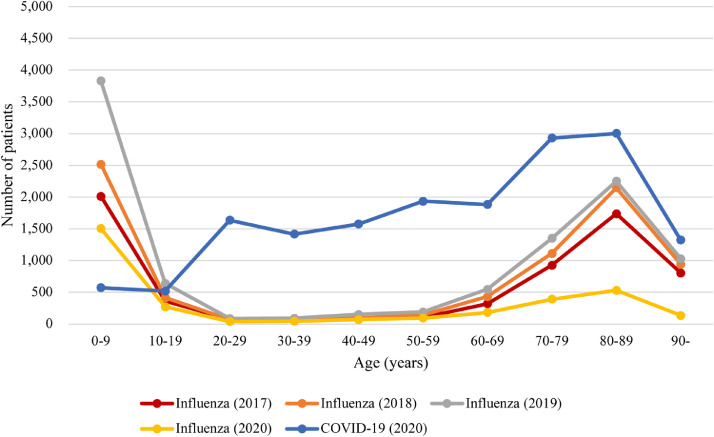
We identified 16,790 COVID-19 patients and 27,870 influenza patients, with the different age distribution (peak at 70-89 years in COVID-19 vs. bimodal peaks at 0-9 and 80-89 years in influenza). On admission, the use of mechanical ventilation was similar in both groups (1·4% vs. 1·4%) but higher in the COVID-19 group (3·3% vs. 2·5%; p<0·0001) during the entire hospitalisation. The crude in-hospital mortality was 5·1% (856/16,790) for COVID-19 and 2·8% (791/27,870) for influenza. Adjusted for potential confounders, the in-hospital mortality was higher for COVID-19 than for influenza (adjusted odds ratio [aOR] 1·83, 95% confidence interval [CI] 1·64-2·04). In age-stratified analyses, the aOR (95%CI) were 0·78 (0·56-1·08) and 2·05 (1·83-2·30) in patients aged 20-69 years and ≥70 years, respectively (p-for-interaction<0·0001). Among patients with mechanical ventilation, the aOR was 0·79 (0·59-1·05).
Patients hospitalised with COVID-19 in Japan were more likely to die than those with influenza. However, this was mainly driven by findings in older people, and there was no difference once mechanical ventilation was started.
Ministry of Health, Labour and Welfare of Japan (21AA2007).
在美国和欧洲的研究中,新冠病毒病(COVID-19)的死亡率高于流感,但西太平洋地区的相关证据较少。
利用日本大规模多中心住院患者索赔数据,我们确定了2020年因COVID-19住院的患者以及2017 - 2020年因流感住院的患者。我们比较了患者特征、支持性治疗和住院死亡率,并对总体、按年龄组以及机械通气患者的住院死亡率进行多变量逻辑回归分析。
我们确定了16790例COVID-19患者和27870例流感患者,年龄分布不同(COVID-19患者的年龄高峰在70 - 89岁,而流感患者的年龄高峰呈双峰分布,分别在0 - 9岁和80 - 89岁)。入院时,两组机械通气的使用率相似(1.4%对1.4%),但在整个住院期间,COVID-19组更高(3.3%对2.5%;p<0.0001)。COVID-19患者的粗住院死亡率为5.1%(856/16790),流感患者为2.8%(791/27870)。在对潜在混杂因素进行调整后,COVID-19患者的住院死亡率高于流感患者(调整后的优势比[aOR]为1.83,95%置信区间[CI]为1.64 - 2.04)。在按年龄分层的分析中,20 - 69岁和≥70岁患者的aOR(95%CI)分别为0.78(0.56 - 1.08)和2.05(1.83 - 2.30)(交互作用p值<0.0001)。在机械通气患者中,aOR为0.79(0.59 - 1.05)。
在日本,因COVID-19住院的患者比因流感住院的患者死亡可能性更大。然而,这主要是由老年人的情况驱动的,一旦开始机械通气,两者并无差异。
日本厚生劳动省(21AA2007)。