"The Protein Factory 2.0", Dipartimento di Biotecnologie e Scienze della Vita, Università degli Studi dell'Insubria, Via J.H. Dunant 3, 21100 Varese, Italy.
Dipartimento di Chimica, Materiali e Ingegneria Chimica "Giulio Natta", Politecnico di Milano, p.za L. da Vinci 32, 20133 Milano, Italy.
Int J Mol Sci. 2021 Dec 27;23(1):264. doi: 10.3390/ijms23010264.
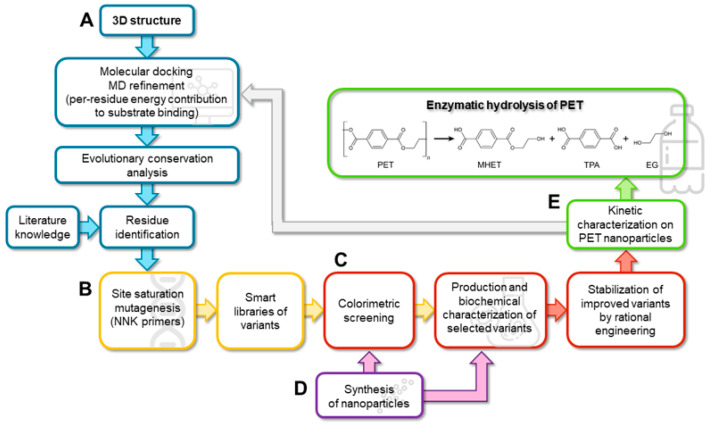
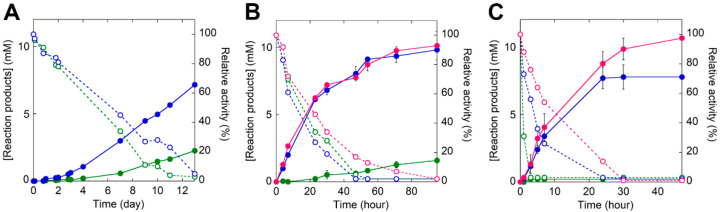
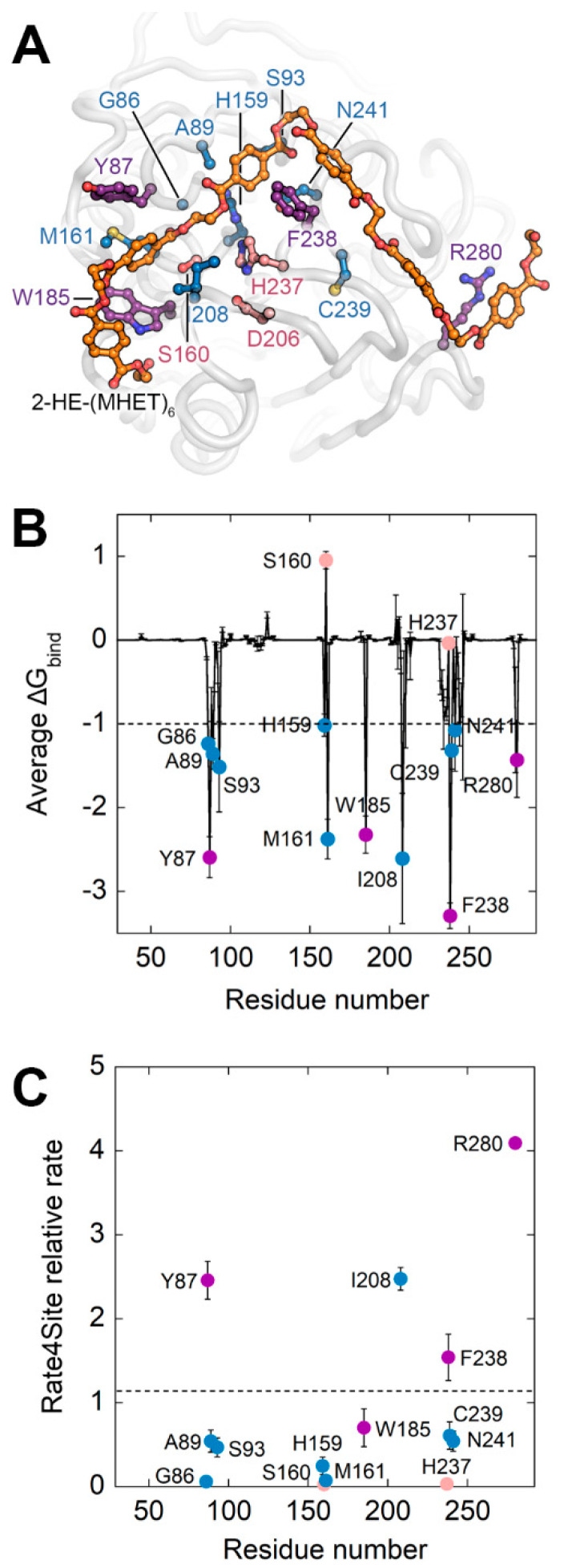
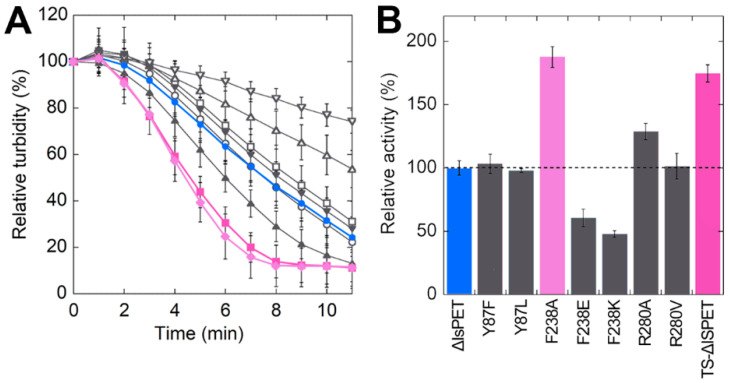
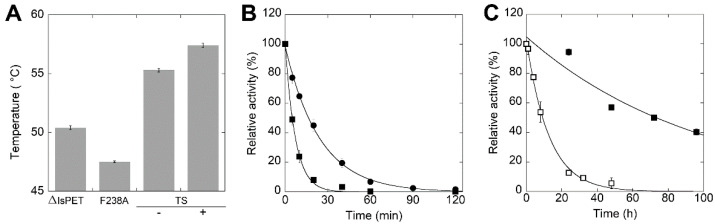
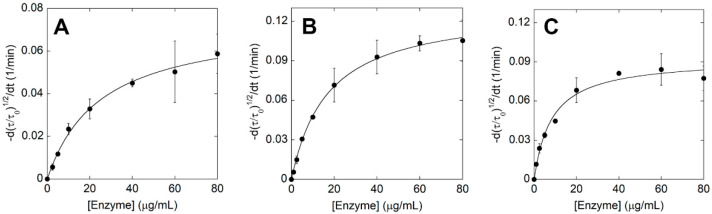
Enzymatic degradation is a promising green approach to bioremediation and recycling of the polymer poly(ethylene terephthalate) (PET). In the past few years, several PET-hydrolysing enzymes (PHEs) have been discovered, and new variants have been evolved by protein engineering. Here, we report on a straightforward workflow employing semi-rational protein engineering combined to a high-throughput screening of variant libraries for their activity on PET nanoparticles. Using this approach, starting from the double variant W159H/S238F of 201-F6 PETase, the W159H/F238A-ΔIsPET variant, possessing a higher hydrolytic activity on PET, was identified. This variant was stabilized by introducing two additional known substitutions (S121E and D186H) generating the TS-ΔIsPET variant. By using 0.1 mg mL of TS-ΔIsPET, 10.6 mM of degradation products were produced in 2 days from 9 mg mL PET microparticles (26% depolymerization yield). Indeed, TS-ΔIsPET allowed a massive degradation of PET nanoparticles (>80% depolymerization yield) in 1.5 h using only 20 μg of enzyme mL. The rationale underlying the effect on the catalytic parameters due to the F238A substitution was studied by enzymatic investigation and molecular dynamics/docking analysis. The present workflow is a well-suited protocol for the evolution of PHEs to help generate an efficient enzymatic toolbox for polyester degradation.
酶促降解是一种很有前途的绿色方法,可用于生物修复和回收聚合物聚对苯二甲酸乙二醇酯(PET)。在过去的几年中,已经发现了几种 PET 水解酶(PHEs),并通过蛋白质工程进化出了新的变体。在这里,我们报告了一种简单的工作流程,该流程结合了半理性蛋白质工程和 PET 纳米粒子变体文库的高通量筛选,以研究其对 PET 的活性。通过这种方法,从 201-F6 PETase 的双变体 W159H/S238F 出发,确定了具有更高 PET 水解活性的 W159H/F238A-ΔIsPET 变体。通过引入两个已知的替代物(S121E 和 D186H),该变体得到了稳定,产生了 TS-ΔIsPET 变体。使用 0.1 mg mL 的 TS-ΔIsPET,在 2 天内从 9 mg mL 的 PET 微球中产生了约 10.6 mM 的降解产物(~26%的解聚产率)。事实上,仅使用 20 μg mL 的酶,TS-ΔIsPET 就可以在 1.5 小时内使 PET 纳米颗粒发生大量降解(>80%的解聚产率)。通过酶学研究和分子动力学/对接分析,研究了 F238A 取代对催化参数的影响的基本原理。该工作流程是 PHE 进化的一种很好的方案,可以帮助生成有效的聚酯降解酶工具包。