Department of Neuroscience and Imaging, University G. d'Annunzio Chieti e Pescara, 66100 Chieti, Italy.
Robotics and Internet-of-Things Laboratory, Prince Sultan University, Riyadh 12435, Saudi Arabia.
Sensors (Basel). 2021 Dec 25;22(1):129. doi: 10.3390/s22010129.
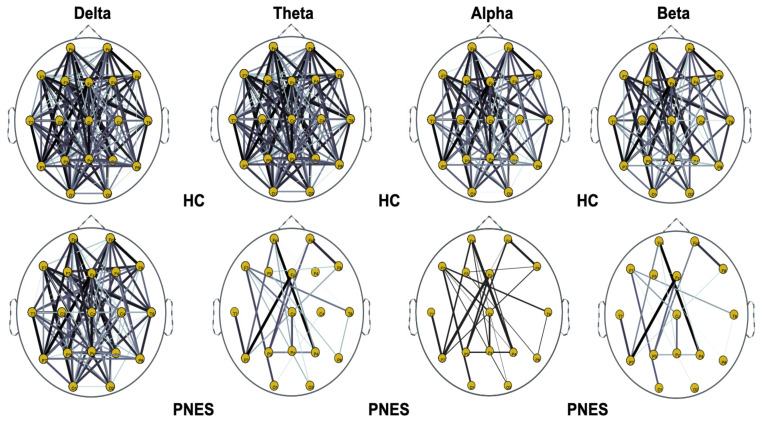
Until now, clinicians are not able to evaluate the Psychogenic Non-Epileptic Seizures (PNES) from the rest-electroencephalography (EEG) readout. No EEG marker can help differentiate PNES cases from healthy subjects. In this paper, we have investigated the power spectrum density (PSD), in resting-state EEGs, to evaluate the abnormalities in PNES affected brains. Additionally, we have used functional connectivity tools, such as phase lag index (PLI), and graph-derived metrics to better observe the integration of distributed information of regular and synchronized multi-scale communication within and across inter-regional brain areas. We proved the utility of our method after enrolling a cohort study of 20 age- and gender-matched PNES and 19 healthy control (HC) subjects. In this work, three classification models, namely support vector machine (SVM), linear discriminant analysis (LDA), and Multilayer perceptron (MLP), have been employed to model the relationship between the functional connectivity features (rest-HC versus rest-PNES). The best performance for the discrimination of participants was obtained using the MLP classifier, reporting a precision of 85.73%, a recall of 86.57%, an F1-score of 78.98%, and, finally, an accuracy of 91.02%. In conclusion, our results hypothesized two main aspects. The first is an intrinsic organization of functional brain networks that reflects a dysfunctional level of integration across brain regions, which can provide new insights into the pathophysiological mechanisms of PNES. The second is that functional connectivity features and MLP could be a promising method to classify rest-EEG data of PNES form healthy controls subjects.
到目前为止,临床医生还无法从其他脑电图(EEG)读数中评估心因性非癫痫性发作(PNES)。没有 EEG 标志物可以帮助区分 PNES 病例和健康受试者。在本文中,我们研究了静息态 EEG 的功率谱密度(PSD),以评估受 PNES 影响的大脑的异常。此外,我们还使用了功能连接工具,如相位滞后指数(PLI)和图衍生指标,以更好地观察规则和同步多尺度通信的分布式信息在区域间大脑区域内和之间的整合。在招募了一项由 20 名年龄和性别匹配的 PNES 患者和 19 名健康对照(HC)受试者组成的队列研究后,我们证明了我们方法的实用性。在这项工作中,我们使用了三种分类模型,即支持向量机(SVM)、线性判别分析(LDA)和多层感知器(MLP),来建立功能连接特征(静息态 HC 与静息态 PNES)之间的关系。使用 MLP 分类器对参与者进行区分的效果最好,报告的精度为 85.73%,召回率为 86.57%,F1 得分为 78.98%,最终准确率为 91.02%。总之,我们的结果假设了两个主要方面。第一个是功能性脑网络的内在组织,反映了大脑区域之间整合功能的失调程度,这可以为 PNES 的病理生理机制提供新的见解。第二个是功能连接特征和 MLP 可能是一种有前途的方法,可以将 PNES 的静息 EEG 数据与健康对照组进行分类。