Ma Xiao, Gao Yun, Zhao Duoyi, Zhang Weilin, Zhao Wei, Wu Meng, Cui Yan, Li Qin, Zhang Zhiyu, Ma Chengbin
The Fourth Affiliated Hospital of China Medical University, Shenyang 110032, China.
Nanomaterials (Basel). 2021 Dec 24;12(1):47. doi: 10.3390/nano12010047.
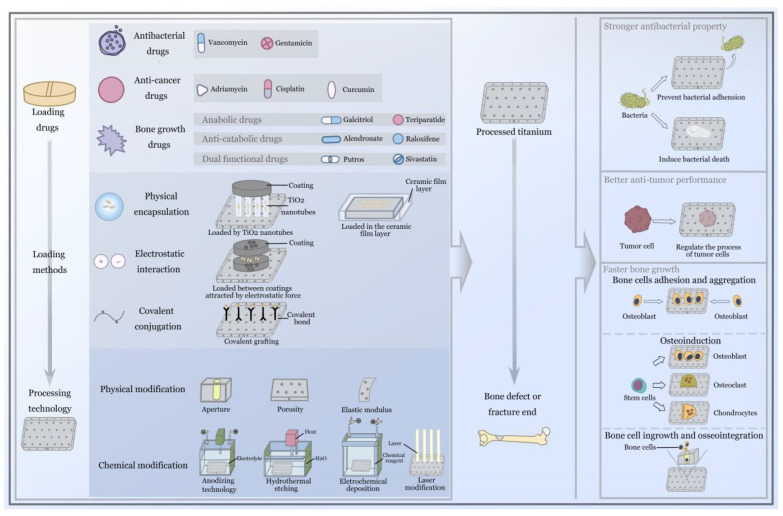
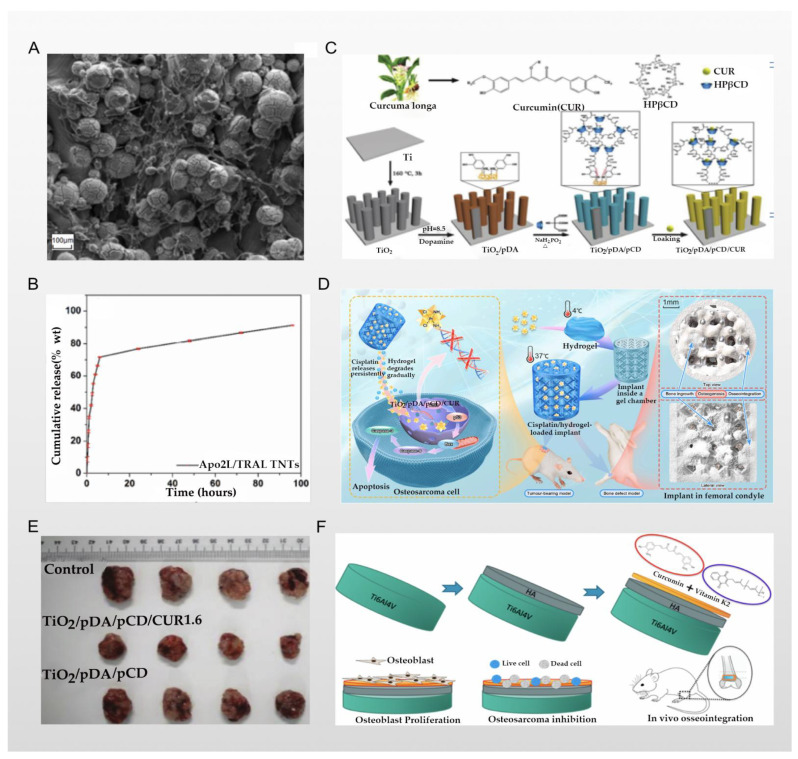
Titanium implants have always been regarded as one of the gold standard treatments for orthopedic applications, but they still face challenges such as pain, bacterial infections, insufficient osseointegration, immune rejection, and difficulty in personalizing treatment in the clinic. These challenges may lead to the patients having to undergo a painful second operation, along with increased economic burden, but the use of drugs is actively solving these problems. The use of systemic drug delivery systems through oral, intravenous, and intramuscular injection of various drugs with different pharmacological properties has effectively reduced the levels of inflammation, lowered the risk of endophytic bacterial infection, and regulated the progress of bone tumor cells, processing and regulating the balance of bone metabolism around the titanium implants. However, due to the limitations of systemic drug delivery systems-such as pharmacokinetics, and the characteristics of bone tissue in the event of different forms of trauma or disease-sometimes the expected effect cannot be achieved. Meanwhile, titanium implants loaded with drugs for local administration have gradually attracted the attention of many researchers. This article reviews the latest developments in local drug delivery systems in recent years, detailing how various types of drugs cooperate with titanium implants to enhance antibacterial, antitumor, and osseointegration effects. Additionally, we summarize the improved technology of titanium implants for drug loading and the control of drug release, along with molecular mechanisms of bone regeneration and vascularization. Finally, we lay out some future prospects in this field.
钛植入物一直被视为骨科应用的金标准治疗方法之一,但在临床上仍面临疼痛、细菌感染、骨整合不足、免疫排斥以及个性化治疗困难等挑战。这些挑战可能导致患者不得不接受痛苦的二次手术,同时增加经济负担,但药物的使用正在积极解决这些问题。通过口服、静脉注射和肌肉注射各种具有不同药理特性的药物来使用全身药物递送系统,有效地降低了炎症水平,降低了内生细菌感染的风险,并调节了骨肿瘤细胞的进程,处理和调节了钛植入物周围骨代谢的平衡。然而,由于全身药物递送系统的局限性,如药代动力学,以及在不同形式的创伤或疾病情况下骨组织的特性,有时无法达到预期效果。与此同时,负载药物用于局部给药的钛植入物逐渐引起了许多研究人员的关注。本文综述了近年来局部药物递送系统的最新进展,详细介绍了各类药物如何与钛植入物协同作用以增强抗菌、抗肿瘤和骨整合效果。此外,我们总结了钛植入物药物负载和药物释放控制的改进技术,以及骨再生和血管生成的分子机制。最后,我们阐述了该领域的一些未来前景。