Metabolism and Investigation Unit, Maimonides Biomedical Research Institute of Cordoba (IMIBIC), Reina Sofia University Hospital, University of Cordoba, 14004 Cordoba, Spain.
Escuela Universitaria de Osuna (Centro Adscrito a la Universidad de Sevilla), 41640 Osuna, Spain.
Int J Environ Res Public Health. 2021 Dec 30;19(1):393. doi: 10.3390/ijerph19010393.
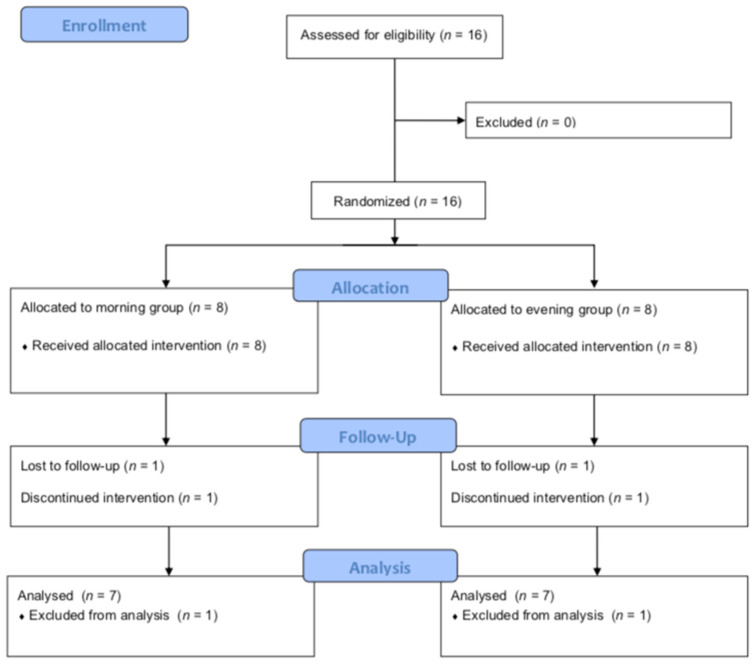
A great deal of evidence has been gathered on the use of creatine as an ergogenic supplement. Recent studies show greater benefits when creatine ingestion is performed close in time to training, but few studies tackle the way that circadian rhythms could influence creatine consumption. The aim of this study was therefore to observe the influence circadian rhythms exert on sports performance after creatine supplementation. Our method involved randomly assigning fourteen women players of a handball team into two groups in a single-blind study: one that consumed the supplement in the morning and one that consumed it in the evening, with both groups following a specific training program. After twelve weeks, the participants exhibited a decreased fat percentage, increased body weight and body water, and improved performance, with these results being very similar in the two groups. It is therefore concluded that, although circadian rhythms may influence performance, these appear not to affect creatine supplementation, as creatine is stored intramuscularly and is available for those moments of high energy demand, regardless of the time of day.
大量证据表明肌酸作为一种运动补剂具有积极作用。最近的研究表明,在训练时接近肌酸摄入时间,其益处更大,但很少有研究探讨昼夜节律如何影响肌酸的消耗。因此,本研究旨在观察昼夜节律对补充肌酸后运动表现的影响。我们的方法是在一项单盲研究中,将一支手球队的 14 名女运动员随机分配到两组:一组在早上服用补充剂,一组在晚上服用,两组都遵循特定的训练计划。十二周后,参与者的体脂百分比下降,体重和身体水分增加,运动表现提高,两组的结果非常相似。因此,尽管昼夜节律可能会影响运动表现,但似乎不会影响肌酸的补充,因为肌酸在肌肉中储存,并且在高能量需求时刻可用,而不管一天中的时间如何。