Department of Biochemistry and Physiology, School of Physical Therapy, University of Valladolid, 42004 Soria, Spain.
Laboratory of Human Performance, Department of Physical Education and Sport, Faculty of Education, University of the Basque Country, 01007 Vitoria, Spain.
Nutrients. 2019 Mar 31;11(4):757. doi: 10.3390/nu11040757.
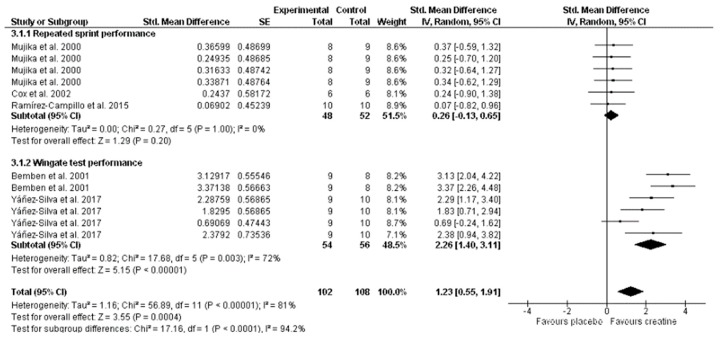
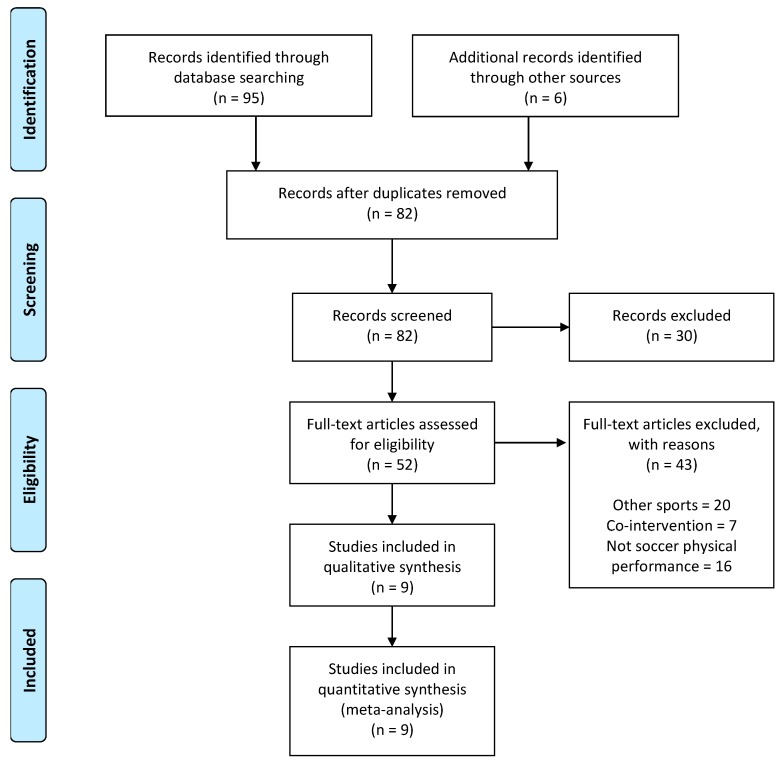
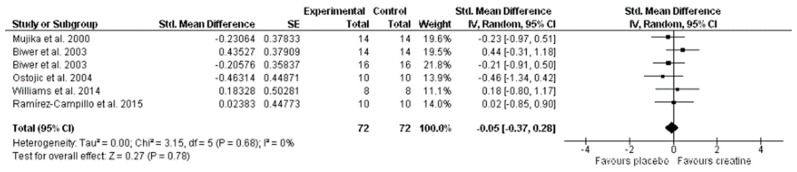
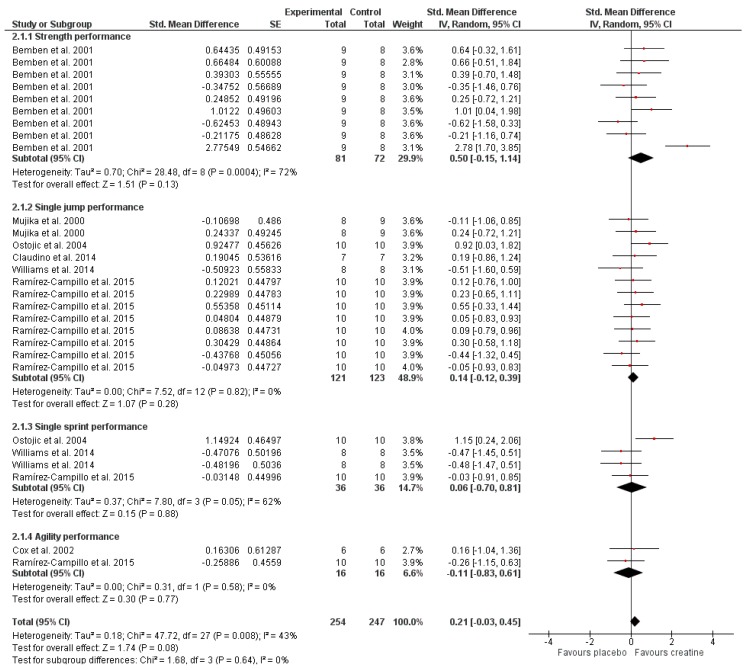
Studies have shown that creatine supplementation increases intramuscular creatine concentrations, favoring the energy system of phosphagens, which may help explain the observed improvements in high-intensity exercise performance. However, research on physical performance in soccer has shown controversial results, in part because the energy system used is not taken into account. The main aim of this investigation was to perform a systematic review and meta-analysis to determine the efficacy of creatine supplementation for increasing performance in skills related to soccer depending upon the type of metabolism used (aerobic, phosphagen, and anaerobic metabolism). A structured search was carried out following the Preferred Reporting Items for Systematic Review and Meta-Analyses (PRISMA) guidelines in the Medline/PubMed and Web of Science, Cochrane Library, and Scopus databases until January 2019. The search included studies with a double-blind and randomized experimental design in which creatine supplementation was compared to an identical placebo situation (dose, duration, timing, and drug appearance). There were no filters applied to the soccer players' level, gender, or age. A final meta-analysis was performed using the random effects model and pooled standardized mean differences (SMD) (Hedges's ). Nine studies published were included in the meta-analysis. This revealed that creatine supplementation did not present beneficial effects on aerobic performance tests (SMD, -0.05; 95% confidence interval (CI), -0.37 to 0.28; = 0.78) and phosphagen metabolism performance tests (strength, single jump, single sprint, and agility tests: SMD, 0.21; 95% CI, -0.03 to 0.45; = 0.08). However, creatine supplementation showed beneficial effects on anaerobic performance tests (SMD, 1.23; 95% CI, 0.55⁻1.91; <0.001). Concretely, creatine demonstrated a large and significant effect on Wingate test performance (SMD, 2.26; 95% CI, 1.40⁻3.11; <0.001). In conclusion, creatine supplementation with a loading dose of 20⁻30 g/day, divided 3⁻4 times per day, ingested for 6 to 7 days, and followed by 5 g/day for 9 weeks or with a low dose of 3 mg/kg/day for 14 days presents positive effects on improving physical performance tests related to anaerobic metabolism, especially anaerobic power, in soccer players.
研究表明,肌酸补充剂可以增加肌肉内肌酸浓度,有利于磷酸原能量系统,这可能有助于解释高强度运动表现的观察到的改善。然而,关于足球运动员体能的研究结果存在争议,部分原因是没有考虑到所使用的能量系统。本研究的主要目的是进行系统评价和荟萃分析,以确定肌酸补充剂对提高与足球相关的技能表现的功效,具体取决于所使用的代谢类型(有氧、磷酸原和无氧代谢)。按照《系统评价和荟萃分析的首选报告项目》(PRISMA)指南,在 Medline/PubMed 和 Web of Science、Cochrane 图书馆和 Scopus 数据库中进行了结构化搜索,截至 2019 年 1 月。该搜索包括双盲和随机实验设计的研究,其中将肌酸补充剂与相同的安慰剂情况(剂量、持续时间、时间和药物外观)进行了比较。对足球运动员的水平、性别或年龄没有应用过滤器。使用随机效应模型和汇总标准化均数差(SMD)(Hedges's )进行了最终荟萃分析。有 9 项研究发表被纳入荟萃分析。结果表明,肌酸补充剂对有氧性能测试(SMD,-0.05;95%置信区间(CI),-0.37 至 0.28; = 0.78)和磷酸原代谢性能测试(力量、单跳、单冲刺和敏捷性测试:SMD,0.21;95%CI,-0.03 至 0.45; = 0.08)没有有益的影响。然而,肌酸补充剂对无氧性能测试(SMD,1.23;95%CI,0.55⁻1.91; <0.001)有有益的影响。具体来说,肌酸对 WIngate 测试表现有显著影响(SMD,2.26;95%CI,1.40⁻3.11; <0.001)。总之,肌酸补充剂以 20⁻30 克/天的负荷剂量,每天分 3⁻4 次摄入,持续 6 至 7 天,然后每天 5 克,持续 9 周,或每天低剂量 3 毫克/公斤,持续 14 天,对提高与无氧代谢相关的体能测试,尤其是足球运动员的无氧能力,有积极影响。