Groningen Institute for Evolutionary Life Sciences - Neurobiology, University of Groningen, Groningen, The Netherlands.
Van Hall Larenstein University of Applied Sciences, Applied Research Centre Food and Dairy, Leeuwarden, The Netherlands.
Nutr Rev. 2021 Mar 9;79(4):429-444. doi: 10.1093/nutrit/nuaa044.
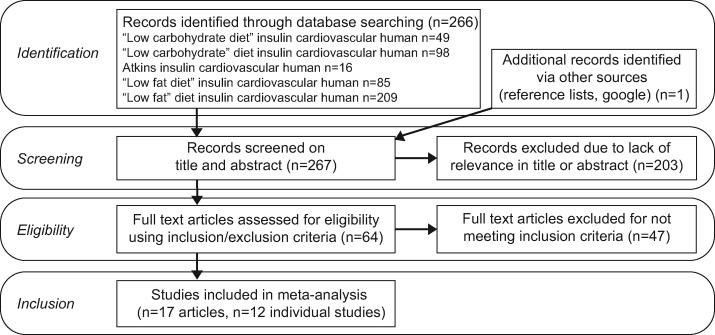
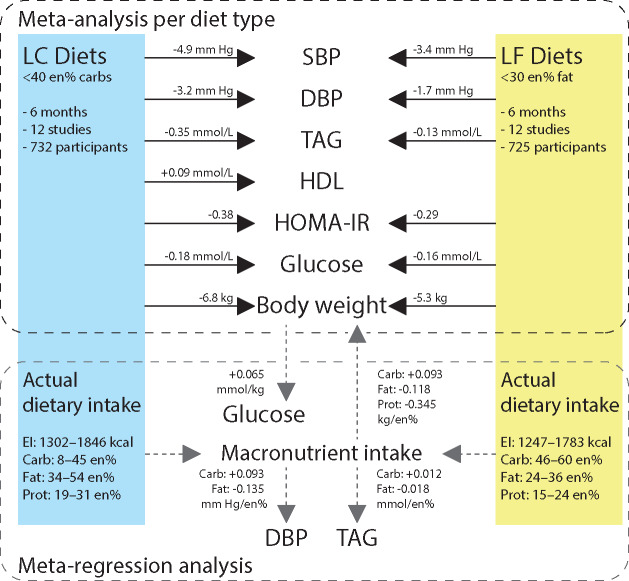
The metabolic syndrome (MetS) comprises cardiometabolic risk factors frequently found in individuals with obesity. Guidelines to prevent or reverse MetS suggest limiting fat intake, however, lowering carbohydrate intake has gained attention too. The aim for this review was to determine to what extent either weight loss, reduction in caloric intake, or changes in macronutrient intake contribute to improvement in markers of MetS in persons with obesity without cardiometabolic disease. A meta-analysis was performed across a spectrum of studies applying low-carbohydrate (LC) and low-fat (LF) diets. PubMed searches yielded 17 articles describing 12 separate intervention studies assessing changes in MetS markers of persons with obesity assigned to LC (<40% energy from carbohydrates) or LF (<30% energy from fat) diets. Both diets could lead to weight loss and improve markers of MetS. Meta-regression revealed that weight loss most efficaciously reduced fasting glucose levels independent of macronutrient intake at the end of the study. Actual carbohydrate intake and actual fat intake at the end of the study, but not the percent changes in intake of these macronutrients, improved diastolic blood pressure and circulating triglyceride levels, without an effect of weight loss. The homeostatic model assessment of insulin resistance improved with both diets, whereas high-density lipoprotein cholesterol only improved in the LC diet, both irrespective of aforementioned factors. Remarkably, changes in caloric intake did not play a primary role in altering MetS markers. Taken together, these data suggest that, beyond the general effects of the LC and LF diet categories to improve MetS markers, there are also specific roles for weight loss, LC and HF intake, but not reduced caloric intake, that improve markers of MetS irrespective of diet categorization. On the basis of the results from this meta-analysis, guidelines to prevent MetS may need to be re-evaluated.
代谢综合征(MetS)包括肥胖患者中常见的心血管代谢危险因素。预防或逆转 MetS 的指南建议限制脂肪摄入,但降低碳水化合物摄入也引起了关注。本综述的目的是确定在没有心血管代谢疾病的肥胖人群中,体重减轻、热量摄入减少或宏量营养素摄入变化在多大程度上有助于改善 MetS 标志物。对应用低碳水化合物(LC)和低脂肪(LF)饮食的一系列研究进行了荟萃分析。通过 PubMed 搜索,共获得了 17 篇描述 12 项单独干预研究的文章,这些研究评估了将肥胖患者分配到 LC(碳水化合物供能<40%)或 LF(脂肪供能<30%)饮食后 MetS 标志物的变化。两种饮食都可以导致体重减轻,并改善 MetS 标志物。元回归显示,无论研究结束时的宏量营养素摄入如何,体重减轻最有效地降低空腹血糖水平。研究结束时实际的碳水化合物摄入和实际脂肪摄入,但不是这些宏量营养素摄入的变化百分比,改善了舒张压和循环甘油三酯水平,而与体重减轻无关。两种饮食都改善了胰岛素抵抗的稳态模型评估,而高密度脂蛋白胆固醇仅在 LC 饮食中改善,这两种情况都与上述因素无关。值得注意的是,热量摄入的变化并没有在改变 MetS 标志物方面发挥主要作用。总的来说,这些数据表明,除了 LC 和 LF 饮食类别对改善 MetS 标志物的一般作用外,体重减轻、LC 和 HF 摄入也有特定作用,而减少热量摄入则与饮食分类无关,也可以改善 MetS 标志物。基于这项荟萃分析的结果,预防 MetS 的指南可能需要重新评估。