Center of Health Sciences, Universidade Federal do Recôncavo da Bahia, Avenida Carlos Amaral, R. do Cajueiro, 1015, Santo Antonio de Jesus 44574-490, Brazil.
Collective Health Institute, Universidade Federal da Bahia, Rua Basílio da Gama, s/n-Canela, Salvador 40110-040, Brazil.
Nutrients. 2021 Dec 28;14(1):128. doi: 10.3390/nu14010128.
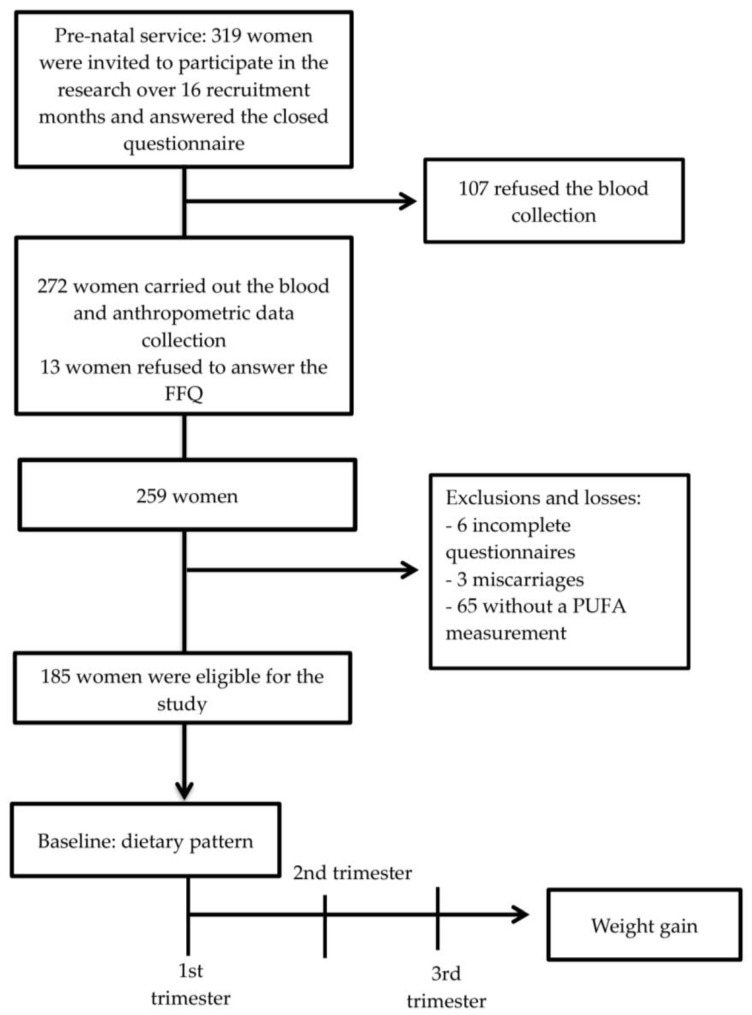
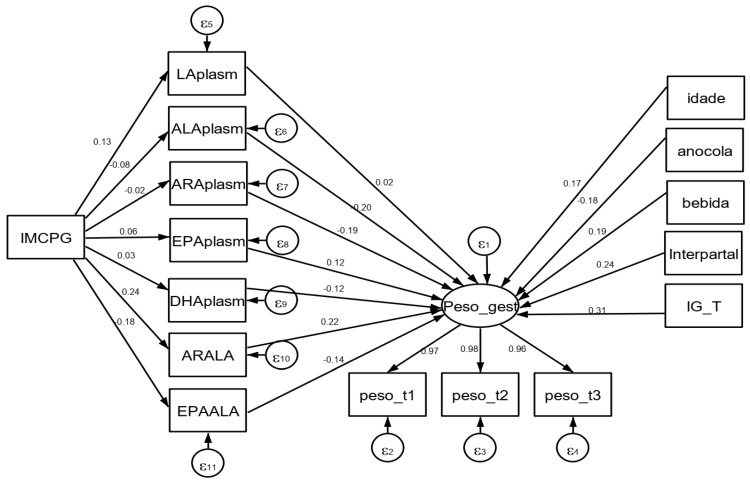
Lower concentrations of omega-3 (ω-3) and higher concentrations of omega-6 (ω-6) have been associated with excess weight in adults; however, the information on this relationship in pregnancy remains in its infancy. This study aimed to investigate the association between plasma levels of ω-3 and ω-6 long-chain polyunsaturated fatty acids (PUFAs) and weight gain during the gestational period. This is a prospective cohort study involving 185 pregnant women registered with the prenatal services of a municipality in the northeast of Brazil. The dosage of the serum concentration of fatty acids and the anthropometric measurements were carried out at the baseline, and the women's weight information in the first, second, and third trimesters was collected from their pregnancy cards. Serum fatty acids were determined with the help of gas chromatography. The response variable of this study is the latent variable weight gain in pregnancy, derived from three variables: gestational weight in the first, second, and third trimesters. The main exposure was the plasma concentrations of PUFAs. Structural equation modeling was used for the data analysis. The mean age of the pregnant women was 26.74 years old (SD: 5.96 years). Most of the women had not completed high school (84%) and had a low income (70.86%). It was observed that the ω-3 PUFAs, represented by ALA plasm (alpha-linolenic acid), DHA (docosahexaenoic acid), and the EPA/ALA ratio (eicosapentaenoic acid to alpha-linolenic acid ratio), were negatively associated with the weight gain during pregnancy construct (-0.20, -0.12, and -0.14, respectively). Meanwhile, the PUFAs represented by the ratio between the ω-6 category acids ARA and LA (arachidonic acid and linoleic acid) had a direct and positive association (0.22) with that construct. Excess maternal weight gain was associated with ω-3 and ω-6 plasma levels. The women with the greatest gestational weight gain were the ones that presented the highest ARA/LA ratio (ω-6) and the lowest plasma concentrations of ALA, DHA, and EPA/ALA ratio (ω-3).
较低水平的ω-3(ω-3)和较高水平的ω-6(ω-6)与成年人超重有关;然而,关于怀孕期间这种关系的信息仍处于起步阶段。本研究旨在探讨孕妇体内长链多不饱和脂肪酸(PUFA)ω-3 和 ω-6 血浆水平与妊娠期间体重增加之间的关系。这是一项前瞻性队列研究,涉及巴西东北部一个市的产前服务登记的 185 名孕妇。在基线时进行了血清脂肪酸浓度的剂量测定和人体测量,从她们的妊娠卡中收集了孕妇在第一、第二和第三个三个月的体重信息。血清脂肪酸通过气相色谱法确定。本研究的因变量是妊娠期间体重增加的潜在变量,由三个变量衍生而来:第一、第二和第三个三个月的妊娠期体重。主要暴露因素是 PUFAs 的血浆浓度。使用结构方程模型进行数据分析。孕妇的平均年龄为 26.74 岁(SD:5.96 岁)。大多数女性没有完成高中学业(84%),收入低(70.86%)。观察到 ω-3 PUFAs,由 ALA 血浆(α-亚麻酸)、DHA(二十二碳六烯酸)和 EPA/ALA 比值(二十碳五烯酸与α-亚麻酸的比值)表示,与妊娠期间体重增加结构呈负相关(分别为-0.20、-0.12 和-0.14)。同时,ω-6 类酸 ARA 和 LA(花生四烯酸和亚油酸)之间的比值表示的 PUFAs 与该结构呈直接正相关(0.22)。母体体重过度增加与 ω-3 和 ω-6 血浆水平有关。妊娠期体重增加最多的女性,其 ARA/LA 比值(ω-6)最高,ALA、DHA 和 EPA/ALA 比值(ω-3)血浆浓度最低。