Department of Clinical and Experimental Medicine, University of Pisa, Via Roma 56, 56126 Pisa, Italy.
Nutrients. 2022 Jan 4;14(1):212. doi: 10.3390/nu14010212.
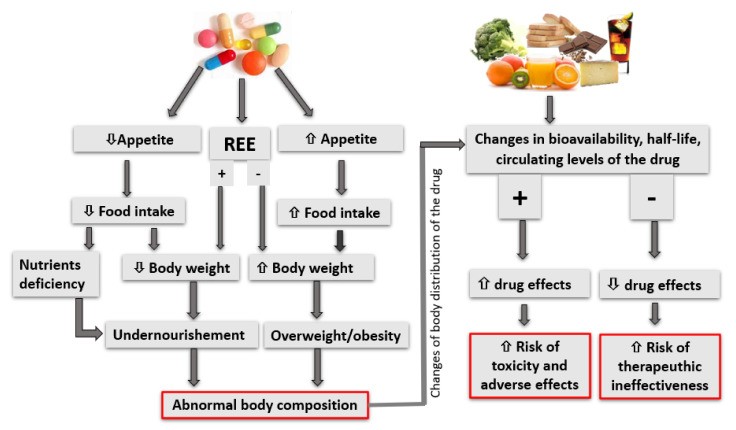
Drugs and food interact mutually: drugs may affect the nutritional status of the body, acting on senses, appetite, resting energy expenditure, and food intake; conversely, food or one of its components may affect bioavailability and half-life, circulating plasma concentrations of drugs resulting in an increased risk of toxicity and its adverse effects, or therapeutic failure. Therefore, the knowledge of these possible interactions is fundamental for the implementation of a nutritional treatment in the presence of a pharmacological therapy. This is the case of chronic kidney disease (CKD), for which the medication burden could be a problem, and nutritional therapy plays an important role in the patient's treatment. The aim of this paper was to review the interactions that take place between drugs and foods that can potentially be used in renal patients, and the changes in nutritional status induced by drugs. A proper definition of the amount of food/nutrient intake, an adequate definition of the timing of meal consumption, and a proper adjustment of the drug dosing schedule may avoid these interactions, safeguarding the quality of life of the patients and guaranteeing the effectiveness of drug therapy. Hence, a close collaboration between the nephrologist, the renal dietitian, and the patient is crucial. Dietitians should consider that food may interact with drugs and that drugs may affect nutritional status, in order to provide the patient with proper dietary suggestions, and to allow the maximum effectiveness and safety of drug therapy, while preserving/correcting the nutritional status.
药物可通过作用于感觉、食欲、静息能量消耗和食物摄入来影响机体的营养状况;相反,食物或其成分之一可能会影响药物的生物利用度和半衰期、循环血浆浓度,从而增加毒性及其不良反应或治疗失败的风险。因此,了解这些可能的相互作用对于在存在药物治疗的情况下实施营养治疗是至关重要的。这就是慢性肾脏病(CKD)的情况,对于这种疾病来说,药物负担可能是一个问题,而营养治疗在患者的治疗中起着重要作用。本文旨在回顾可能发生在肾患者中的药物与食物之间的相互作用,以及药物引起的营养状况变化。通过适当定义食物/营养素的摄入量、适当定义用餐时间、以及适当调整药物给药时间表,可以避免这些相互作用,保障患者的生活质量并保证药物治疗的有效性。因此,肾病学家、肾脏营养师和患者之间的密切合作至关重要。营养师应考虑到食物可能与药物相互作用,以及药物可能影响营养状况,以便为患者提供适当的饮食建议,并在保持/纠正营养状况的同时,使药物治疗达到最大的有效性和安全性。