García-Bernalt Diego Juan, Fernández-Soto Pedro, Muñoz-Bellido Juan Luis, Febrer-Sendra Begoña, Crego-Vicente Beatriz, Carbonell Cristina, López-Bernús Amparo, Marcos Miguel, Belhassen-García Moncef, Muro Antonio
Infectious and Tropical Diseases Research Group (e-INTRO), Research Centre for Tropical Diseases at the University of Salamanca (IBSAL-CIETUS), Biomedical Research Institute of Salamanca, Faculty of Pharmacy, University of Salamanca, 37007 Salamanca, Spain.
Microbiology and Parasitology Service, Complejo Asistencial Universitario de Salamanca (CAUSA), University of Salamanca, 37007 Salamanca, Spain.
J Clin Med. 2021 Dec 29;11(1):158. doi: 10.3390/jcm11010158.
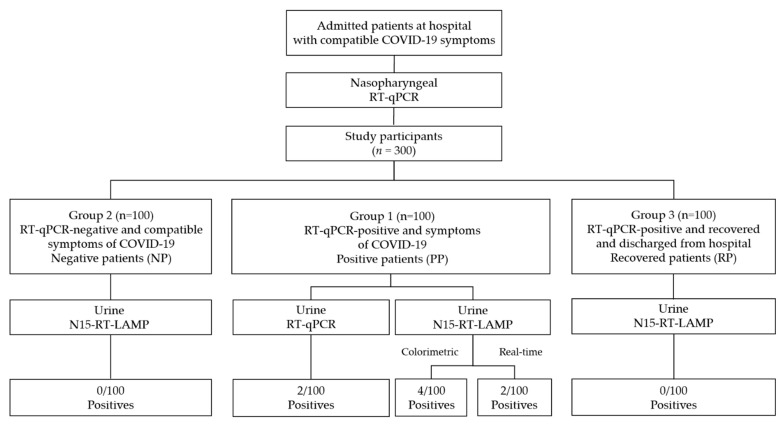
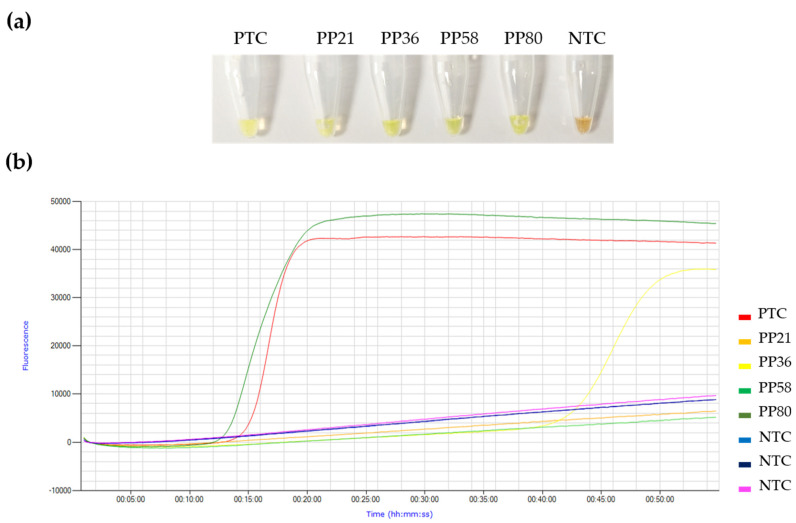
Detection of SARS-CoV-2 is routinely performed in naso/oropharyngeal swabs samples from patients via RT-qPCR. The RT-LAMP technology has also been used for viral RNA detection in respiratory specimens with both high sensitivity and specificity. Recently, we developed a novel RT-LAMP test for SARS-CoV-2 RNA detection in nasopharyngeal swab specimens (named, N15-RT-LAMP) that can be performed as a single-tube colorimetric method, in a real-time platform, and as dry-LAMP. To date, there has been very little success in detecting SARS-CoV-2 RNA in urine by RT-qPCR, and the information regarding urine viral excretion is still scarce and not comprehensive. Here, we tested our N15-RT-LAMP on the urine of 300 patients admitted to the Hospital of Salamanca, Spain with clinical suspicion of COVID-19, who had a nasopharyngeal swab RT-qPCR-positive ( = 100), negative ( = 100), and positive with disease recovery ( = 100) result. The positive group was also tested by RT-qPCR for comparison to N15-RT-LAMP. Only a 4% positivity rate was found in the positive group via colorimetric N15-RT-LAMP and 2% via RT-qPCR. Our results are consistent with those obtained in other studies that the presence of SARS-CoV-2 RNA in urine is a very rare finding. The absence of SARS-CoV-2 RNA in urine in the recovered patients might suggest that the urinary route is very rarely used for viral particle clearance.
通过逆转录定量聚合酶链反应(RT-qPCR)对患者的鼻咽拭子样本进行严重急性呼吸综合征冠状病毒2(SARS-CoV-2)的常规检测。逆转录环介导等温扩增(RT-LAMP)技术也已用于呼吸道标本中的病毒RNA检测,具有高灵敏度和特异性。最近,我们开发了一种用于检测鼻咽拭子标本中SARS-CoV-2 RNA的新型RT-LAMP检测方法(命名为N15-RT-LAMP),该方法可以单管比色法、实时平台以及干LAMP的形式进行。迄今为止,通过RT-qPCR在尿液中检测SARS-CoV-2 RNA的成功率非常低,关于尿液中病毒排泄的信息仍然稀缺且不全面。在此,我们对西班牙萨拉曼卡医院收治的300例临床怀疑为新型冠状病毒肺炎(COVID-19)的患者的尿液进行了N15-RT-LAMP检测,这些患者的鼻咽拭子RT-qPCR检测结果分别为阳性(n = 100)、阴性(n = 100)和疾病康复后阳性(n = 100)。阳性组也通过RT-qPCR进行检测以与N15-RT-LAMP作比较。通过比色法N15-RT-LAMP在阳性组中发现的阳性率仅为4%,通过RT-qPCR为2%。我们的结果与其他研究结果一致,即尿液中存在SARS-CoV-2 RNA是非常罕见的发现。康复患者尿液中不存在SARS-CoV-2 RNA可能表明尿路很少用于病毒颗粒清除。