Cognitive and Information Sciences, University of California-Merced, Merced, USA.
Applied Mathematics, University of California-Merced, Merced, USA.
Sci Rep. 2022 Jan 10;12(1):421. doi: 10.1038/s41598-021-04463-6.
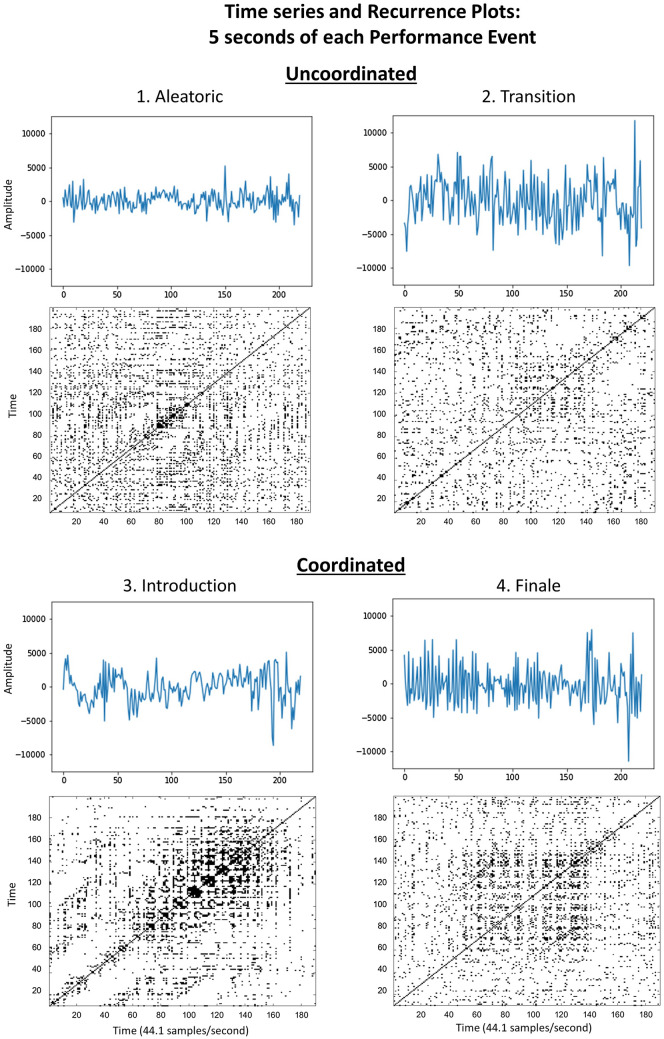
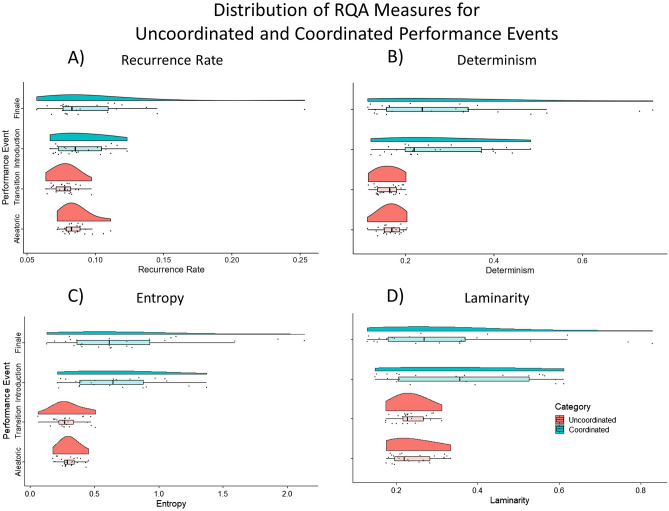
Humans interact with other humans at a variety of timescales and in a variety of social contexts. We exhibit patterns of coordination that may differ depending on whether we are genuinely interacting as part of a coordinated group of individuals vs merely co-existing within the same physical space. Moreover, the local coordination dynamics of an interacting pair of individuals in an otherwise non-interacting group may spread, propagating change in the global coordination dynamics and interaction of an entire crowd. Dynamical systems analyses, such as Recurrence Quantification Analysis (RQA), can shed light on some of the underlying coordination dynamics of multi-agent human interaction. We used RQA to examine the coordination dynamics of a performance of "Welcome to the Imagination World", composed for wind orchestra. This performance enacts a real-life simulation of the transition from uncoordinated, non-interacting individuals to a coordinated, interacting multi-agent group. Unlike previous studies of social interaction in musical performance which rely on different aspects of video and/or acoustic data recorded from each individual, this project analyzes group-level coordination patterns solely from the group-level acoustic data of an audio recording of the performance. Recurrence and stability measures extracted from the audio recording increased when musicians coordinated as an interacting group. Variability in these measures also increased, indicating that the interacting ensemble of musicians were able to explore a greater variety of behavior than when they performed as non-interacting individuals. As an orchestrated (non-emergent) example of coordination, we believe these analyses provide an indication of approximate expected distributions for recurrence patterns that may be measurable before and after truly emergent coordination.
人类在各种时间尺度和社会背景下与他人互动。我们表现出的协调模式可能会有所不同,具体取决于我们是作为一个协调的个体群体的一部分进行真正的互动,还是仅仅在同一物理空间中共同存在。此外,非相互作用群体中相互作用的个体对的局部协调动态可能会传播,从而改变整个群体的全局协调动态和相互作用。动态系统分析,如递归量化分析(RQA),可以揭示多主体人类相互作用的一些潜在协调动态。我们使用 RQA 来研究为管乐团创作的“欢迎来到想象世界”表演的协调动态。该表演真实模拟了从不协调、非相互作用的个体向协调、相互作用的多主体群体的转变。与之前依赖于从每个个体记录的视频和/或声学数据的不同方面来研究音乐表演中的社会相互作用的研究不同,该项目仅从表演的音频记录的群体水平声学数据分析群体水平的协调模式。当音乐家作为相互作用的群体协调时,从音频记录中提取的递归和稳定性度量增加。这些度量的可变性也增加了,这表明相互作用的音乐家合奏能够探索比作为非相互作用的个体更多样化的行为。作为协调的管弦乐(非涌现)示例,我们认为这些分析提供了在真正涌现协调之前和之后可测量的递归模式的近似预期分布的指示。