Department of Physical Therapy, Occupational Therapy, Physical Medicine and Rehabilitation, Universidad Rey Juan Carlos (URJC), Madrid. Spain;.
Intelligent Data Analysis Laboratory, Department of Electronic Engineering, ETSE (Engineering School), Universitat de València (UV), Valencia, Spain.
Int J Infect Dis. 2022 Mar;116:241-244. doi: 10.1016/j.ijid.2022.01.007. Epub 2022 Jan 10.
This multicenter study investigated clinical risk factors associated with the number of long-term symptoms after COVID.
Clinical features, symptoms at hospital admission, hospitalization data, and the number of symptoms after COVID was systematically assessed for patients who recovered from COVID-19 in 4 hospitals in Madrid (Spain) from February 20 to May 31, 2020.
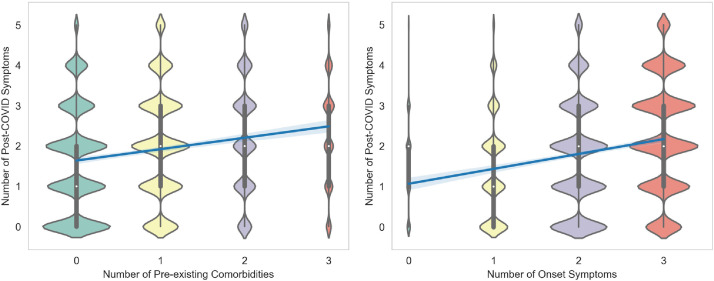
Overall, 1,969 patients (46.5% women, age: 61, SD: 16 years) were randomly assessed 8.4 months (SD 1.5) after hospital discharge. Female gender (odds ratio [OR] 1.82, 95% confidence interval [CI] 1.57-2.10), number of morbidities (OR 1.182, 95% CI 1.08-1.29), number of symptoms at hospital admission (OR 1.309, 95% CI 1.15-1.49) and days at the hospital (OR 1.01, 95% CI 1.007-1.017) were associated (all, p <0.001) with more long-term symptoms after COVID. Further, vomiting (OR 1.78, 95% CI 1.26-2.52), throat pain (OR 1.36, 95% CI 1.02-1.81), diarrhea (OR 1.51, 95% CI 1.25-1.82), dyspnea (OR 1.20, 95% CI 1.01-1.41), or headache (OR 1.50, 95% CI 1.28-1.75) as symptoms at hospital admission were also associated (all, p <0.01) with a higher number of symptoms after COVID.
This multicenter study found that a higher number of symptoms at hospital admission were the most relevant risk factor for developing more symptoms after COVID, supporting the assumption that a higher symptom load at the acute phase is associated with a greater likelihood of long-term symptoms after COVID.
本多中心研究旨在调查与 COVID 后长期症状数量相关的临床危险因素。
对 2020 年 2 月 20 日至 5 月 31 日在西班牙马德里的 4 家医院从 COVID-19 中康复的患者进行了临床特征、入院时症状、住院数据以及 COVID 后症状数量的系统评估。
共有 1969 名患者(46.5%为女性,年龄 61 岁,标准差 16 岁)在出院后 8.4 个月(标准差 1.5)时被随机评估。女性(比值比 [OR] 1.82,95%置信区间 [CI] 1.57-2.10)、合并症数量(OR 1.182,95%CI 1.08-1.29)、入院时症状数量(OR 1.309,95%CI 1.15-1.49)和住院天数(OR 1.01,95%CI 1.007-1.017)与 COVID 后出现更多长期症状相关(均,p<0.001)。此外,入院时出现呕吐(OR 1.78,95%CI 1.26-2.52)、咽痛(OR 1.36,95%CI 1.02-1.81)、腹泻(OR 1.51,95%CI 1.25-1.82)、呼吸困难(OR 1.20,95%CI 1.01-1.41)或头痛(OR 1.50,95%CI 1.28-1.75)也与 COVID 后出现更多症状相关(均,p<0.01)。
本多中心研究发现,入院时出现更多症状是 COVID 后出现更多症状的最相关危险因素,这支持了在急性期症状负荷较高与 COVID 后出现长期症状的可能性较大的假设。