Department of Pediatric Infectious Disease, Tepecik Training and Research Hospital, Health Sciences University, Izmir, Turkey.
Department of Pediatric Infectious Disease, Izmir Katip Celebi University, Izmir, Turkey.
Eur J Pediatr. 2022 Apr;181(4):1575-1584. doi: 10.1007/s00431-021-04348-w. Epub 2022 Jan 22.
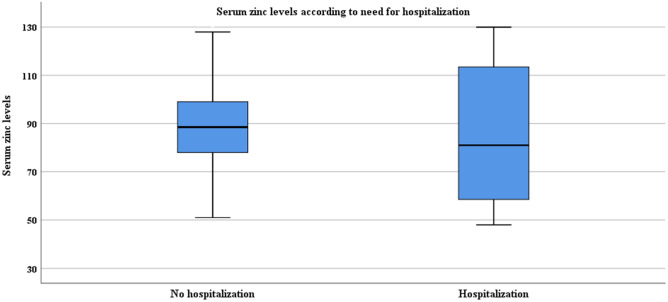
Zinc has potent immunoregulatory and antiviral effects that are critical for growth, immunity, and neurologic development. The aim of this study was to determine the clinical significance of serum zinc levels in pediatric patients with COVID-19 and to demonstrate its association with disease severity. This prospective observational study was conducted between August 3 and November 15, 2020, in pediatric patients aged 1 month to 18 years with confirmed COVID-19 using reverse transcription-polymerase chain reaction. We defined a control group whose serum zinc levels were determined 1 year ago at the same time as those of patients with COVID-19. We used 70 μg/dL as the cut-off zinc value to define zinc deficiency. Statistical analyses were performed using the SPSS for Windows statistics package program. One hundred children with confirmed COVID-19 and 269 children in the control group participated in the study. The median age was 13.3 (IQR: 8-15.4) years in patients with confirmed COVID-19, 11 patients had low serum zinc levels, and 89 patients had normal serum zinc levels. Patients in the group with low zinc levels had a significantly higher hospitalization rate than the group with normal zinc levels (5 (45.5%) and 10 patients (11.2%), respectively) (p = 0.011). The median serum zinc level in patients with COVID-19 was 88.5 mcg/dL (IQR 77.2-100), which was significantly lower than the median level in the control group, which was 98 mcg/dL (IQR 84-111) (p = 0.001). There was no association between the severity of COVID-19 and the serum zinc levels of the children.
Serum zinc levels may be influenced by many factors such as fasting status, diurnal variation, exercise, and sex, and may give an impression of the zinc status of the population rather than reflecting the individual. The fact that the incidence of hospitalization was significantly higher in patients with both COVID-19 and low serum zinc levels suggests that these patients require a detailed assessment of their living environment.
• Serum zinc levels have been found to be low in adult patients diagnosed with COVID-19. • There was a correlation between the severity of COVID-19 and serum zinc levels in adults.
• Children with low serum zinc levels were found to have a higher number of hospitalizations. • No association was found between the severity of COVID-19 disease and serum zinc levels in children.
本研究旨在确定 COVID-19 患儿血清锌水平的临床意义,并探讨其与疾病严重程度的关系。
这是一项前瞻性观察研究,于 2020 年 8 月 3 日至 11 月 15 日期间,对经逆转录聚合酶链反应(RT-PCR)确诊的 1 个月至 18 岁 COVID-19 患儿进行研究。我们定义了一个对照组,其血清锌水平是在与 COVID-19 患儿相同的时间在 1 年前确定的。我们将 70μg/dL 作为锌缺乏的截断值。使用 SPSS for Windows 统计软件包程序进行统计学分析。
共 100 例确诊 COVID-19 的患儿和 269 例对照组患儿参与了本研究。确诊 COVID-19 患儿的中位年龄为 13.3(IQR:8-15.4)岁,11 例患儿血清锌水平较低,89 例患儿血清锌水平正常。血清锌水平较低组患儿的住院率明显高于血清锌水平正常组(5 例[45.5%]和 10 例[11.2%])(p=0.011)。COVID-19 患儿的中位血清锌水平为 88.5mcg/dL(IQR:77.2-100),明显低于对照组的 98mcg/dL(IQR:84-111)(p=0.001)。COVID-19 患儿的血清锌水平与疾病严重程度无相关性。
血清锌水平可能受禁食状态、昼夜节律变化、运动和性别等多种因素的影响,可能反映的是人群的锌营养状况,而不是个体的情况。COVID-19 患儿和血清锌水平较低的患儿住院率明显升高,这表明这些患儿需要对其生活环境进行详细评估。
成人 COVID-19 患者的血清锌水平较低。成人 COVID-19 患者的血清锌水平与疾病严重程度相关。
血清锌水平较低的儿童住院人数较多。儿童 COVID-19 患者的血清锌水平与疾病严重程度无关。