Tønnessen Øystein, Dhir Amandeep, Flåten Bjørn-Tore
Department of Management, School of Business and Law, University of Agder, Kristiansand, Norway.
Egde Consulting AS, Kristiansand, Norway.
Technol Forecast Soc Change. 2021 Sep;170:120866. doi: 10.1016/j.techfore.2021.120866. Epub 2021 May 25.
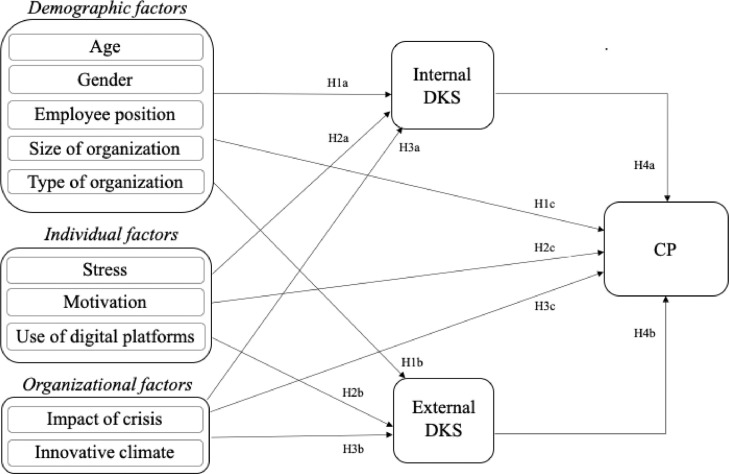
The outbreak of the COVID-19 pandemic and the resulting social distancing requirements have led to major disruptions in the world of work. The outcomes of the enforced and large-scale work from home (WFH) practices are currently largely unexplored. This study aims to address this gap in the research by investigating the external and internal digital knowledge sharing (DKS) and creative performance (CP) of employees under these extraordinary circumstances. The social capital theory was utilized as the theoretical lens for examining the associations of DKS and CP with demographic, individual, and organizational factors. An online cross-sectional survey was carried out among knowledge workers based in Norway during the pandemic lockdown. The study results indicate that internal and external DKS are significant predictors of CP in the WFH context during the COVID-19 pandemic. Females and older employees are more likely to engage in external DKS than their counterparts. Furthermore, individual motivation is found to be positively associated with internal DKS, external DKS, and CP. The findings suggest that increased use of digital platforms helps increase CP in the WFH setting resulting from the pandemic. Various theoretical and practical implications are discussed, and future research avenues are proposed.
新冠疫情的爆发以及由此产生的社交距离要求给工作领域带来了重大干扰。目前,强制推行的大规模居家办公(WFH)做法的效果在很大程度上尚未得到探究。本研究旨在通过调查在这些特殊情况下员工的外部和内部数字知识共享(DKS)及创新绩效(CP)来填补这一研究空白。社会资本理论被用作理论视角,以考察DKS和CP与人口统计学、个人及组织因素之间的关联。在疫情封锁期间,对挪威的知识工作者进行了一项在线横断面调查。研究结果表明,在新冠疫情期间的居家办公环境中,内部和外部DKS是CP的重要预测因素。与男性和年轻员工相比,女性和年长员工更有可能参与外部DKS。此外,发现个人动机与内部DKS、外部DKS和CP呈正相关。研究结果表明,在疫情导致的居家办公环境中,增加数字平台的使用有助于提高CP。讨论了各种理论和实际意义,并提出了未来的研究方向。