Department of Business Management, DHET-NRF SARChI Entrepreneurship Education, University of Johannesburg, Auckland Park, South Africa.
Department of Market Research, Institute of Management and Economics, Clausthal University of Technology, Clausthal-Zellerfeld, Germany.
PLoS One. 2022 Jan 28;17(1):e0263022. doi: 10.1371/journal.pone.0263022. eCollection 2022.
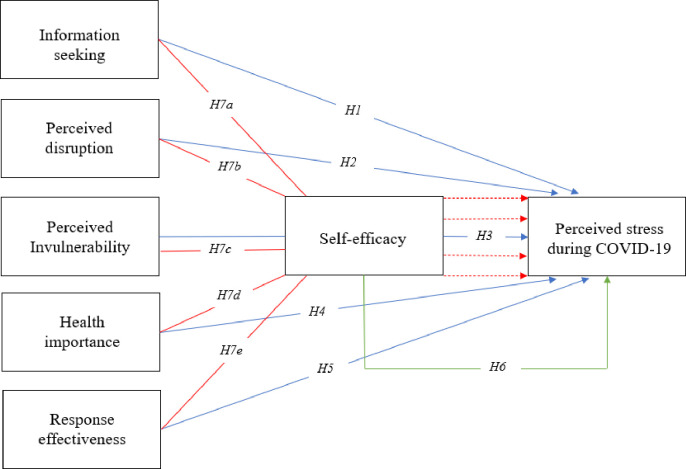
The impact that COVID-19 had on individuals globally has been immense. Our study aims to determine if the various COVID-19 related beliefs (information seeking; invulnerability; disruption; health importance and response effectiveness) are predictors of perceived stress and if self-efficacy acts as a mediator in reducing perceived COVID-19 related stress. From a large sample of 23,629, data were assessed using validated multi-item measures for seven COVID-19 related beliefs, self-efficacy and perceived stress. After conducting a series of tests and checks via Confirmatory Factor Analyses, linear modelling and mediation analyses with bootstrapping were applied to test direct and mediation hypotheses. It is found that stress perception is most strongly affected by self-efficacy and perceived disruption. Except for information seeking, which positively affected perceived stress, self-efficacy partially mediates all other COVID-19 related beliefs (perceptions of disruption, health importance and response effectiveness) in conjunction with their direct effects. Only perceived invulnerability elicited opposite effects on stress, increasing stress directly but decreasing stress indirectly by increasing self-efficacy. This finding gives reason to believe that individuals may disclose that they are less vulnerable to COVID-19, fostering their self-efficacy, but still accept that stressing factors such as economic and social consequences apply. Overall, reinforcing self-efficacy was carved out as the most important resilience factor against perceiving high levels of stress. On this basis, implications for research and practice are provided.
新冠疫情对全球个人造成了巨大影响。本研究旨在确定与新冠疫情相关的七种信念(信息寻求、不易感、干扰、健康重要性和应对有效性)是否可以预测感知压力,以及自我效能感是否可以作为减轻感知新冠相关压力的中介因素。本研究从一个 23629 人的大样本中,使用经过验证的多项目措施评估了与新冠相关的信念、自我效能感和感知压力的七个方面。通过一系列验证性因素分析、线性模型和带 bootstrap 的中介分析测试后,直接和中介假设得到了检验。研究发现,自我效能感和感知干扰对压力感知的影响最大。除了信息寻求会正向影响感知压力外,自我效能感部分中介了其他所有与新冠相关的信念(对干扰、健康重要性和应对有效性的感知),同时也考虑了它们的直接影响。只有感知不易感会对压力产生相反的影响,直接增加压力,但通过增加自我效能感间接降低压力。这一发现表明,个体可能会公开表示他们不易感染新冠,从而增强自我效能感,但仍会接受经济和社会后果等压力因素的影响。总的来说,增强自我效能感被认为是减轻感知压力的最重要的适应因素。在此基础上,本研究还为研究和实践提供了相关启示。