Department of Microbiology, Vestfold Hospital Trust, Postbox 2168, 3103, Tønsberg, Norway.
Department of Gastrointestinal Surgery, Vestfold Hospital Trust, 3103, Tønsberg, Norway.
Sci Rep. 2022 Jan 31;12(1):1682. doi: 10.1038/s41598-022-05723-9.
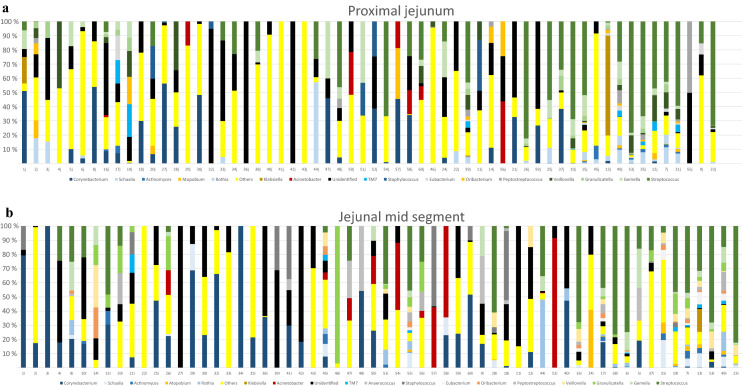
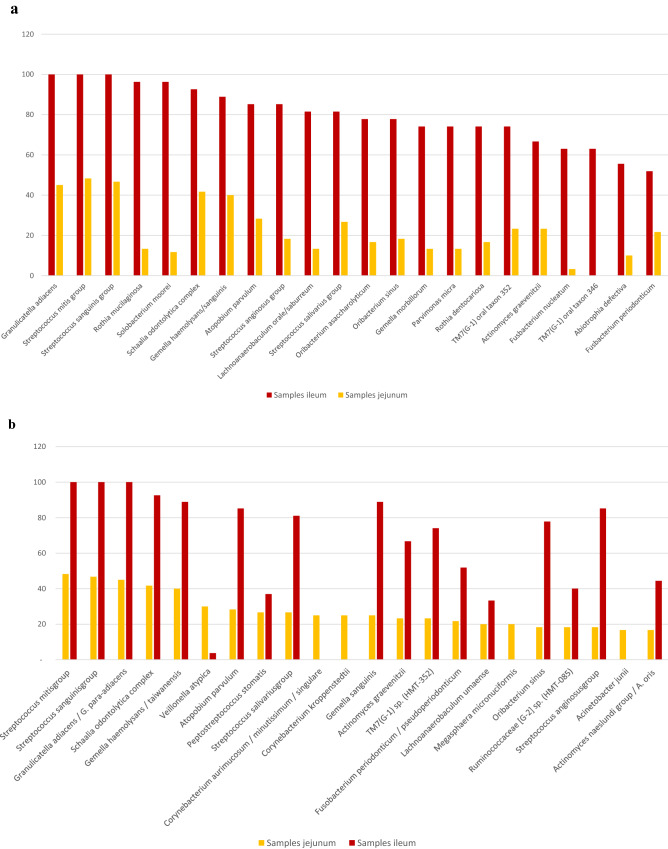
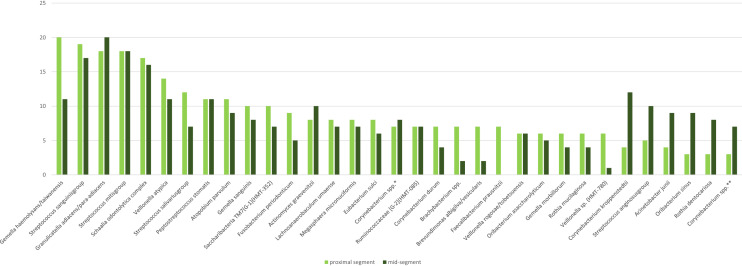
Descriptions of the small intestinal microbiota are deficient and conflicting. We aimed to get a reliable description of the jejunal bacterial microbiota by investigating samples from two separate jejunal segments collected from the luminal mucosa during surgery. Sixty patients with morbid obesity selected for elective gastric bypass surgery were included in this survey. Samples collected by rubbing a swab against the mucosa of proximal and mid jejunal segments were characterized both quantitatively and qualitatively using a combination of microbial culture, a universal quantitative PCR and 16S deep sequencing. Within the inherent limitations of partial 16S sequencing, bacteria were assigned to the species level. By microbial culture, 53 patients (88.3%) had an estimated bacterial density of < 1600 cfu/ml in both segments whereof 31 (51.7%) were culture negative in both segments corresponding to a bacterial density below 160 cfu/ml. By quantitative PCR, 46 patients (76.7%) had less than 10 bacterial genomes/ml in both segments. The most abundant and frequently identified species by 16S deep sequencing were associated with the oral cavity, most often from the Streptococcus mitis group, the Streptococcus sanguinis group, Granulicatella adiacens/para-adiacens, the Schaalia odontolytica complex and Gemella haemolysans/taiwanensis. In general, few bacterial species were identified per sample and there was a low consistency both between the two investigated segments in each patient and between patients. The jejunal mucosa of fasting obese patients contains relatively few microorganisms and a core microbiota could not be established. The identified microbes are likely representatives of a transient microbiota and there is a high degree of overlap between the most frequently identified species in the jejunum and the recently described ileum core microbiota.
对小肠微生物组的描述是不足和相互矛盾的。我们旨在通过研究手术期间从两个不同的空肠段的腔黏膜中收集的样本,获得对空肠细菌微生物组的可靠描述。这项调查纳入了 60 名因病态肥胖而选择接受择期胃旁路手术的患者。通过用拭子擦拭近端和中段空肠段的黏膜来收集样本,使用微生物培养、通用定量 PCR 和 16S 深度测序的组合对样本进行定量和定性分析。在部分 16S 测序的固有局限性内,将细菌分配到种水平。通过微生物培养,53 名患者(88.3%)在两个段的估计细菌密度均<1600 cfu/ml,其中 31 名(51.7%)在两个段均为培养阴性,对应的细菌密度低于 160 cfu/ml。通过定量 PCR,46 名患者(76.7%)在两个段的细菌基因组均<10 个/ml。通过 16S 深度测序最丰富和最常鉴定的物种与口腔有关,最常见的是来自缓症链球菌属、血链球菌属、颗粒亚种/副颗粒亚种、Schaalia odontolytica 复合体和 Gemella haemolysans/taiwanensis。一般来说,每个样本中鉴定的细菌种类较少,每个患者的两个研究段之间以及患者之间的一致性较低。禁食肥胖患者的空肠黏膜中含有相对较少的微生物,并且无法建立核心微生物组。鉴定出的微生物可能是短暂微生物组的代表,并且在空肠中最常鉴定的物种与最近描述的回肠核心微生物组之间存在高度重叠。