Wei Guoli, Gu Jialin, Gu Zhancheng, Du Cheng, Huang Xiaofei, Xing Haiyan, Li Lingchang, Zhang Aiping, Hu Xingxing, Huo Jiege
Affiliated Hospital of Integrated Traditional Chinese and Western Medicine, Nanjing University of Chinese Medicine, Nanjing, China.
Jiangsu Province Academy of Traditional Chinese Medicine, Nanjing, China.
Front Neurol. 2022 Jan 18;12:783249. doi: 10.3389/fneur.2021.783249. eCollection 2021.
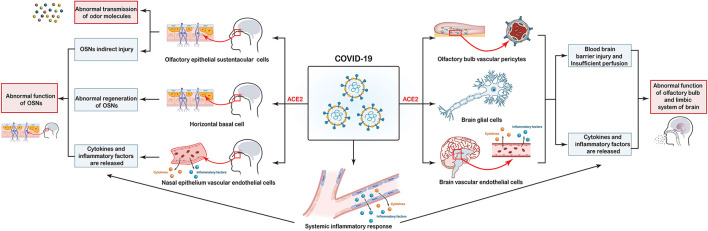
The coronavirus disease 2019 (COVID-19) pandemic is wreaking havoc on public-health and economic systems worldwide. Among the several neurological symptoms of patients with COVID-19 reported in clinical practice, olfactory dysfunction (OD) is the most common. OD occurs as the earliest or the only clinical manifestation in some patients. Increasing research attention has focused on OD, which is listed as one of the main diagnostic symptoms of severe acute respiratory syndrome-coronavirus-2 infection. Multiple clinical and basic-science studies on COVID-19-induced OD are underway to clarify the underlying mechanism of action. In this review, we summarize the clinical characteristics, mechanisms, evaluation methods, prognosis, and treatment options of COVID-19-induced OD. In this way, we hope to improve the understanding of COVID-19-induced OD to aid early identification and precise intervention.
2019年冠状病毒病(COVID-19)大流行正在对全球公共卫生和经济系统造成严重破坏。在临床实践中报告的COVID-19患者的几种神经症状中,嗅觉功能障碍(OD)最为常见。在一些患者中,OD是最早出现的或唯一的临床表现。越来越多的研究关注集中在OD上,它被列为严重急性呼吸综合征冠状病毒2感染的主要诊断症状之一。目前正在进行多项关于COVID-19诱发OD的临床和基础科学研究,以阐明其潜在作用机制。在本综述中,我们总结了COVID-19诱发OD的临床特征、机制、评估方法、预后和治疗选择。通过这种方式,我们希望提高对COVID-19诱发OD的认识,以帮助早期识别和精准干预。