Department of Medicine, Oregon Health & Sciences University, Portland, OR, USA.
San Francisco Coordinating Center, San Francisco, CA, USA.
J Bone Miner Res. 2022 Apr;37(4):597-607. doi: 10.1002/jbmr.4518. Epub 2022 Feb 27.
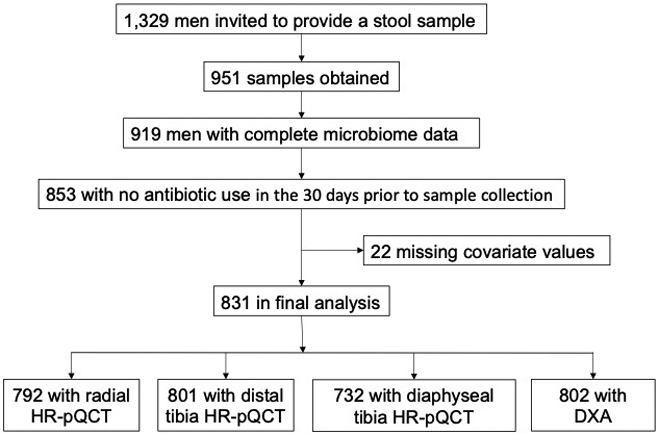
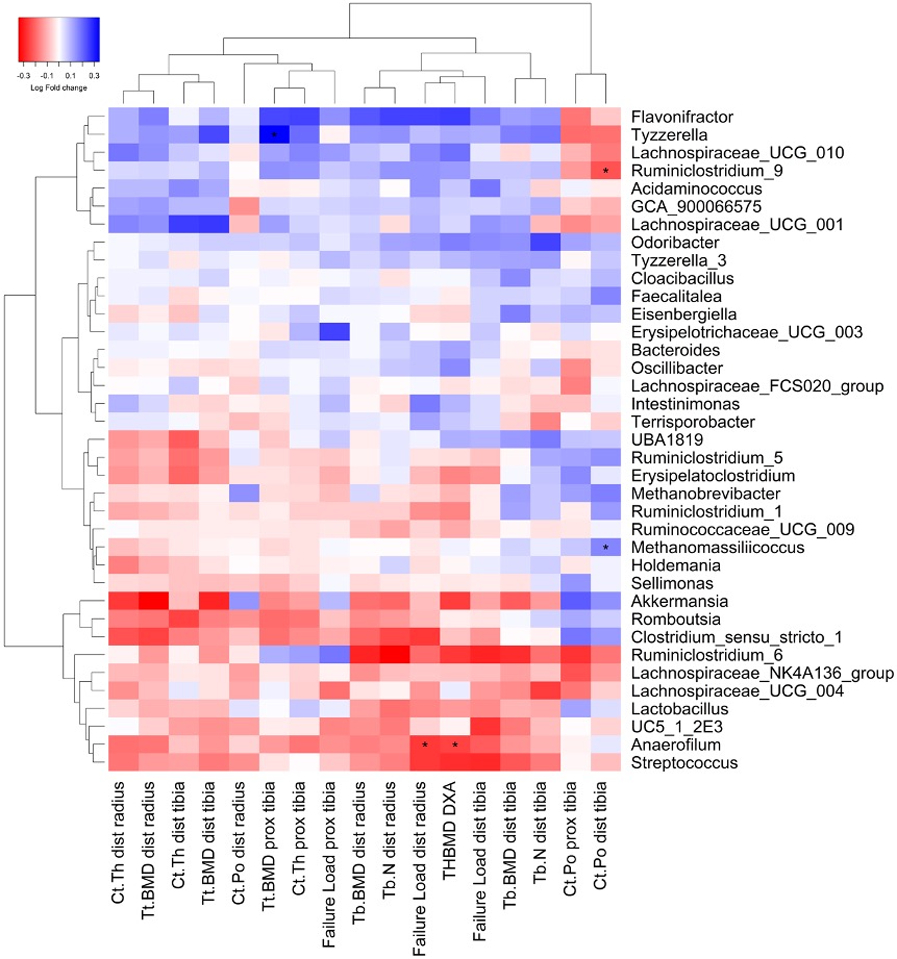
In preclinical models, the composition and function of the gut microbiota have been linked to bone growth and homeostasis, but there are few available data from studies of human populations. In a hypothesis-generating experiment in a large cohort of community-dwelling older men (n = 831; age range, 78-98 years), we explored the associations between fecal microbial profiles and bone density, microarchitecture, and strength measured with total hip dual-energy X-ray absorptiometry (DXA) and high-resolution peripheral quantitative computed tomography (HRpQCT) (distal radius, distal and diaphyseal tibia). Fecal samples were collected and the 16S rRNA gene V4 hypervariable region sequenced. Sequences were bioinformatically processed through the DADA2 pipeline and then taxonomically assigned using SILVA. Generalized linear models as implemented in microbiome multivariable association with linear models (MaAsLin 2) were used to test for associations between skeletal measures and specific microbial genera. The abundances of four bacterial genera were weakly associated with bone density, structure, or strength (false discovery rate [FDR] ≤ 0.05), and the measured directions of associations of genera were generally consistent across multiple bone measures, supporting a role for microbiota on skeletal homeostasis. However, the associated effect sizes were small (log2 fold change < ±0.35), limiting power to confidently identify these associations even with high resolution skeletal imaging phenotypes, and we assessed the resulting implications for the design of future cohort-based studies. As in analogous examples from genomewide association studies, we find that larger cohort sizes will likely be needed to confidently identify associations between the fecal microbiota and skeletal health relying on 16S sequencing. Our findings bolster the view that the gut microbiome is associated with clinically important measures of bone health, while also indicating the challenges in the design of cohort-based microbiome studies. © 2022 American Society for Bone and Mineral Research (ASBMR).
在临床前模型中,肠道微生物群的组成和功能与骨骼生长和稳态有关,但来自人类群体研究的可用数据很少。在一项针对居住在社区的老年男性(n=831;年龄范围为 78-98 岁)的大型队列的假设生成实验中,我们探讨了粪便微生物群谱与通过全髋双能 X 射线吸收法(DXA)和高分辨率外周定量计算机断层扫描(HRpQCT)(桡骨远端、胫骨远端和骨干)测量的骨密度、微结构和强度之间的关联。收集粪便样本并对 16S rRNA 基因 V4 高变区进行测序。通过 DADA2 管道对序列进行生物信息学处理,然后使用 SILVA 进行分类分配。使用在微生物组多变量与线性模型关联中实现的广义线性模型(MaAsLin 2)来测试骨骼测量值与特定微生物属之间的关联。四个细菌属的丰度与骨密度、结构或强度呈弱相关(错误发现率[FDR]≤0.05),并且属的关联方向在多个骨骼测量值中基本一致,支持微生物群在骨骼稳态中的作用。然而,相关的效应大小较小(log2 倍变化 < ±0.35),即使使用高分辨率骨骼成像表型,也限制了识别这些关联的能力,并且我们评估了对未来基于队列的研究设计的影响。与全基因组关联研究中的类似例子一样,我们发现,为了依靠 16S 测序有信心地识别粪便微生物群与骨骼健康之间的关联,可能需要更大的队列规模。我们的研究结果支持了这样一种观点,即肠道微生物群与临床重要的骨骼健康测量值有关,同时也表明了基于队列的微生物组研究设计所面临的挑战。