Kıraç Hayrettin, Dalda Şekerci Akife, Coşkun Ömer Faruk, Gülşen Osman
Department of Horticulture, Faculty of Agriculture, Erciyes University, 38280 Talas, Kayseri, Turkey.
Department of Horticulture, Faculty of Agriculture, Hatay Mustafa Kemal University, Alahan, 31060 Antakya, Hatay Turkey.
Genet Resour Crop Evol. 2022;69(5):1833-1841. doi: 10.1007/s10722-022-01343-4. Epub 2022 Feb 2.
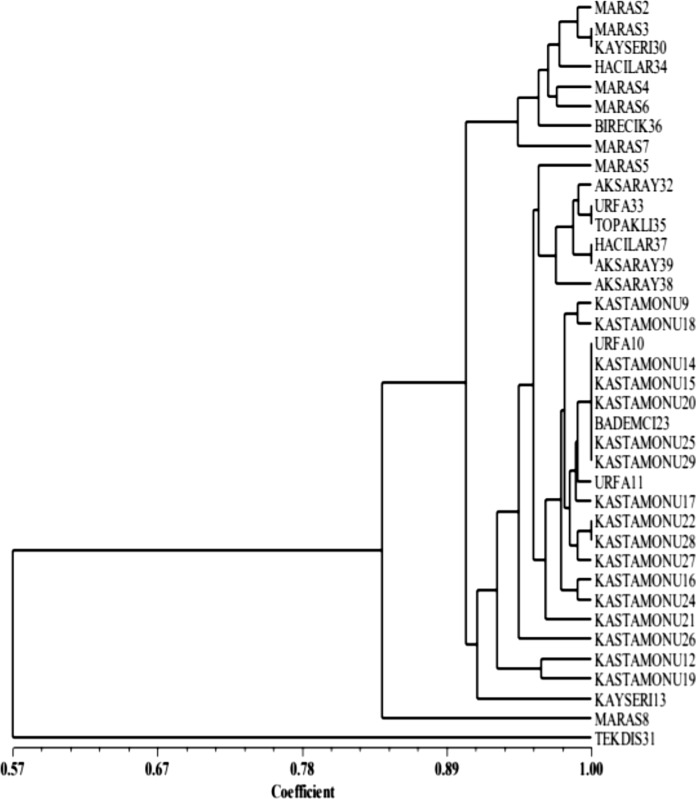
Garlic is a vegetable widely used both in food and as a pharmaceutical raw material in the world due to its contents. Although morphological differences are observed in garlic, which is obligatory apomictically propagated, clonal propagation causes narrowing variation, a genetic bottleneck. This situation complicates breeding programs aiming improvements in preferred agronomic characteristics. For this reason, determining the morphological and molecular differences between garlic genotypes originating from Turkey is important for breeding studies. In this study, morphological and molecular characteristics of 39 garlic genotypes, which are widely cultivated in Turkey, were determined. Kahramanmaraş4 genotype was different from other genotypes in terms of some morphological features (fresh weight, dry weight, and bulb diameter). In the molecular characterization study, 10 Inter-Simple Sequence Repeats (ISSR) primers were used, and it was determined that the genotype TekDiş31 of Tunceli region was different from other garlic genotypes. Genetic similarity coefficient was found to be high (0.85-1.0) in genotypes except for TekDiş31 garlic genotype. In general, some garlic clones (Maraş3 and Kayseri30, Urfa33 and Topaklı35, Kastamonu22 and Kastamonu28, Urfa10 and Kastamonu14, Kastamonu29 and Bademci23) were completely similar to each other, while few differences were found among others. In conclusion, this study revealed that the garlic plant, despite its clonal propagation, consisted of some level of morphological and partially molecular variation. Due to its mode of reproduction (vegetative), this variation may largely be due to point or chromosomal mutation. Furthermore, the 10 identified ISSR primers can generate valuable information for genetic diversity for use by garlic breeders.
大蒜是一种因其成分而在全球范围内广泛用于食品和作为制药原料的蔬菜。尽管在必须通过无融合生殖进行繁殖的大蒜中观察到形态差异,但克隆繁殖会导致变异范围变窄,形成遗传瓶颈。这种情况使旨在改善优良农艺性状的育种计划变得复杂。因此,确定源自土耳其的大蒜基因型之间的形态和分子差异对于育种研究很重要。在本研究中,测定了在土耳其广泛种植的39个大蒜基因型的形态和分子特征。卡赫拉曼马拉什4基因型在一些形态特征(鲜重、干重和鳞茎直径)方面与其他基因型不同。在分子特征研究中,使用了10个简单序列重复区间(ISSR)引物,确定通杰利地区的TekDiş31基因型与其他大蒜基因型不同。除TekDiş31大蒜基因型外,其他基因型的遗传相似系数较高(0.85 - 1.0)。总体而言,一些大蒜克隆(马拉什3和开塞利30、乌尔法33和托帕克利35、卡斯塔莫努22和卡斯塔莫努28、乌尔法10和卡斯塔莫努14、卡斯塔莫努29和巴德姆奇23)彼此完全相似,而其他克隆之间则发现了一些差异。总之,本研究表明,大蒜植株尽管通过克隆繁殖,但仍存在一定程度的形态和部分分子变异。由于其繁殖方式(营养繁殖),这种变异可能很大程度上是由于点突变或染色体突变。此外,所鉴定的10个ISSR引物可为大蒜育种者利用遗传多样性提供有价值的信息。