MRC-University of Glasgow Centre for Virus Research, Glasgow, United Kingdom.
Computational Biology Division, Department of Integrative Biomedical Sciences, University of Cape Town, South Africa.
Genome Biol Evol. 2022 Feb 4;14(2). doi: 10.1093/gbe/evac018.
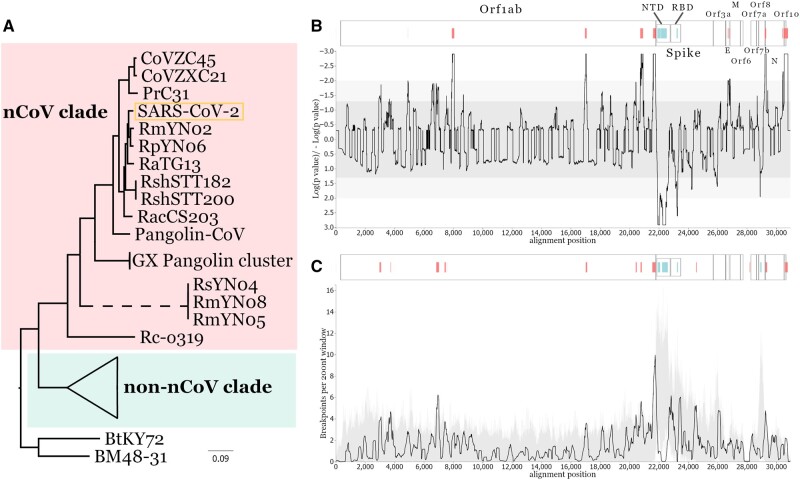
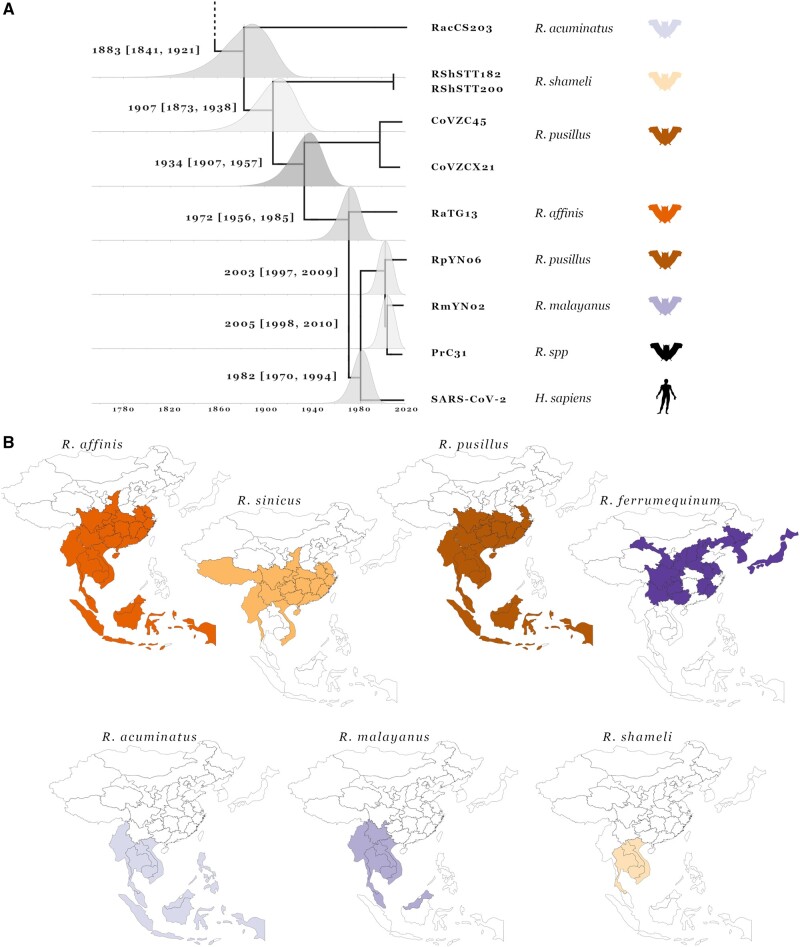
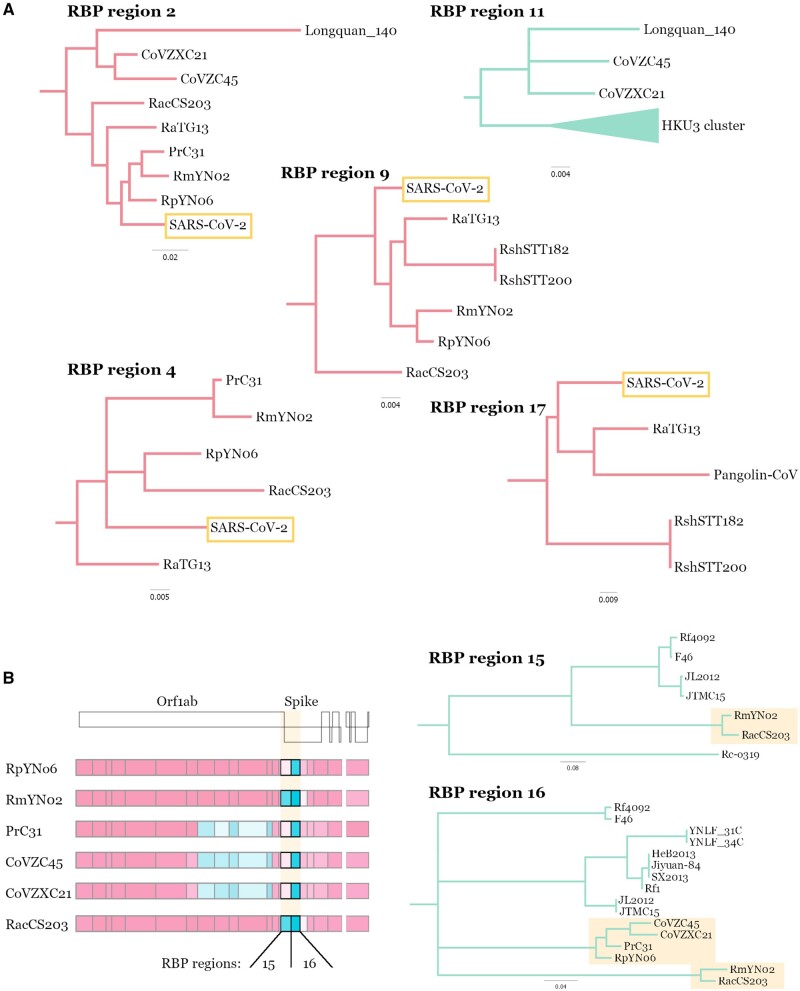
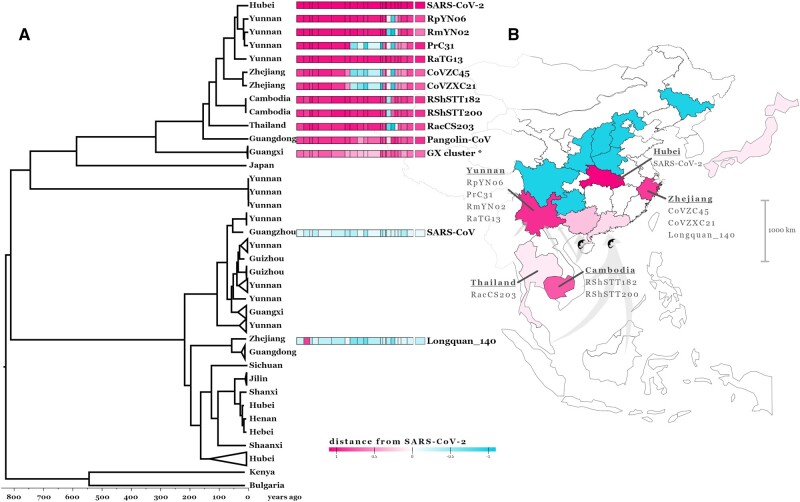
The lack of an identifiable intermediate host species for the proximal animal ancestor of SARS-CoV-2, and the large geographical distance between Wuhan and where the closest evolutionary related coronaviruses circulating in horseshoe bats (members of the Sarbecovirus subgenus) have been identified, is fueling speculation on the natural origins of SARS-CoV-2. We performed a comprehensive phylogenetic study on SARS-CoV-2 and all the related bat and pangolin sarbecoviruses sampled so far. Determining the likely recombination events reveals a highly reticulate evolutionary history within this group of coronaviruses. Distribution of the inferred recombination events is nonrandom with evidence that Spike, the main target for humoral immunity, is beside a recombination hotspot likely driving antigenic shift events in the ancestry of bat sarbecoviruses. Coupled with the geographic ranges of their hosts and the sampling locations, across southern China, and into Southeast Asia, we confirm that horseshoe bats, Rhinolophus, are the likely reservoir species for the SARS-CoV-2 progenitor. By tracing the recombinant sequence patterns, we conclude that there has been relatively recent geographic movement and cocirculation of these viruses' ancestors, extending across their bat host ranges in China and Southeast Asia over the last 100 years. We confirm that a direct proximal ancestor to SARS-CoV-2 has not yet been sampled, since the closest known relatives collected in Yunnan shared a common ancestor with SARS-CoV-2 approximately 40 years ago. Our analysis highlights the need for dramatically more wildlife sampling to: 1) pinpoint the exact origins of SARS-CoV-2's animal progenitor, 2) the intermediate species that facilitated transmission from bats to humans (if there is one), and 3) survey the extent of the diversity in the related sarbecoviruses' phylogeny that present high risk for future spillovers.
SARS-CoV-2 的近亲动物祖先缺乏可识别的中间宿主物种,而武汉与在马蹄蝠(Sarbecovirus 亚属成员)中循环的进化上最接近的冠状病毒之间的地理位置相距甚远,这引发了对 SARS-CoV-2 自然起源的猜测。我们对 SARS-CoV-2 以及迄今为止采样的所有相关蝙蝠和穿山甲沙贝科病毒进行了全面的系统发育研究。确定可能的重组事件揭示了这群冠状病毒内高度网状的进化史。推断出的重组事件的分布是随机的,有证据表明,Spike 是体液免疫的主要靶标,它位于重组热点附近,可能导致蝙蝠沙贝科病毒祖先中的抗原转变事件。再加上其宿主的地理范围和采样地点,遍布中国南方,进入东南亚,我们确认马蹄蝠 Rhinolophus 是 SARS-CoV-2 前体的可能储存宿主。通过追踪重组序列模式,我们得出结论,这些病毒的祖先在过去 100 年中,在其蝙蝠宿主的范围内,在相对较近的地理范围内发生了移动和共同循环,范围扩展到中国和东南亚。我们确认,由于在云南采集的最接近的已知亲缘病毒与 SARS-CoV-2 的共同祖先大约在 40 年前,因此尚未采样到 SARS-CoV-2 的直接近亲。我们的分析强调需要对野生动物进行更多的采样:1)确定 SARS-CoV-2 的动物前体的确切起源,2)确定从蝙蝠传播到人类的中间宿主(如果存在),3)调查相关沙贝科病毒的系统发育中存在的高风险未来溢出的多样性程度。