Wildlife Conservation Society, Viet Nam Country Program, Ha Noi, Viet Nam.
Wildlife Conservation Society, Global Conservation Program, New York City, NY, United States.
Front Public Health. 2022 Mar 9;10:826116. doi: 10.3389/fpubh.2022.826116. eCollection 2022.
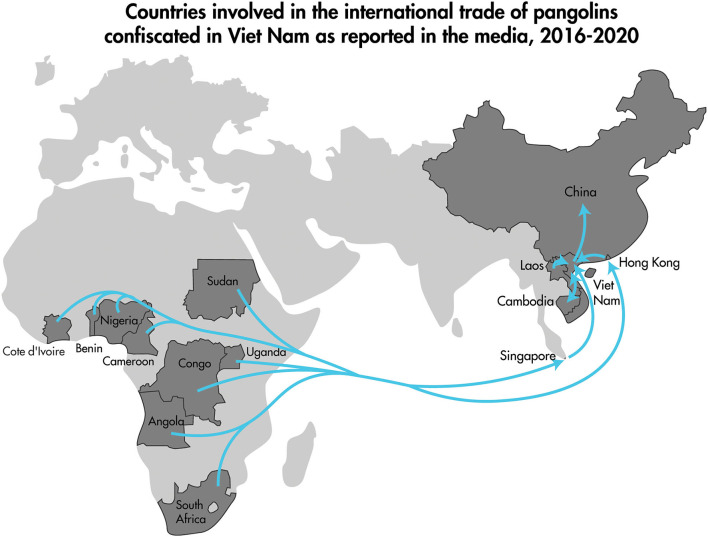
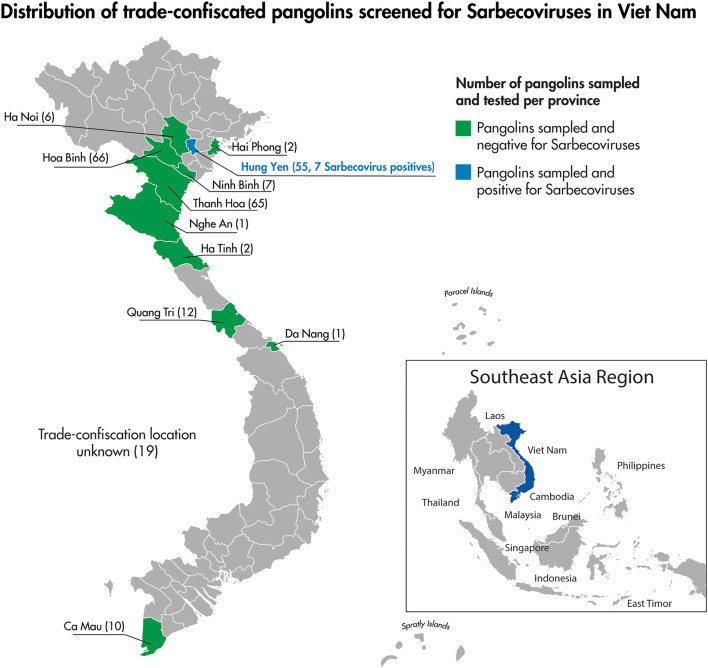
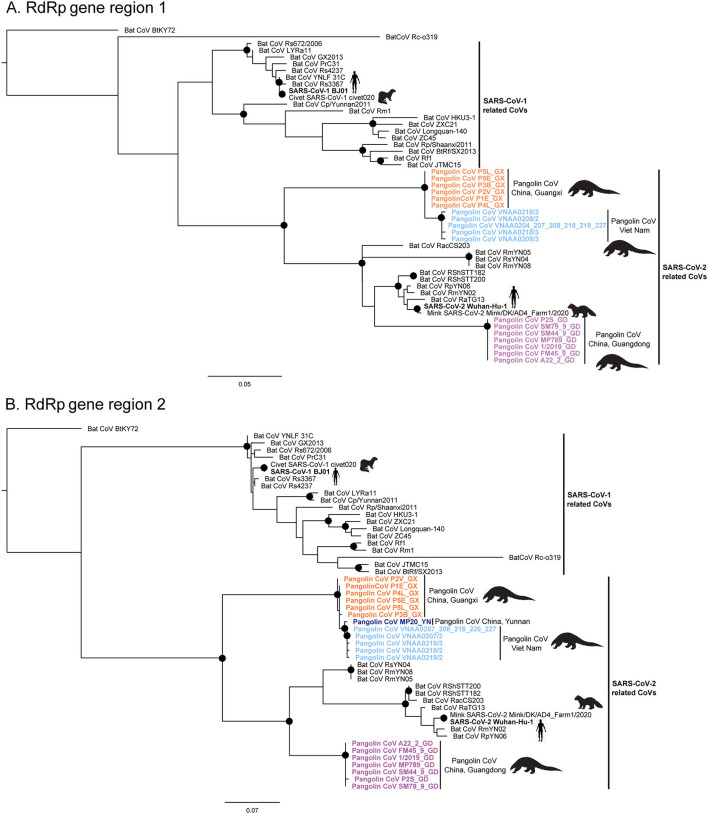
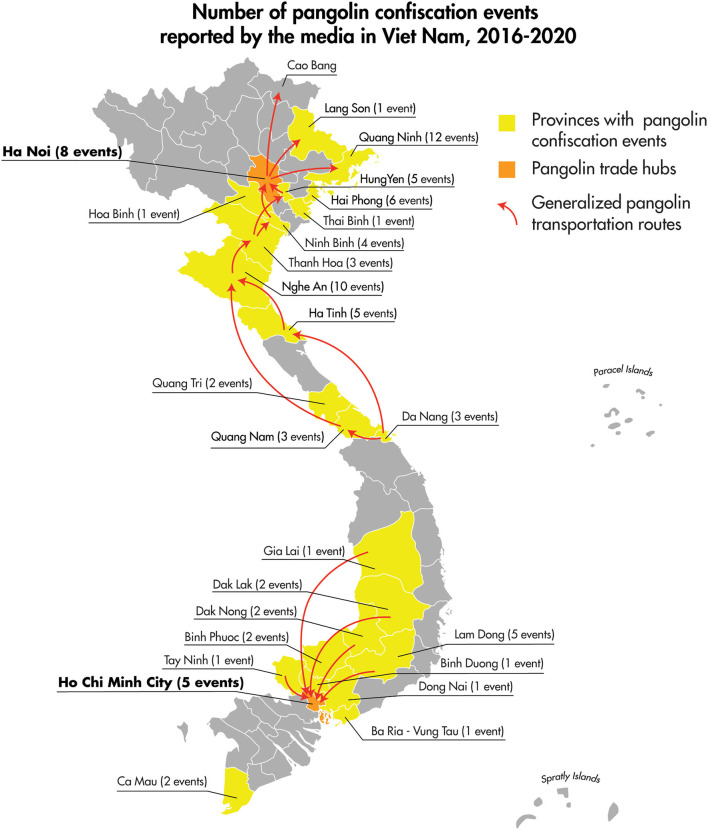
Despite the discovery of several closely related viruses in bats, the direct evolutionary progenitor of SARS-CoV-2 has not yet been identified. In this study, we investigated potential animal sources of SARS-related coronaviruses using archived specimens from Sunda pangolins () and Chinese pangolins () confiscated from the illegal wildlife trade, and from common palm civets () raised on wildlife farms in Viet Nam. A total of 696 pangolin and civet specimens were screened for the presence of viral RNA from five zoonotic viral families and from Sarbecoviruses using primers specifically designed for pangolin coronaviruses. We also performed a curated data collection of media reports of wildlife confiscation events involving pangolins in Viet Nam between January 2016 and December 2020, to illustrate the global pangolin supply chain in the context of Viet Nam where the trade confiscated pangolins were sampled for this study. All specimens from pangolins and civets sampled along the wildlife supply chains between February 2017 and July 2018, in Viet Nam and tested with conventional PCR assays designed to detect flavivirus, paramyxovirus, filovirus, coronavirus, and orthomyxovirus RNA were negative. Civet samples were also negative for Sarbecoviruses, but 12 specimens from seven live pangolins confiscated in Hung Yen province, northern Viet Nam, in 2018 were positive for Sarbecoviruses. Our phylogenetic trees based on two fragments of the RdRp gene revealed that the Sarbecoviruses identified in these pangolins were closely related to pangolin coronaviruses detected in pangolins confiscated from the illegal wildlife trade in Yunnan and Guangxi provinces, China. Our curated data collection of media reports of wildlife confiscation events involving pangolins in Viet Nam between January 2016 and December 2020, reflected what is known about pangolin trafficking globally. Pangolins confiscated in Viet Nam were largely in transit, moving toward downstream consumers in China. Confiscations included pangolin scales sourced originally from Africa (and African species of pangolins), or pangolin carcasses and live pangolins native to Southeast Asia (predominately the Sunda pangolin) sourced from neighboring range countries and moving through Viet Nam toward provinces bordering China.
尽管在蝙蝠中发现了几种密切相关的病毒,但 SARS-CoV-2 的直接进化祖先尚未确定。在这项研究中,我们使用从非法野生动植物贸易中没收的巽他穿山甲和中华穿山甲以及越南野生动物养殖场饲养的普通穿山甲的存档标本,研究了与 SARS 相关的冠状病毒的潜在动物来源。总共对 696 只穿山甲和獴标本进行了筛查,以检测来自五个人畜共患病毒科和 Sarbecoviruses 的病毒 RNA,使用专门为穿山甲冠状病毒设计的引物进行检测。我们还对 2016 年 1 月至 2020 年 12 月期间越南涉及穿山甲的野生动物没收事件的媒体报道进行了精心收集,以说明在越南的全球穿山甲供应链背景下,该贸易中被没收的穿山甲是本研究采样的对象。2017 年 2 月至 2018 年 7 月期间,在越南沿野生动物供应链采集的穿山甲和獴标本,以及用常规 PCR 检测设计检测黄病毒、副粘病毒、丝状病毒、冠状病毒和正粘病毒 RNA 的检测均为阴性。獴样本也为 Sarbecoviruses 阴性,但 2018 年在越南北部永福省没收的 7 只活体穿山甲中有 12 个样本为 Sarbecoviruses 阳性。基于 RdRp 基因的两个片段构建的系统发育树显示,在这些穿山甲中鉴定的 Sarbecoviruses 与在中国云南和广西省非法野生动植物贸易中没收的穿山甲中检测到的穿山甲冠状病毒密切相关。我们对 2016 年 1 月至 2020 年 12 月期间越南涉及穿山甲的媒体报道的精心收集反映了全球范围内对穿山甲贩运的了解。在越南没收的穿山甲主要是过境,运往中国下游消费者。没收的穿山甲鳞片来自非洲(和非洲穿山甲物种),或来自邻国的穿山甲尸体和原产于东南亚的活体穿山甲(主要是巽他穿山甲),然后通过越南运往与中国接壤的省份。