Key Laboratory of Industrial Fermentation (Ministry of Education), Hubei University of Technology, Wuhan, China.
Hubei Key Laboratory of Industrial Microbiology, Hubei University of Technology, Wuhan, China.
Cell Biochem Biophys. 2022 Jun;80(2):277-293. doi: 10.1007/s12013-022-01067-3. Epub 2022 Feb 10.
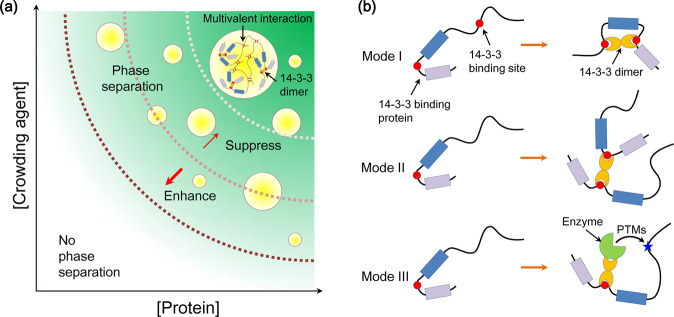
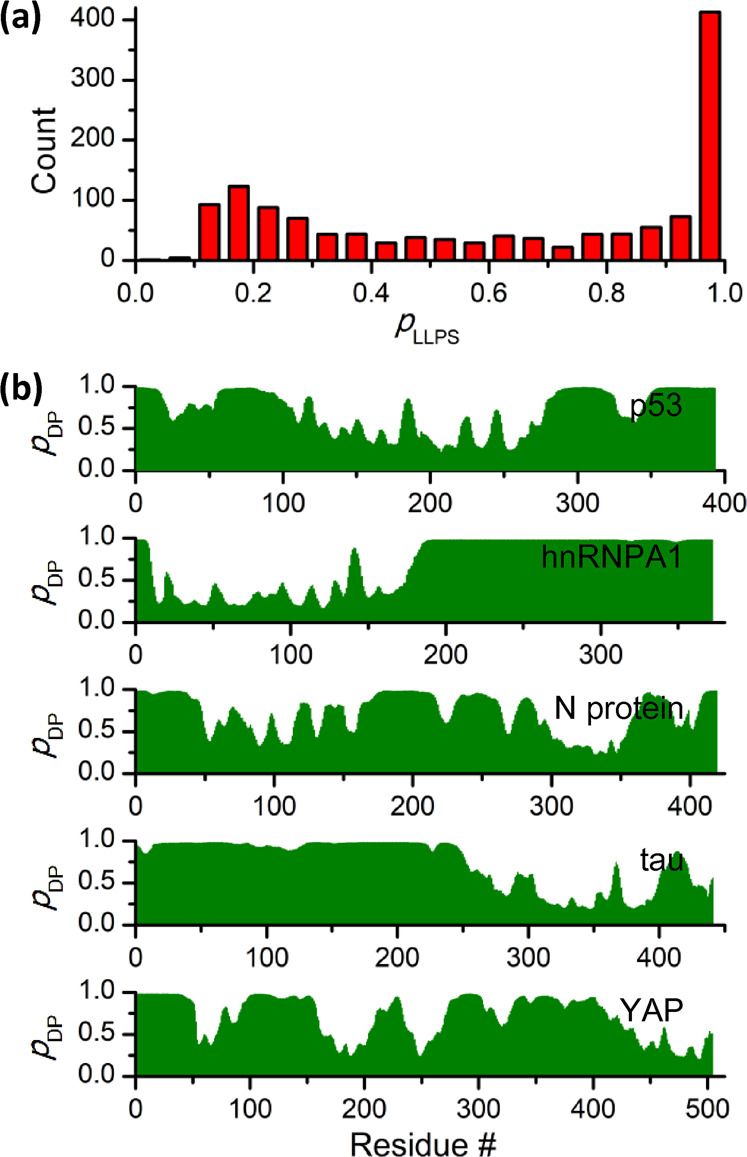
The 14-3-3 family proteins are vital scaffold proteins that ubiquitously expressed in various tissues. They interact with numerous protein targets and mediate many cellular signaling pathways. The 14-3-3 binding motifs are often embedded in intrinsically disordered regions which are closely associated with liquid-liquid phase separation (LLPS). In the past ten years, LLPS has been observed for a variety of proteins and biological processes, indicating that LLPS plays a fundamental role in the formation of membraneless organelles and cellular condensates. While extensive investigations have been performed on 14-3-3 proteins, its involvement in LLPS is overlooked. To date, 14-3-3 proteins have not been reported to undergo LLPS alone or regulate LLPS of their binding partners. To reveal the potential involvement of 14-3-3 proteins in LLPS, in this review, we summarized the LLPS propensity of 14-3-3 binding partners and found that about one half of them may undergo LLPS spontaneously. We further analyzed the phase separation behavior of representative 14-3-3 binders and discussed how 14-3-3 proteins may be involved. By modulating the conformation and valence of interactions and recruiting other molecules, we speculate that 14-3-3 proteins can efficiently regulate the functions of their targets in the context of LLPS. Considering the critical roles of 14-3-3 proteins, there is an urgent need for investigating the involvement of 14-3-3 proteins in the phase separation process of their targets and the underling mechanisms.
14-3-3 家族蛋白是普遍存在于各种组织中的重要支架蛋白,它们与许多蛋白质靶标相互作用,并介导许多细胞信号通路。14-3-3 结合基序通常嵌入固有无序区域,与液-液相分离(LLPS)密切相关。在过去的十年中,已经观察到多种蛋白质和生物过程发生 LLPS,表明 LLPS 在无膜细胞器和细胞凝聚物的形成中起着基本作用。尽管对 14-3-3 蛋白进行了广泛的研究,但它在 LLPS 中的参与仍被忽视。迄今为止,尚未报道 14-3-3 蛋白单独发生 LLPS 或调节其结合伙伴的 LLPS。为了揭示 14-3-3 蛋白在 LLPS 中的潜在参与,在本综述中,我们总结了 14-3-3 结合伙伴的 LLPS 倾向,发现其中约有一半可能自发发生 LLPS。我们进一步分析了代表性 14-3-3 结合物的相分离行为,并讨论了 14-3-3 蛋白如何参与其中。通过调节相互作用的构象和价态并募集其他分子,我们推测 14-3-3 蛋白可以在 LLPS 环境中有效地调节其靶标的功能。考虑到 14-3-3 蛋白的关键作用,迫切需要研究 14-3-3 蛋白在其靶标的相分离过程中的参与及其潜在机制。