Sensors and Aerosols Laboratory, Department of Mechanical Engineering, Ulsan National Institute of Science and Technology (UNIST), Ulsan, 44919, Republic of Korea.
Department of Biomedical Engineering, UNIST, Ulsan, 44919, Republic of Korea.
Sci Rep. 2022 Feb 10;12(1):2311. doi: 10.1038/s41598-022-06101-1.
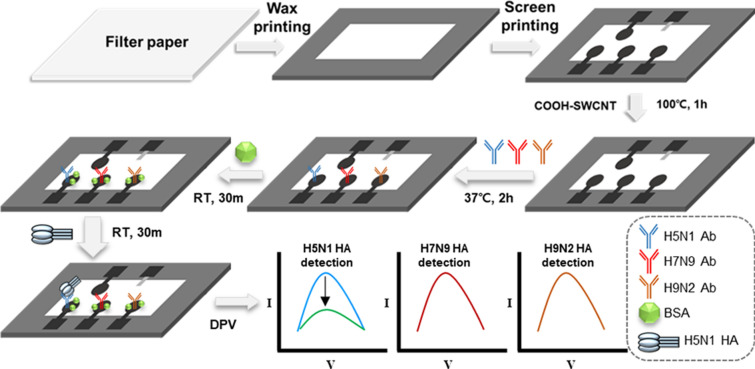
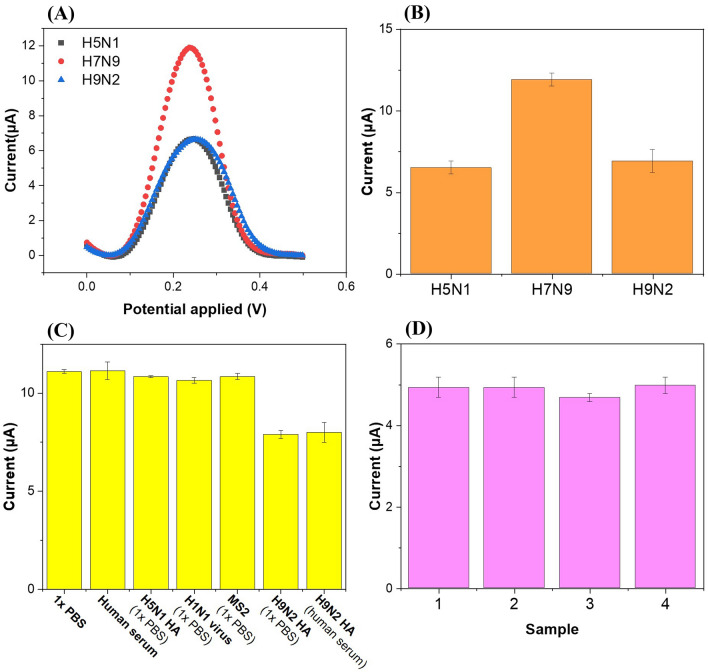
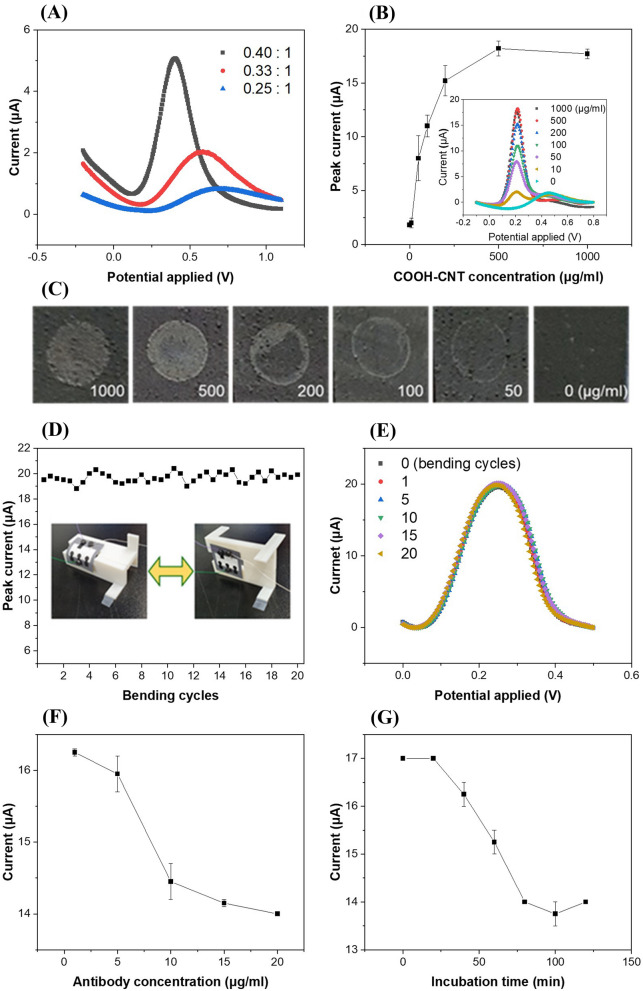
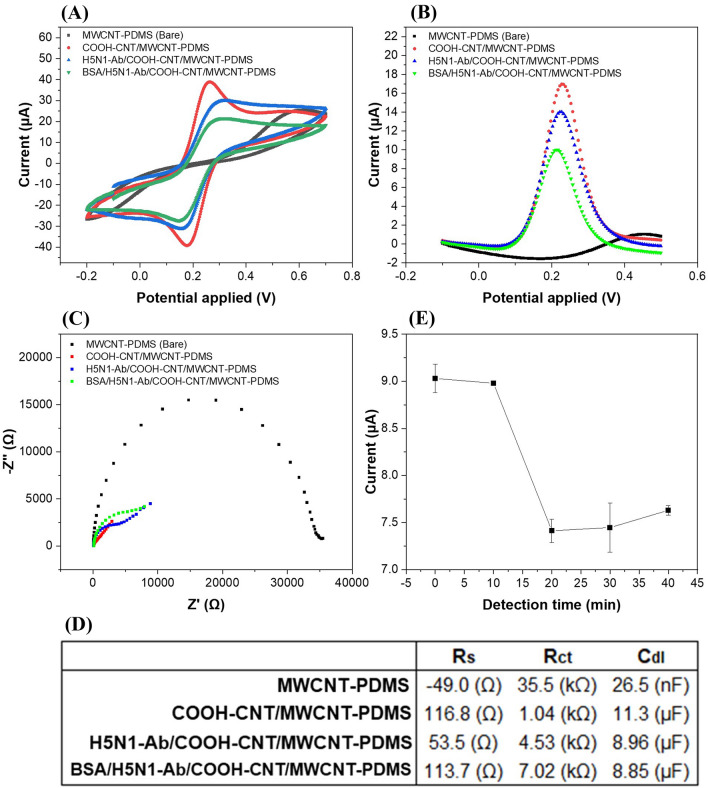
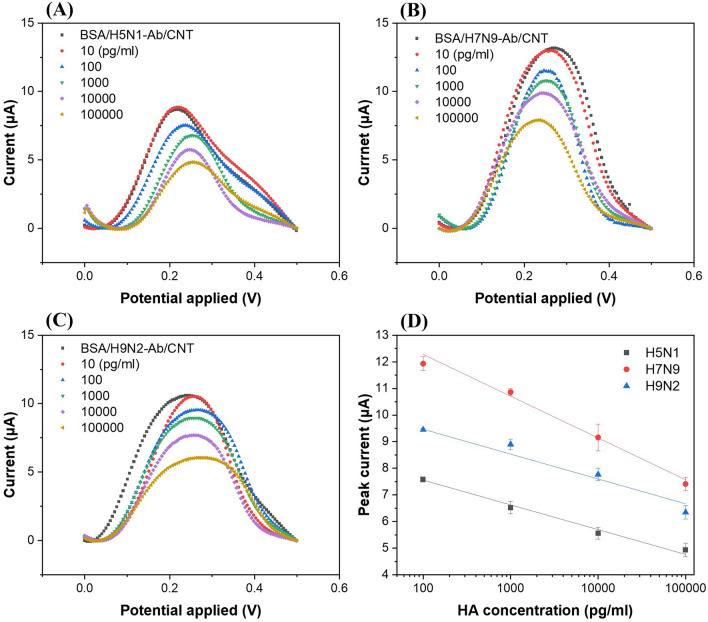
Many studies have been conducted on measuring avian influenza viruses and their hemagglutinin (HA) antigens via electrochemical principles; most of these studies have used gold electrodes on ceramic, glass, or silicon substrates, and/or labeling for signal enhancement. Herein, we present a paper-based immunosensor for label-free measurement of multiple avian influenza virus (H5N1, H7N9, and H9N2) antigens using flexible screen-printed carbon nanotube-polydimethylsiloxane electrodes. These flexible electrodes on a paper substrate can complement the physical weakness of the paper-based sensors when wetted, without affecting flexibility. The relative standard deviation of the peak currents was 1.88% when the electrodes were repeatedly bent and unfolded twenty times with deionized water provided each cycle, showing the stability of the electrodes. For the detection of HA antigens, approximately 10-μl samples (concentration: 100 pg/ml-100 ng/ml) were needed to form the antigen-antibody complexes during 20-30 min incubation, and the immune responses were measured via differential pulse voltammetry. The limits of detections were 55.7 pg/ml (0.95 pM) for H5N1 HA, 99.6 pg/ml (1.69 pM) for H7N9 HA, and 54.0 pg/ml (0.72 pM) for H9N2 HA antigens in phosphate buffered saline, and the sensors showed good selectivity and reproducibility. Such paper-based sensors are economical, flexible, robust, and easy-to-manufacture, with the ability to detect several avian influenza viruses.
许多研究已经通过电化学原理来测量禽流感病毒及其血凝素 (HA) 抗原;这些研究大多使用陶瓷、玻璃或硅衬底上的金电极,和/或进行信号增强标记。本文提出了一种基于纸的无标记免疫传感器,用于使用柔性丝网印刷碳纳米管-聚二甲基硅氧烷电极测量多种禽流感病毒 (H5N1、H7N9 和 H9N2) 抗原。这些柔性电极位于纸质衬底上,可以弥补纸质传感器在润湿时的物理弱点,而不会影响其灵活性。当电极用去离子水重复弯曲和展开二十次时,其峰值电流的相对标准偏差为 1.88%,表明电极的稳定性。对于 HA 抗原的检测,大约需要 10-μl 的样品(浓度:100 pg/ml-100 ng/ml)在 20-30 分钟的孵育时间内形成抗原-抗体复合物,并且通过差分脉冲伏安法测量免疫反应。在磷酸盐缓冲盐水中,H5N1 HA 的检测限为 55.7 pg/ml(0.95 pM),H7N9 HA 的检测限为 99.6 pg/ml(1.69 pM),H9N2 HA 的检测限为 54.0 pg/ml(0.72 pM),传感器表现出良好的选择性和重现性。这种基于纸张的传感器经济、灵活、坚固且易于制造,具有检测多种禽流感病毒的能力。